
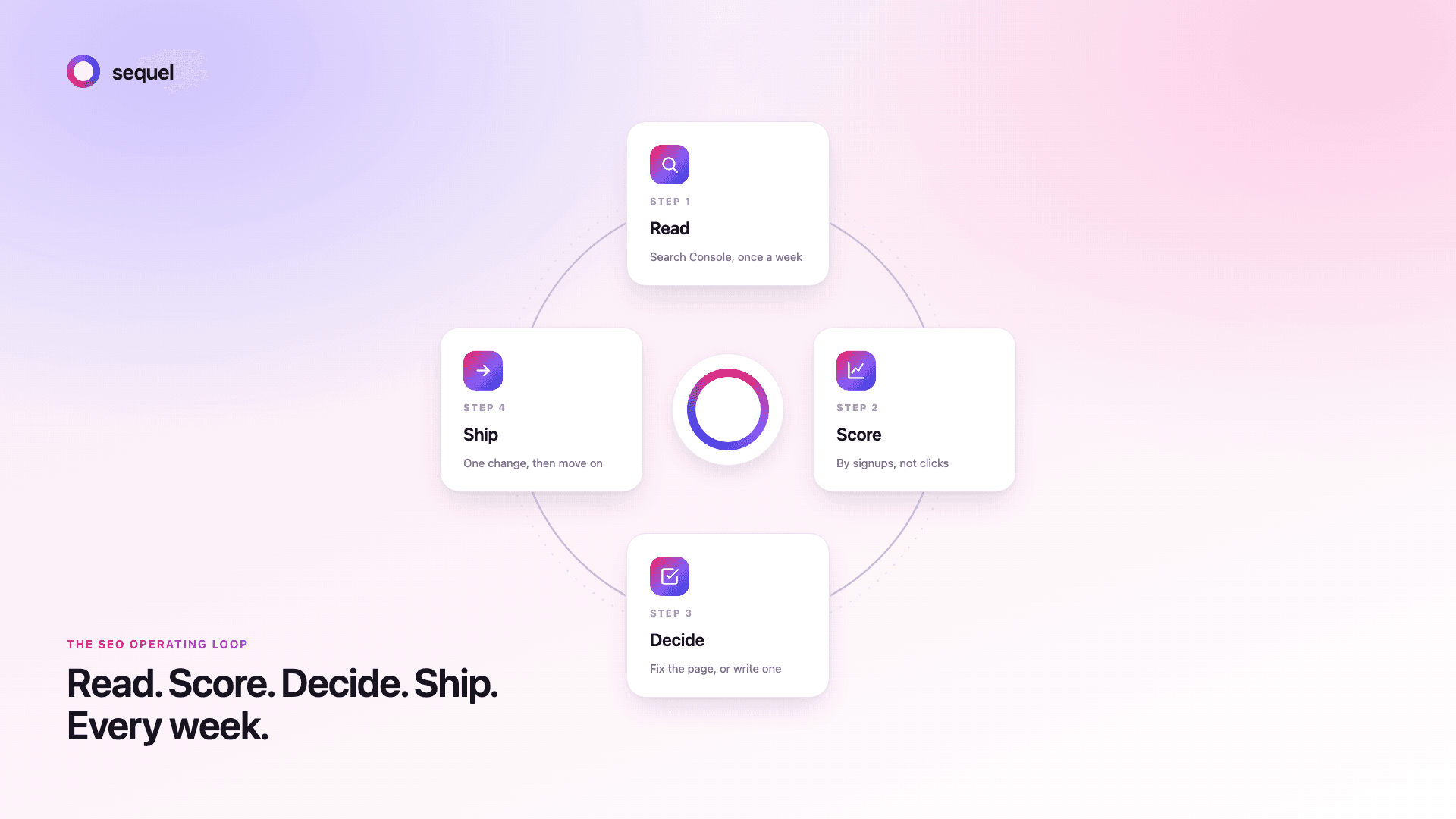
A weekly SEO checklist is what's missing from most SEO advice, which reads like a list of things to do once: audit the site, build some links, write some content. Almost none of it says what to do next Tuesday. That gap is why so many SEO efforts stall. The tactics are fine. Nobody comes back to check whether they worked.
The loop fixes that. It's a fixed 15 to 20 minute routine: read what changed in Search Console, decide whether each flagged page needs a fix or a new page needs writing, ship the highest-value change, and score last week's changes by signups instead of clicks. Run it every week and it compounds. Run it once a quarter and you're back to guessing.
TL;DR
| Question | Answer |
|---|---|
| How often should I check Search Console? | Weekly, on a fixed day, for 15 to 20 minutes. Daily only for a new site or after a drop. |
| What do I check each week? | Pages losing clicks, queries stuck at positions 8-20, high-impression pages with low CTR, and new long-tail queries. |
| Fix or write? | Fix if the page already ranks or gets impressions. Write only when no page targets the query cluster at all. |
| How do I know a page is actually working? | Join clicks per page to signups per page. A page with traffic and zero signups is a bigger problem than a page with no traffic. |
| Should I trust keyword volume tools? | Use them to rank ideas, not to decide. Read the actual search results before committing a week to a keyword. |
| What kills the loop fastest? | Quitting after 6 to 8 weeks. Most pages that ever rank in the top 10 take longer than a month to get there, and 72.9% of today's top-10 pages are more than three years old. |
What a weekly SEO checklist is
A weekly SEO checklist is a fixed, recurring review of Search Console data that ends in a short, ranked list of actions: which pages to fix, which page to write, and which pages to leave alone. It is not a dashboard and not a monthly report. The output is a to-do list with three or four items, not a chart nobody acts on. One Reddit thread on why marketing reports don't change anything put it plainly: teams have the data, they just stop at reporting it instead of deciding what to do with it.
The loop has four moving parts, run in the same order every week:
- Read: pull the week's Search Console change, clicks, impressions, position, and new queries.
- Score: join that traffic to what actually matters, signups or revenue, not clicks.
- Decide: for each flagged page, choose fix, write, or ignore.
- Ship: make the one or two changes that matter most, then move on.
Sequel's own SEO playbooks, covered throughout this guide, are built around the same four parts, so the loop below works whether an agent runs the pull or you do it by hand.
Step 1: Read Search Console on a schedule, not an obsession
Reddit's SEO community argues about cadence constantly, and the answer that keeps winning is: weekly, on a fixed schedule, for a short window. One r/seogrowth thread asking practitioners which report they actually read every week got a consistent answer:
> "I check Google Search Console every week. The reports I rely on most are: Performance (clicks, impressions, CTR, average position), Queries with rising/falling trends, Pages gaining or losing traffic, Indexing/Coverage issues, Core Web Vitals... Everything else I usually review monthly unless something looks off." > > u/TailorSingle1902, r/seogrowth
Checking more often doesn't help. A r/bigseo thread from someone managing 30+ sites made the same point from the other direction, after admitting to opening Search Console multiple times a day:
> "The honest fix is checking on a fixed schedule and less often, daily clicks are mostly noise and only the trend over a couple of weeks actually tells you anything." > > u/marintkael, r/bigseo
Four things are worth a look every week:
- Pages losing clicks week over week, even if position held steady. That's usually a SERP change, not a ranking drop. See how to investigate an organic traffic drop for the full diagnostic.
- Queries sitting at position 8-20, non-brand. CTR falls off a cliff after position 3, from 3.89% down to under 1% by position 6, so these queries are invisible until they cross into the top 5.
- High-impression, low-CTR pages. Google is already showing the page; people aren't clicking. That's a title and snippet problem, not a content problem.
- New queries with real word count. Anything four or more words that wasn't there last month is worth a look, covered in Step 5.
Search Console's own data lags two to three days, so a weekly cadence sidesteps most of that noise on its own. The full mechanics of joining Search Console to GA4 cover the URL normalization details if you're building this by hand.
Step 2: Score every page by signups, not clicks
This is the step most weekly reviews skip, and it's the one that decides whether the loop is worth running at all. Clicks tell you what got attention. They don't tell you what got a customer.
The clearest illustration comes from a founder who tracked eight months of content output down to the dollar:
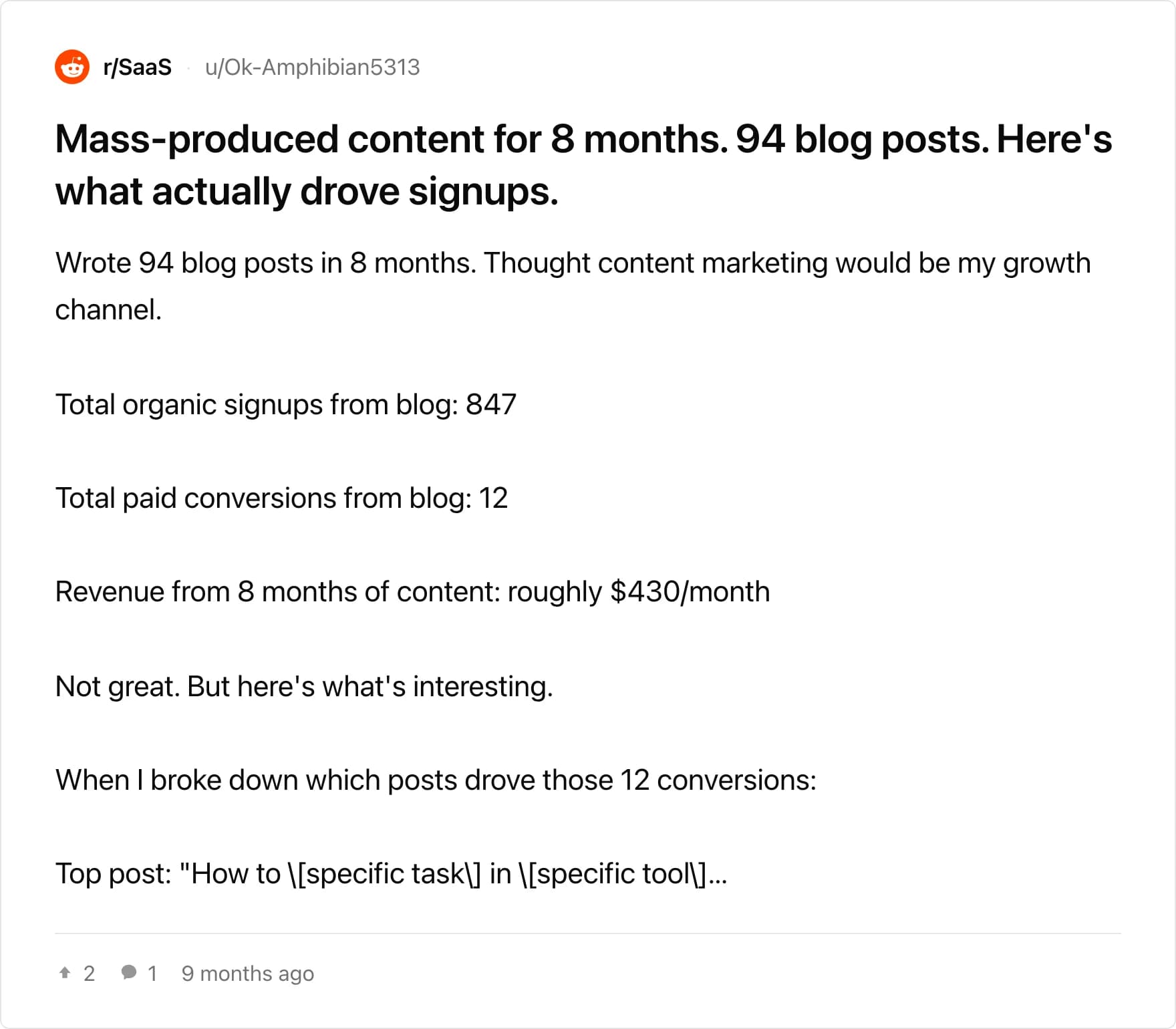
Ninety-four posts produced 847 signups and 12 paid conversions. Read the full thread on r/SaaS. The same poster found the gap wasn't about traffic volume, it was about topic: "Thought leadership doesn't convert. My posts about 'the future of automation' and 'why no-code matters' got decent traffic but zero signups. People read, nodded, left." Comparison and bottom-of-funnel posts did the actual converting.
A r/marketing thread with 20,000 monthly organic visitors and almost no conversions got the same diagnosis from a reply:
> "I would carefully reevaluate your existing traffic. I'd rather have 20 qualifying visitors per month than 20,000 visitors that don't bring me a penny in revenue." > > u/JoshClarify, r/marketing
There's a sharper version of this problem too: content that ranks well can actively repel conversions by answering the question too completely.
> "There's a pattern where pages that rank well and get deep engagement actually repel conversions because they answer the question too well. The reader leaves satisfied without needing you. The fix isn't better CTAs, it's designing content that intentionally creates a next question only your product can answer." > > u/Sea_Refuse_5439, r/content_marketing
To score pages this way, join Search Console's clicks-per-page to your signups-per-page on the landing page path. It sounds simple; the tooling has been broken for years. A 2023 r/GoogleAnalytics thread asking exactly this question is still getting replies confirming the gap two years later:
> "There is no more important thing than knowing where my converting users are coming from. With Google Ads this is provided and obvious, but how can we know which organic keywords are turning into sign-ups?" > > u/citydan-real, r/GoogleAnalytics
The full join across Search Console, GA4, HubSpot, and Stripe covers exactly this gap and how to close it without a custom pipeline. Once it's set up, the weekly review ranks flagged pages by signups per click, not clicks alone, and a page with 400 clicks and zero signups drops below a page with 40 clicks and 6 signups every time.
Step 3: Decide fix or write, the core SEO loop decision
Every flagged page from Step 1 needs a call: fix it, write something new, or leave it. Most teams default to writing, because writing feels like progress and fixing feels like admitting the old page was wrong. The data says fix first.
| Pattern in Search Console | What it means | Action |
|---|---|---|
| Position 8-20, rising impressions | Google trusts the page, ranking hasn't caught up | Fix: add a section that directly answers the query, tighten the title |
| Position 1-10, high impressions, CTR below the position curve | The result isn't earning the click it's shown | Fix: rewrite title and meta description |
| Traffic declining on a page that used to rank | Content is aging or a competitor updated theirs | Fix: refresh with current data, bump the date, request indexing |
| Real query volume, no page targets it at all | A genuine content gap | Write: a new page, linked from a page that already ranks nearby |
| Impressions near zero for weeks | Likely not indexed, not a ranking problem | Debug indexing before touching the content, see debugging an unindexed page |
Practitioners consistently report that fixing beats publishing, when the update is a genuine improvement and not a rewrite of the page's core angle. One agency SEO who worked at Searchmetrics put a number on it:
> "Updating old content was one of the most predictable and impactful things I saw our clients do. If done correctly, it can easily lead to +10% SEO traffic. If you have never done it and just published articles every day for 5 years, it can lead to +100% traffic." > > u/maltelandwehr, r/bigseo
Another practitioner in the same thread reported a 7% clicks increase after a month spent entirely on updating existing content and its internal links, no new pages published. But the thread carries a warning too: a full content-and-keyword-focus rewrite lost one client 40% of their traffic overnight. Tighten and add, don't bulldoze.
The technical SEO audit and content decay checks feed this step. The weekly loop doesn't replace them, it decides when to run them.
Step 4: Kill weak keywords before anyone writes a word
Before a "write" decision turns into an actual page, check whether the keyword is worth it. Search volume tools disagree with each other constantly, because none of them have Google's own data. One frequently-cited Ahrefs-vs-Semrush thread, where the original poster found Ahrefs showing less than half the volume Semrush reported for the same keyword, put the mechanism simply in a reply:
> "Because both are just estimates that are wildly inaccurate. They have no way of knowing hard search volumes. The only place you can get accurate search volumes is from Google." > > u/TheMacMan, r/SEO
The fix practitioners converge on is reading the actual search results before committing:
> "I map the SERP before touching content. I Google the query and ask: is it dominated by AI answers or blog posts? Is Reddit ranking? Quora? YouTube? Are product pages showing up, or just listicles? If a thread from 2021 ranks in the top 5, that's basically Google begging for a better result." > > u/Yulia_vankuva, r/seogrowth
Use volume estimates to order a shortlist. Use the SERP to decide whether to write at all. Ten minutes of reading beats a week of writing for the wrong intent.
Step 5: Write for the queries already sitting in your data
Search Console already contains evidence of how people search when they're talking to an AI assistant instead of typing keywords: longer, more conversational queries. Multiple practitioners have found that Google's AI Mode is now recording its follow-up prompts as ordinary Search Console queries:
> "It was recently noticed and confirmed that AI Mode records those prompts as queries in the 'Performance' section of the Search Console. This was noticed by 'yes' queries, which were confirmed to be follow-up questions in AI Mode." > > u/annseosmarty, r/AISearchAnalytics
A regex filter in the Search Console query field (([^" "]*\s){10,}?) surfaces these. The data backs up why they're worth chasing: analysis of Google Ads search-term data from January 2025 to August 2026 found the share of impressions from 3-4 word queries jumped from 33% to 48% in under two years, and the conversion share from 5+ word queries roughly tripled. The full method for isolating this traffic in GA4 covers the mechanics.
The conversion upside is real but the volume is still small. One widely-shared 2026 breakdown put numbers on it:
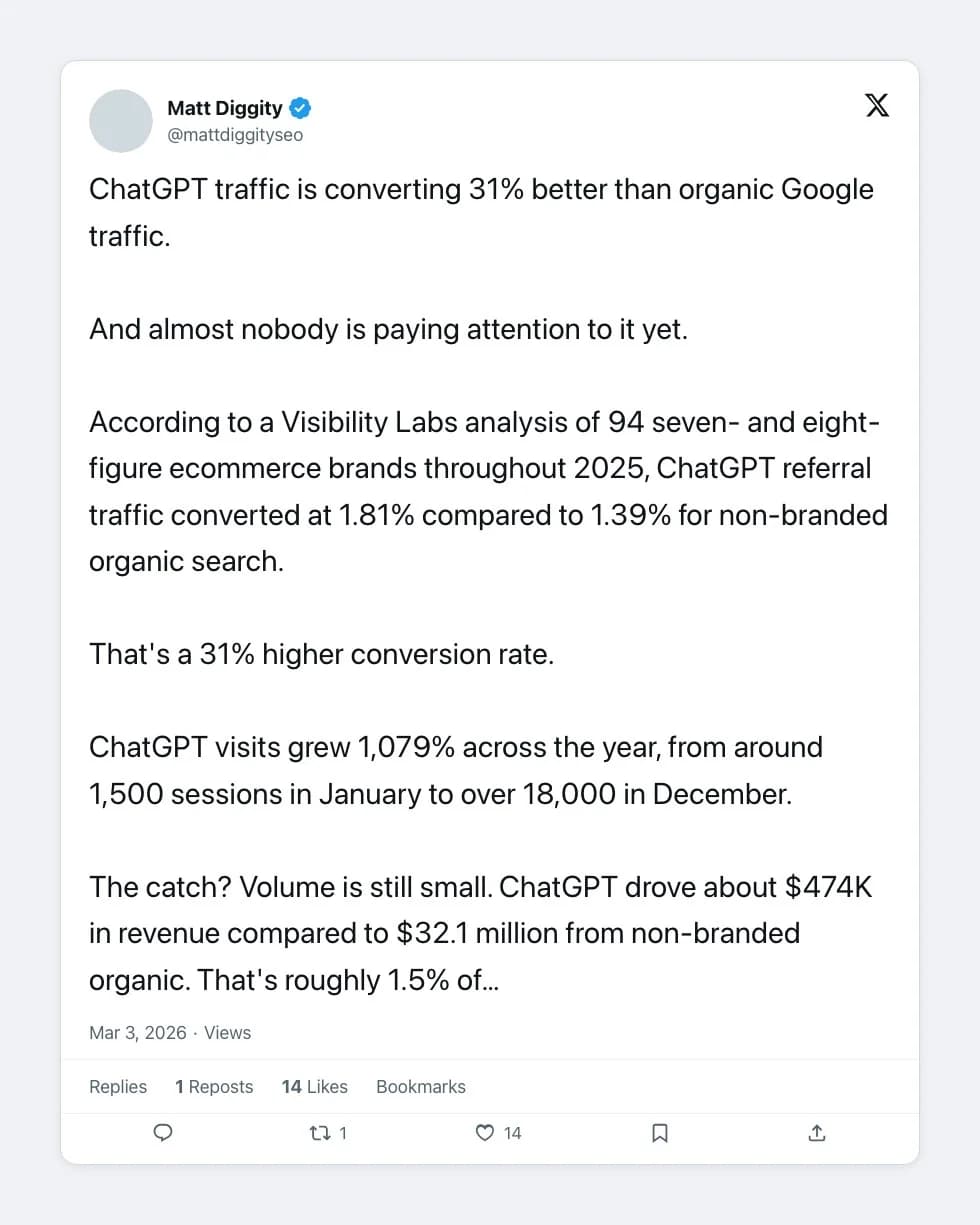
Matt Diggity, citing a Visibility Labs analysis of 94 ecommerce brands, found ChatGPT referral traffic converting at 1.81% versus 1.39% for non-branded organic search, a 31% lift, while growing 1,079% across the year. But it still totaled only 1.5% of the revenue non-branded organic drove. Worth watching weekly, not worth over-indexing on yet.
Getting into that traffic runs partly through Bing. ChatGPT's browsing and search features draw on Bing's index alongside its own crawler, which is why practitioners report IndexNow submissions to Bing occasionally showing up in AI-assistant citations too:
> "Perplexity uses Bing's index heavily. ChatGPT uses its own crawler (GPTBot) plus Bing. So getting indexed on Bing through IndexNow actually helps with AI search visibility too." > > u/Unleash_The_Gay_823, r/SaaS
IndexNow is a free, one-line ping on every deploy. Practitioners are split on whether it moves rankings, but nobody reports it hurting, and several report faster discovery on Bing specifically. Treat it as a cheap habit, not a strategy.
Step 6: Let your strongest pages carry your stuck ones
Internal links from pages that already rank are one of the highest-value, lowest-effort moves in the loop, and they pair directly with the position 8-20 pages flagged in Step 1:
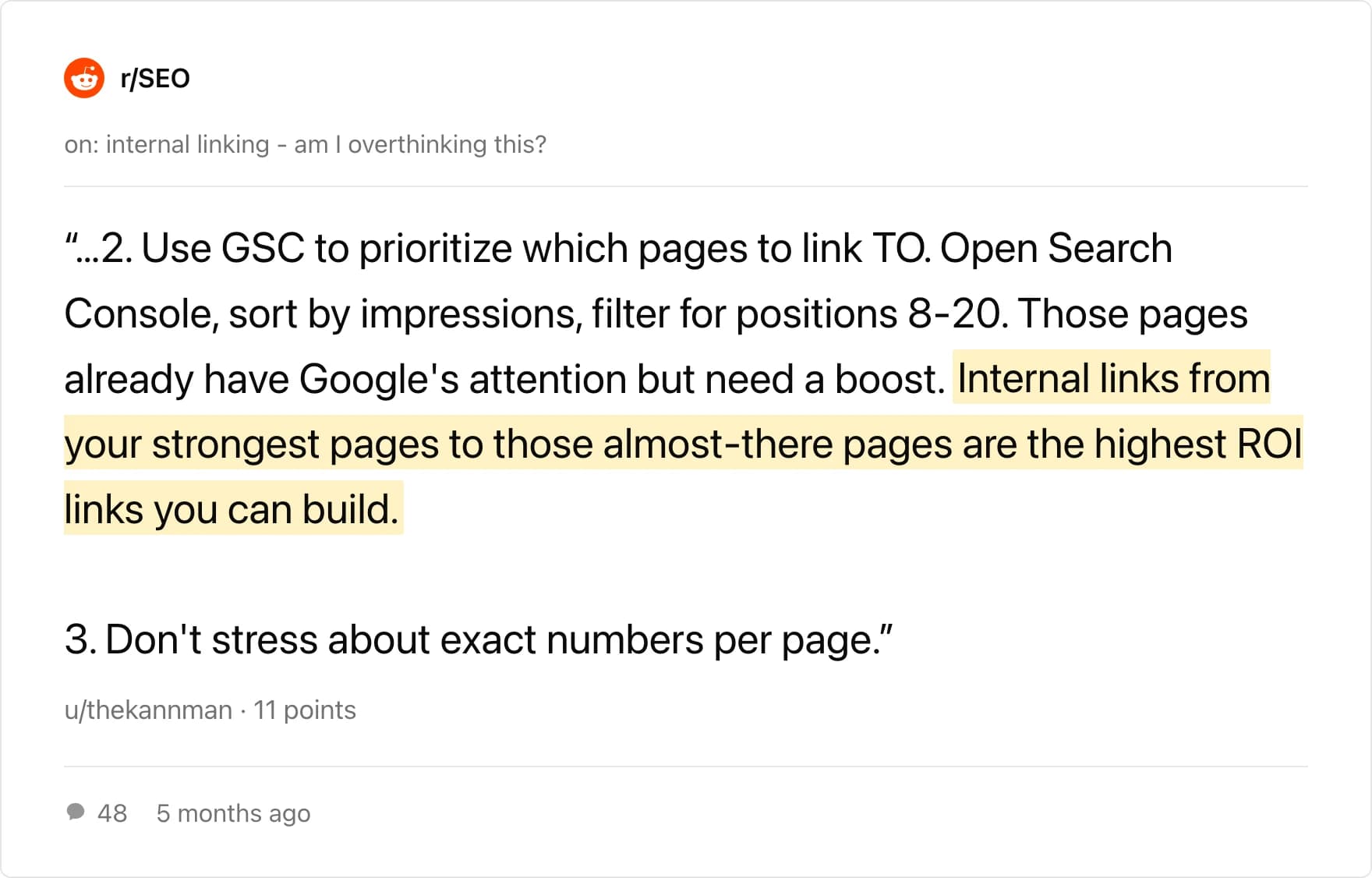
Read the full thread on r/SEO. The logic holds up: a page Google already trusts enough to show for a query has authority to spare. Pointing a link at a stuck page, from a strong one, with descriptive anchor text, is a five-minute edit compared to a new piece of content. Rotate the link monthly to the next stuck page once the first one holds its position. Skip pages that don't genuinely belong together; forced links read as spam to both readers and Google.
Gotchas that stall the SEO loop
- Don't publish in large batches. New pages compete with each other for a limited crawl budget, and a wave of new URLs often lands in "Discovered - currently not indexed" rather than getting crawled. Google's own definition: the page was found but crawling it was deprioritized. Smaller batches, watched weekly, index more reliably than a pile shipped at once.
- Don't quit at week 6. Only 1.74% of newly published pages reach the top 10 within a year, and the average #1-ranking page is five years old. The feedback is slow and often silent right before it isn't.
- AI Overviews are cutting into clicks even when rankings hold. Ahrefs' 2026 update found AI Overviews now reduce position-1 CTR by 58%, up from 34.5% just a year earlier. If impressions are flat but clicks fell, check whether an AI Overview now sits above the result before assuming a ranking problem.
- Weekly reporting isn't the same as weekly automation. A chat session is for judgment calls, not for shipping the same report every Monday morning unattended. Scheduled pulls plus an interactive review is the right split, not a fully unattended pipeline. More on why chat interfaces alone don't solve recurring reporting.
The "don't quit" gotcha is the one that ends the most loops early:
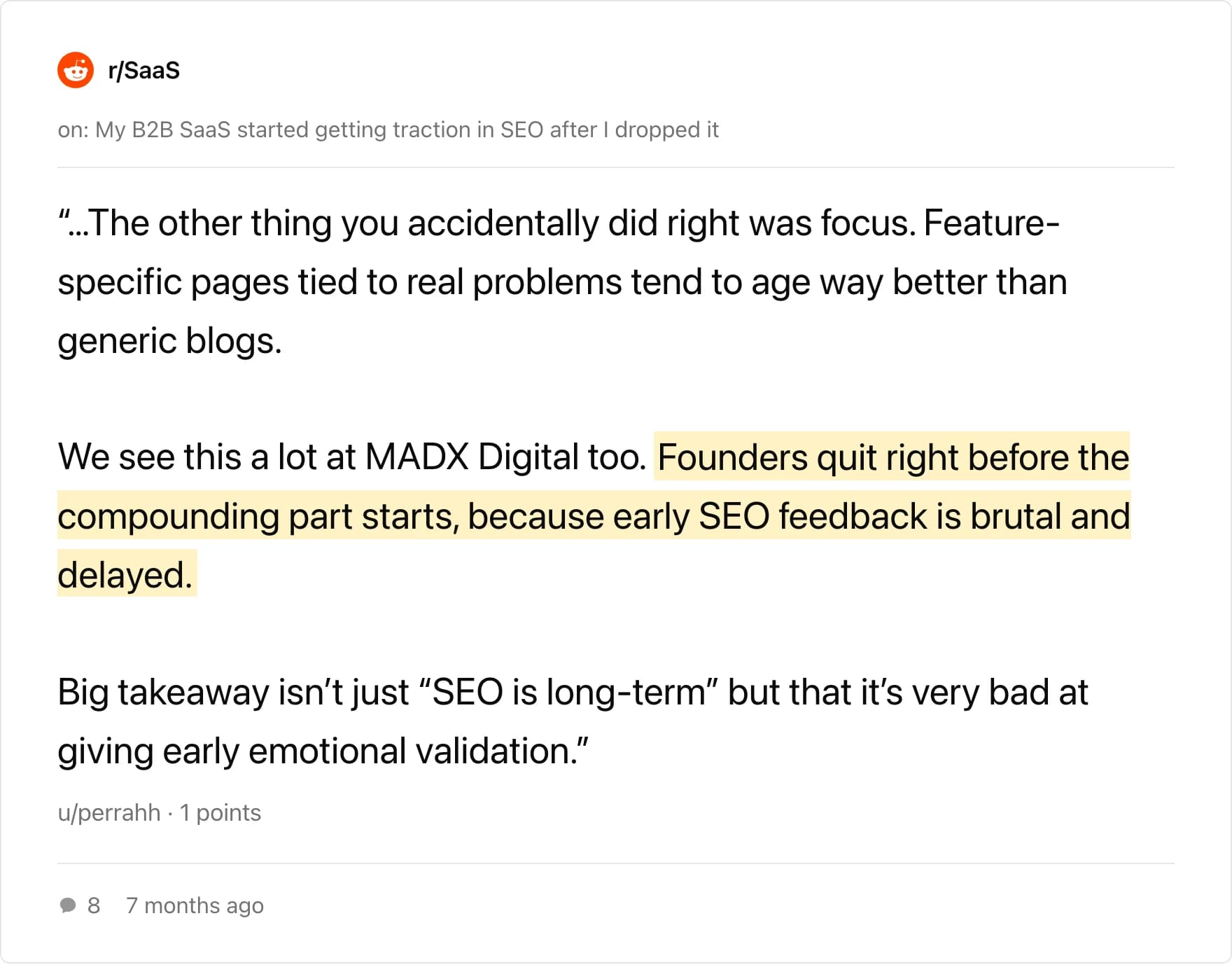
Read the full thread on r/SaaS. The original poster dropped their SEO effort out of frustration, then watched traffic grow anyway once Google had time to trust what was already published.
Running it with an agent
An AI agent connected to Search Console and your revenue data can run most of this loop without turning it into a second job. Point it at the four reads from Step 1, have it join clicks to signups from Step 2, and it can hand back a ranked list: which pages to fix, whether a new page is worth writing, and which keywords to skip.
Sequel connects to Google Search Console, GA4, and your product database over MCP, so the same weekly question, "what should I fix or write this week," pulls real numbers instead of a stale export. It runs read-only, so nothing changes without you approving it, and every query it runs is visible before you act on it.
The judgment call, fix or write, still belongs to a person. What the agent removes is the 20 minutes of tab-switching to get to that decision in the first place.
Get started free and connect Search Console to see this week's numbers, or read the Search Console and GA4 join if you want the mechanics first.