
TL;DR
| Theme | What practitioners say |
|---|---|
| Setup | The connector is easy. Auth across five Google products is not. |
| Accuracy | Failures are fluent, not loud. Wrong answers look right. |
| Context | The agent writes good SQL and misunderstands your metrics. |
| Scale | More MCP servers makes results worse, not better. |
| Safety | Read everywhere. Write nowhere without approval. |
| Trust | Agencies treat client data access as a fireable risk. |
| Cost | AI did not kill the paid connector. |
| Output | Chat answers do not solve recurring reporting. |
We read 32 Reddit threads across r/GoogleAnalytics, r/TechSEO, r/PPC, r/analytics, r/mcp, r/bigseo, and r/ProductManagement to find out what happens after marketers connect their data to AI agents.
The headline: almost nobody's problem is getting connected. The problems start immediately after.
Here are the eight patterns that came up again and again, with the threads behind them.
1. The auth dance is the real setup cost
The single most practical blocker is not the AI. It is Google.
Someone on r/mcp asked for one server covering Google Ads, Merchant Center, Search Console, GA4, and WordPress, so an agent could audit an account end to end. The replies were sympathetic rather than helpful. "The api auth dance for each is its own project," one wrote. Another: "it either breaks on auth or turns into a time sink fast."
Marketing agencies feel this hardest. In a thread about where agencies should start with MCP, Meta came up as the worst offender. "Meta opened their CLI recently but that's annoyingly hard because of the app requirements afaik. Got turned off so haven't checked it again."
A technical SEO who built a CLI unifying Google and Bing Webmaster data named the multi-client version of the problem directly: "multi-account orchestration without re-auth hell."
That phrase is the whole theme. Nobody minds authenticating once. They mind authenticating five times per client.
2. The failures are fluent
This is the pattern with the most emotion behind it, and the one most people underestimate before they hit it.
A practitioner who mapped seventeen analytics MCP combinations described a near-miss on a multi-client report, where a context-trimming optimization caused one client's data to bleed into another's summary. The thread's response is the best sentence in this entire research set.
"The failure is fluent. A trimmed context doesn't throw an error, it produces a clean, plausible report about the wrong account."
The GA4-specific version is uglier. A marketer testing three ways to analyze GA4 with AI asked for an October versus November comparison and got a reported 35% increase, when the real trend was a decrease of around 60%. The tool had silently used the prior year and hit a row cap. "No disclaimers, nothing."
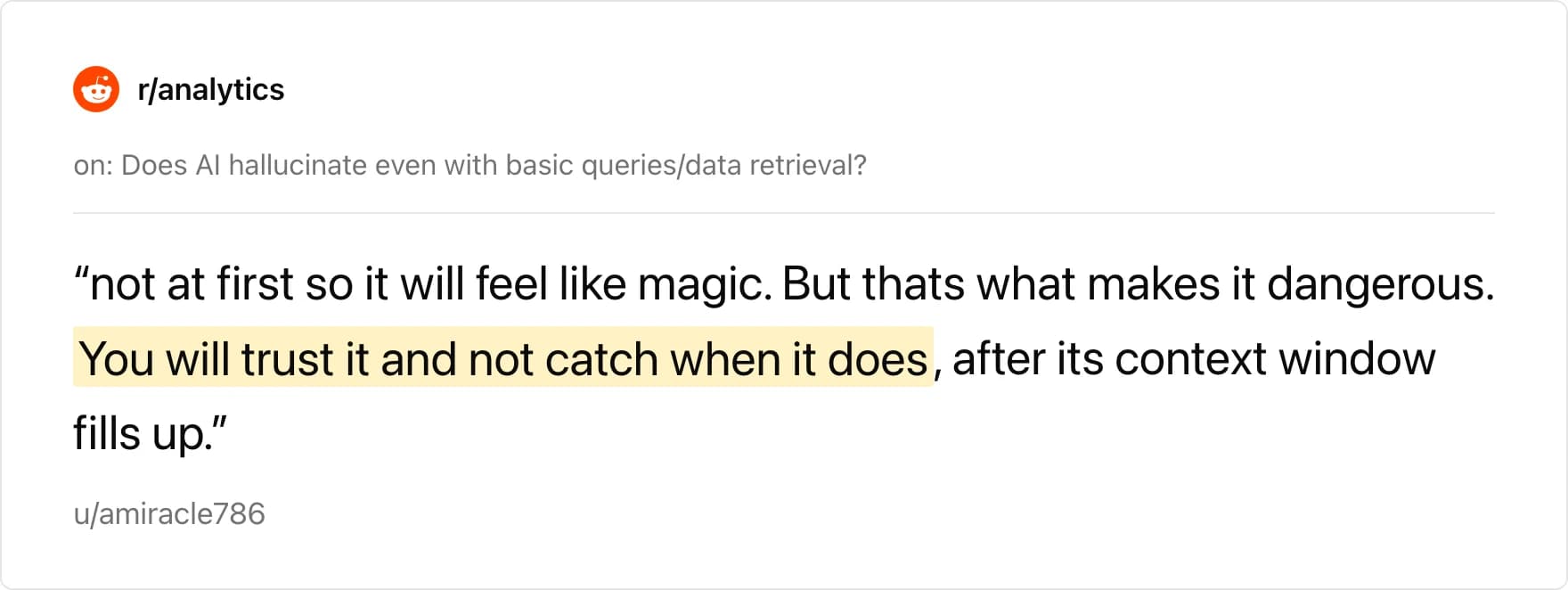
On r/analytics, a thread asking whether AI hallucinates on basic retrieval drew 55 points and 69 comments. The most-upvoted reply explained why this sneaks up on people. "Not at first so it will feel like magic. But thats what makes it dangerous. You will trust it and not catch when it does, after its context window fills up."
Another commenter listed the mundane traps that break e-commerce analysis specifically. "Do we count canceled or refunded orders? Are any percentages in decimal format or reporting format?"
We went deeper on this failure mode in why your GA4 MCP server returns confident, wrong numbers.
3. Your agent writes good SQL and misreads your business
The most-agreed-with observation across the technical threads is that query generation stopped being the bottleneck.
An analyst who connected Claude to Snowflake wrote that permissions took forever, then hit the real wall: "Your revenue definitions, your customer logic, your metric nuances. That stuff does not live in a schema."
The top reply: "The connection is a solved problem. The business context isn't." And the reason, in one line: "What kills these setups is that 'revenue' means three different things depending on who's asking."
Someone who had made it work reported the price. Building the context layer "took 3 weeks to develop just that."
In a thread on agentic analytics, a commenter dismissed the model-quality theory outright: "the model just makes the SQL prettier on the way to the wrong answer." Their prescription was a single authoritative definition per metric, treated "as gospel, not as a thing to re-derive."
This is the argument we expand in the connector is the easy part.
4. More servers makes it worse
There is a strong instinct to connect everything. The measurement says don't.
The same practitioner who mapped seventeen combinations ran the arithmetic on their own sessions. "Fixed overhead (system prompt + tool defs + deferred catalogues) regularly ate 85 to 93% of context. Pruning connectors was consistently a bigger win than any prompt optimisation."
Their two sharpest rules of thumb:
- "A single server is mostly a faster dashboard. You ask a question, you get a number, you still do the work."
- "Two servers for the same data is a downgrade, not redundancy."
A commenter added the part people miss when they trim. "You can drop from seven servers to four and still be carrying a few hundred tool definitions you never call."
The independent corroboration comes from r/analyticsengineering, where the complaint was cost: "the token usage is way higher than expected because the model gets our entire schema dumped on it before it can answer anything."
5. Read everywhere, write nowhere
The PPC community is years ahead of everyone else here, because their agents can spend money.
The best-engaged thread we found, with 80 points and 80 comments, was a practitioner describing how they use Claude Code and Codex to manage Google and Meta Ads rather than just analyze them.
Their honest assessment of the risk: "Big minus: hallucinations. If you just ask it 'what happened in this account?' it will 100% invent the answer. The only way I trust it is when it runs scripts and saves outputs."
The top comment set the boundary in seven words. "Claude should be used as an analyst, not as a buyer role."
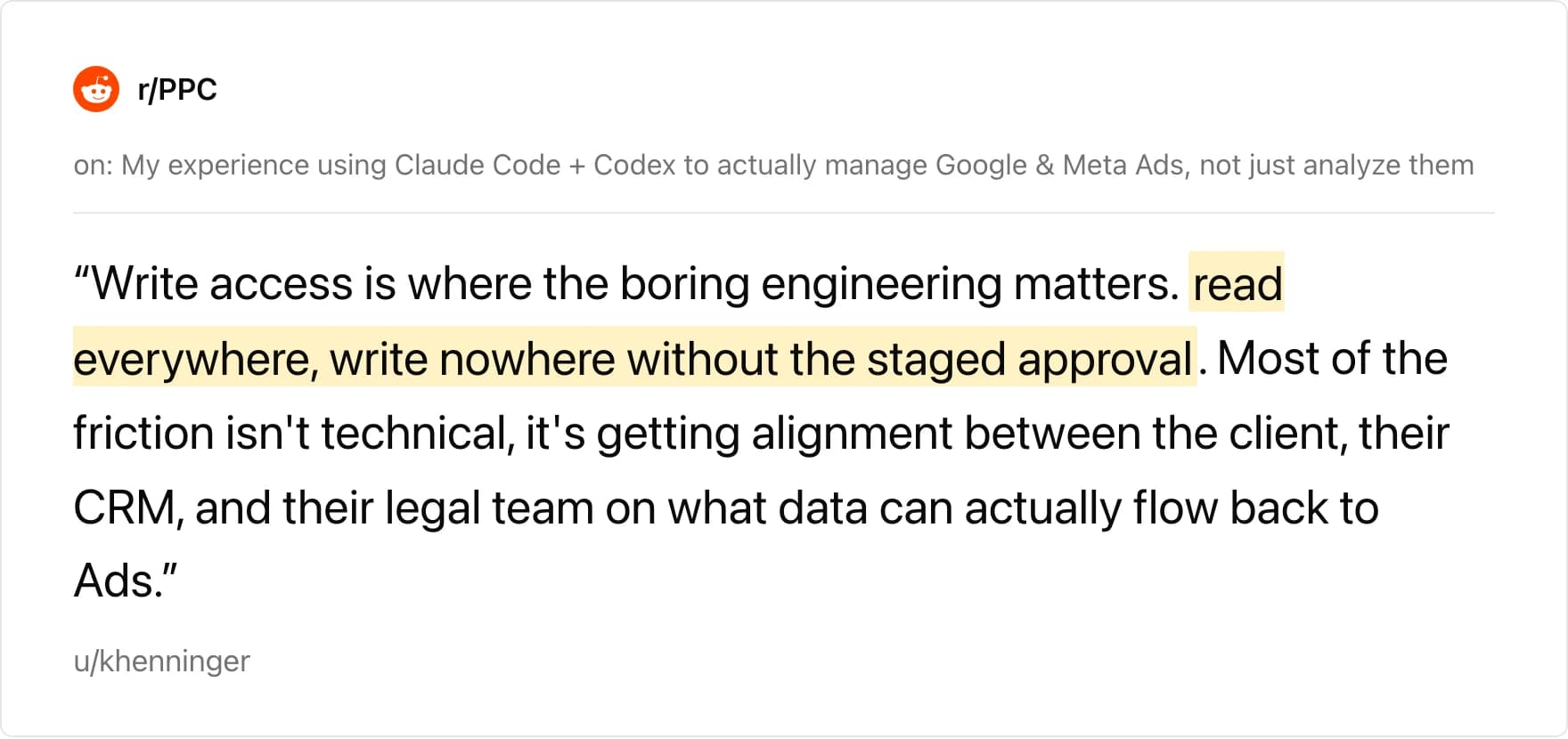
A practitioner running more than 110 accounts gave the most operational version. "Write access is where the boring engineering matters. Read everywhere, write nowhere without the staged approval."
The same thread produced the strategic insight underneath all of this. "The main thing I have learned is that Google Ads alone is not enough context. Google can tell you a keyword converted. It cannot tell you whether that lead was useless in the CRM."
In a related thread on the Ads API with 30 points, the advice was the same. "Write operations need more care. I'd recommend always building a dry-run/preview step before any mutation goes live."
6. Agencies see a firing offence, not a feature
When someone posted a GA4 analysis tool to r/GoogleAnalytics, the reaction was not about features.
"Why would I give priority data and trade secrets to a 3rd party?"
Another was more specific about the professional stakes. "There's absolutely no way I could grant third party access to work data unless they were contracted and legally bound to confidentiality and security rules. I'm guessing I could be fired for it and if I'm honest, I think I'd probably deserve it."
A PPC consultant summarized the agency read in one sarcastic line. "Give all my client's data to a GPT from someone on reddit. I guess I don't care about my clients."
The lesson for anyone evaluating tools in this category: security posture is a gate, not a differentiator. Features do not get evaluated until it clears. Our take on that model is in MCP security and governance.
The same thread also contained the most quietly ambitious request we found. "I want a version of ChatGPT that will tell me how broken the dataLayer is and whether or not the metrics it generates are reliable enough to be relevant."
Nobody has built that yet.
7. AI did not kill the connector
A thread on Supermetrics alternatives with 66 comments produced the cleanest debate in the set.
One commenter declared: "The age of connectors is over. Just get Claude to build you one."
The top-voted reply, at more than double the score, quoted that line back next to its own rebuttal: "You might need a connector."
The community verdict is that AI changes what you do with data, not how it physically moves. Someone did note the trade-off worth taking seriously. "Spend a week on this and possibly save hundreds or thousands in yearly costs."
The related pressure shows up in SEO tooling. In a thread on building an SEO dashboard from Search Console and GA4, the motivation was both cost and trust: "extremely frustrated with the high cost of Semrush, Ahrefs, etc. and honestly not trusting their data." A reply made the case for first-party sources. "For client reporting this setup is more transparent and trustworthy than third party tools because the data comes directly from Google."
8. Chat does not solve recurring reporting
The demand that comes up most often is weekly reporting. The tooling answer is still unsettled.
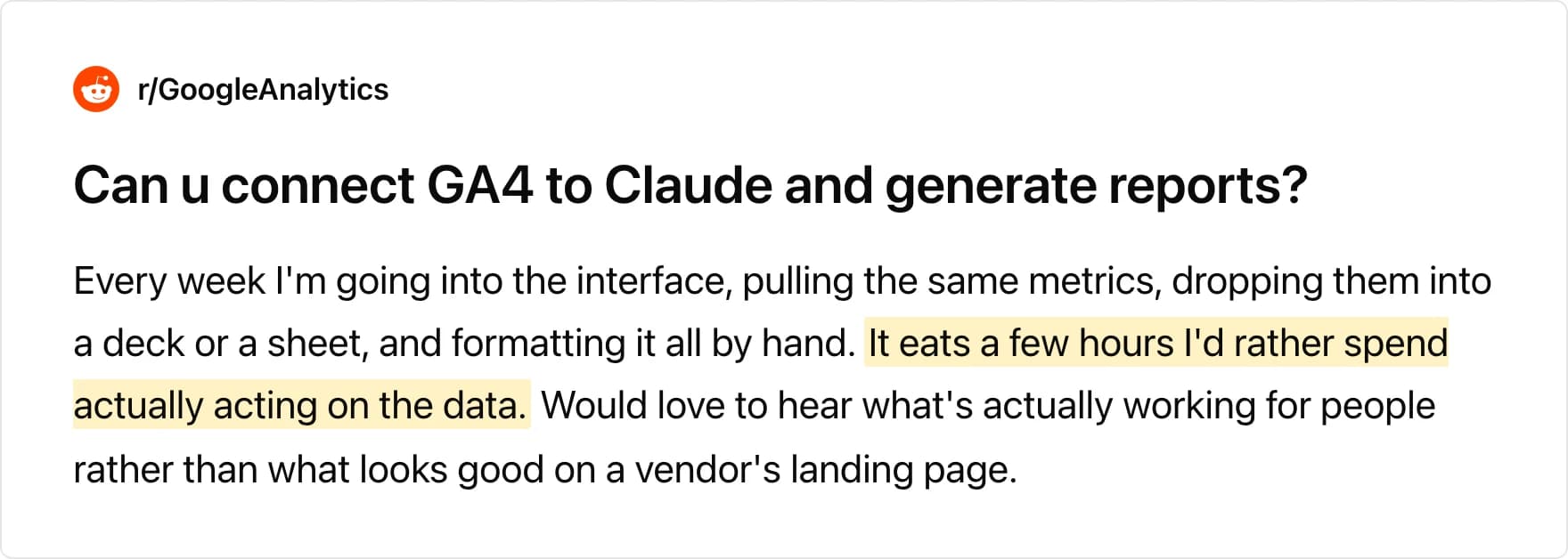
The canonical version, with 24 points and 47 comments, is can you connect GA4 to Claude and generate reports. The ask is painfully ordinary. "Every week I'm going into the interface, pulling the same metrics, dropping them into a deck or a sheet, and formatting it all by hand."
The comments could not agree on a working answer. One warned it is "not exactly user friendly" for non-technical people. Another advised against it outright: "I wouldn't connect GA4 directly to Claude for scheduled reporting." A third offered the most practical workaround. "Never send Claude raw exports, have your sheet pre-calculate WoW/MoM changes and anomalies first."
The seventeen-combination map was blunt about the category boundary. "MCP is interactive by design. If you want the same report every Monday at 9am, that's a cron job or an n8n pipeline calling APIs, not a chat session someone has to remember to open."
That distinction is worth internalizing before you evaluate anything. Interactive investigation and scheduled reporting are different products.
What people actually want connected
Counting mentions across the threads we read, the demand is lopsided and clustered.
| Rank | Source | Why it comes up |
|---|---|---|
| 1 | Google Analytics | Driven as much by GA4 UI frustration as AI interest |
| 2 | Search Console | The most-requested second connector, asked for unprompted |
| 3 | Google Ads | Read is easy, write is the whole argument |
| 4 | BigQuery | The escape hatch when GA4 sampling bites |
| 5 | Meta Ads | Wanted, but app approval is the wall |
| 6 | HubSpot and Salesforce | The lead-quality context that makes ad data mean something |
| 7 | Stripe and Shopify | Revenue truth versus platform-reported conversions |
| 8 | PostHog, Mixpanel, Amplitude | Product-side questions the marketing stack cannot answer |
The pattern underneath the ranking matters more than the ranking. Almost nobody wants one source. Every high-engagement thread is someone trying to join Search Console with GA4, or ads with GA4 and a CRM.
That is why the single-source server keeps getting dismissed as a faster dashboard. The question that justifies the setup is the one that spans two systems.
A checklist before you connect anything
Distilled from what worked for the people above.
- Start with two sources that answer one real question. Search Console plus GA4 is the most-recommended pairing, and both are free.
- Pin absolute date ranges. Relative ranges are where silent drift enters.
- Write down your top ten metric definitions first. The agent will invent them otherwise.
- Keep it read-only until you have calibrated. Then add staged approval before any write.
- Prune your connected servers. Fewer, well-chosen sources beat everything connected at once.
- Verify one number by hand every week. Two minutes, catches drift before a client does.
- Use a pipeline, not a chat, for fixed recurring reports. Save the agent for questions you have not asked before.
A note on what we could not verify
One widely shared post claiming an AI had fabricated analytics data for three months was deleted before we could read it, and several commenters in the follow-up thread argued it was invented. We have left it out of the patterns above.
It is worth mentioning only because the reaction was revealing. One commenter noted how long a wrong dashboard could survive unnoticed, and another observed that "people are used to the numbers they see every day, even if it's wrong." The fear is real even where the story was not.
Where Sequel fits
Most of what practitioners ask for in these threads maps to a few design decisions.
Sequel connects Google Analytics, Search Console, BigQuery, HubSpot, Stripe, PostHog, Mixpanel, Amplitude, and your databases through one authenticated workspace, which removes the repeated OAuth setup per source and per client. It reads across those sources in a single answer, so the cross-source questions people actually care about do not require an export.
Every query is shown before you act on it, and access is read-only by default. Sequel reads from your sources and returns results as conversation context, so an agent investigating an ad account cannot change it.
Metric definitions are stored in the workspace and applied on every query, which is the "one place, treated as gospel" pattern that thread after thread converged on.
If you want to start narrow, our guides cover connecting Google Analytics to Claude Code and connecting Search Console to ChatGPT. For the category overview, see AI agents for marketing analytics and what MCP is.
The pattern worth remembering
Across 32 threads, the people getting value were not the ones with the best tools. They were the ones who connected less, defined more, and checked their numbers against something.
Get started free and pick one question that spans two of your sources.