
TL;DR
| Question | Answer |
|---|---|
| What is a marketing AI agent? | Software that answers plain-English marketing questions by reading your data sources directly |
| What it replaces | The manual cycle of opening five tabs, exporting CSVs, and stitching them in a Sheet |
| How it differs from a BI dashboard | Dashboards answer pre-anticipated questions; agents answer whatever you ask in the moment |
| Typical data sources | Warehouse (BigQuery/Snowflake/Postgres) plus GA4, HubSpot, Stripe, Google Ads, Meta Ads |
| Will it replace analysts? | No — it removes the repetitive parts, not the framing and judgment |
| Time to first value | Usually under 10 minutes once one source is connected |
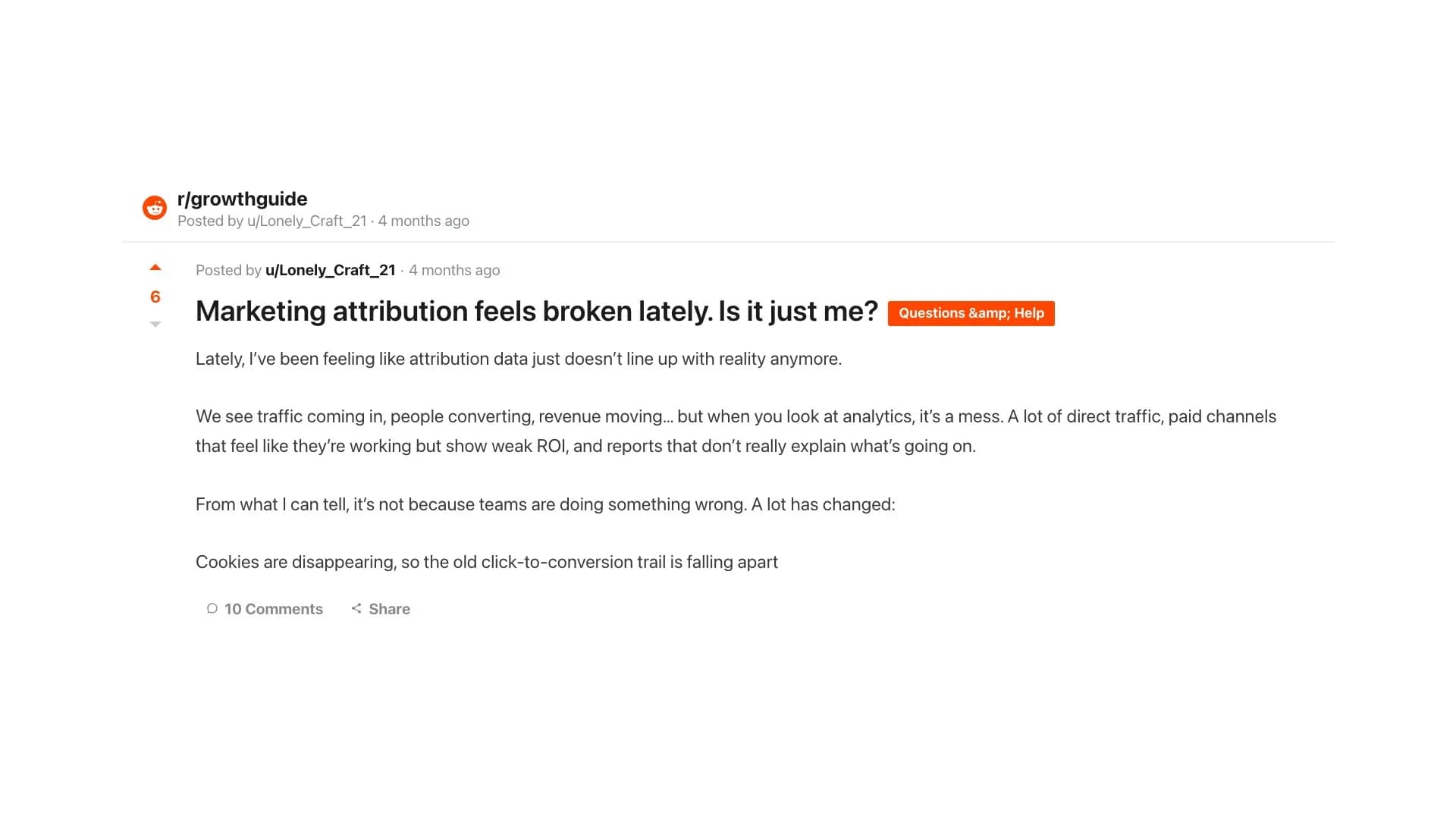
A marketer on r/growthguide opened a thread last quarter with three words that summarized the entire industry: "Marketing attribution feels broken lately." The replies piled up. GA4 and Meta disagree on which campaign drove the sale. Google Ads says one number, Shopify says another. The CMO wants a clean answer by Monday and the data team is two weeks deep in a backlog.
The unglamorous reason most marketing teams cannot answer their own questions is not strategy. It is plumbing. GA4 lives in one place, HubSpot in another, Stripe in a third, ad spend across two platforms, and the warehouse has the joined view but you need someone who writes SQL to get at it. The fix that has emerged over the last eighteen months is a category of tool people are starting to call a marketing AI agent.
A marketing AI agent is software that takes a question in plain English, reads the data sources it has access to, writes the query, runs it, and returns the answer. No tabs, no exports, no Looker Studio rebuild. This guide covers what a marketing AI agent actually is, why the category has appeared now, how it works underneath, what it can and cannot do in 2026, and how to choose one. If you want the foundation underneath, our AI data analyst guide covers the engine in more depth.
What is a marketing AI agent?
A marketing AI agent is an AI system that answers marketing performance questions by reading your data directly. You type "what was our blended CAC last week by channel," and the agent inspects the schemas of your connected sources, decides which tables to join, writes the SQL or API call, executes it, and returns a chart with the numbers. The same agent can write a weekly report, flag a CPA spike, or pull a cohort retention curve.
The category overlaps with three things people have heard of and is not quite any of them.
It is not a chatbot stapled to a dashboard. Conversational interfaces on top of pre-built reports only answer the questions the dashboard already supports. Ask anything outside that surface and you get a polite shrug.
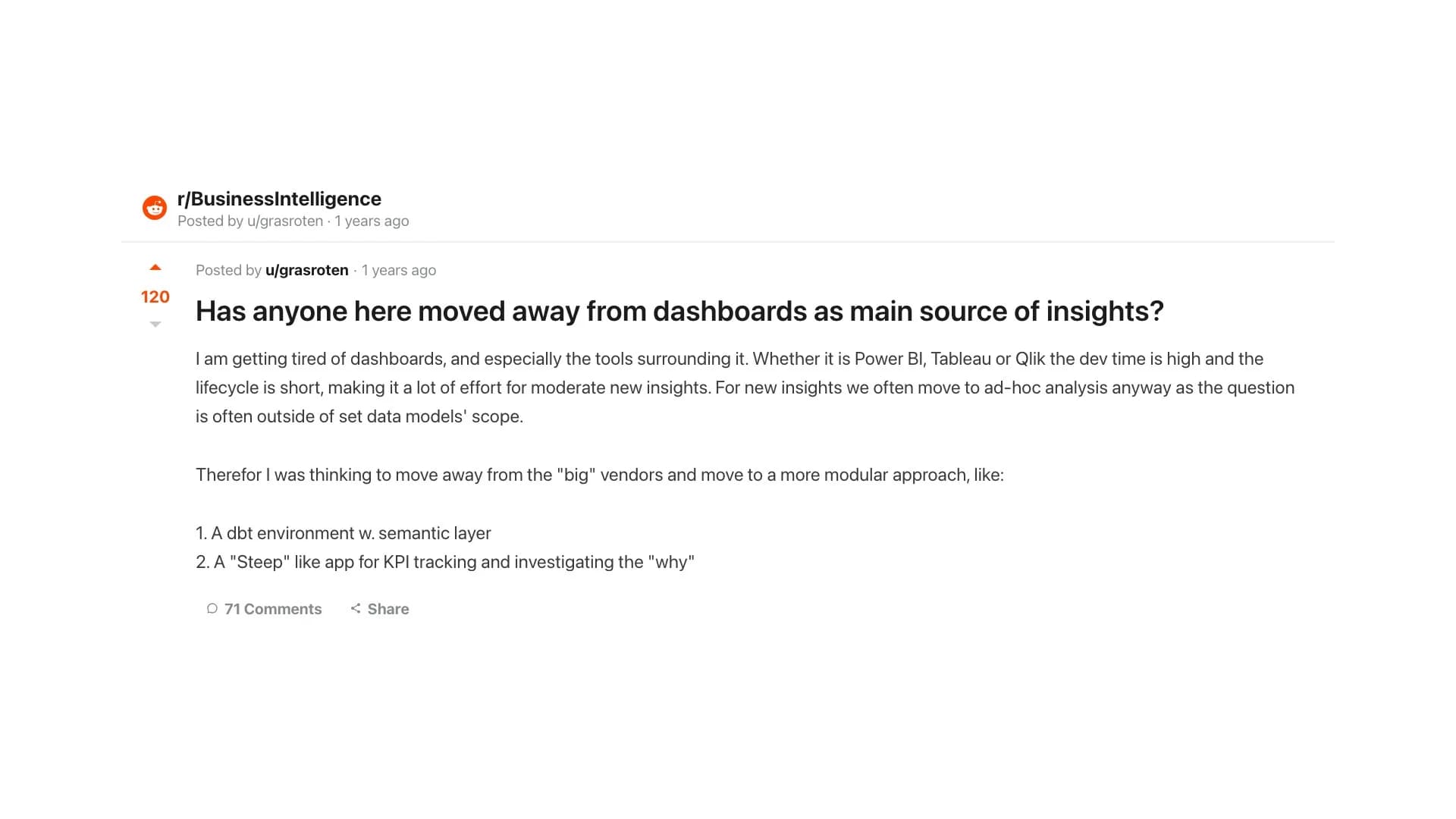
It is not a marketing analytics platform like a Looker workspace or a Hex notebook. Those still expect somebody to model the data, build the report, and maintain it. As one BI lead summarized on r/BusinessIntelligence, traditional dashboards have "high dev time" and a "short lifecycle". The work to keep them current eats the value.
It is not a single-tool AI feature. GA4 has its Intelligence panel. Meta has its AI suggestions. HubSpot has Breeze. Each of those answers questions about its own data. A marketing AI agent is the layer above all of them — it reaches into every connected tool, merges the data at query time, and answers the cross-tool question that none of the single-tool features can touch.
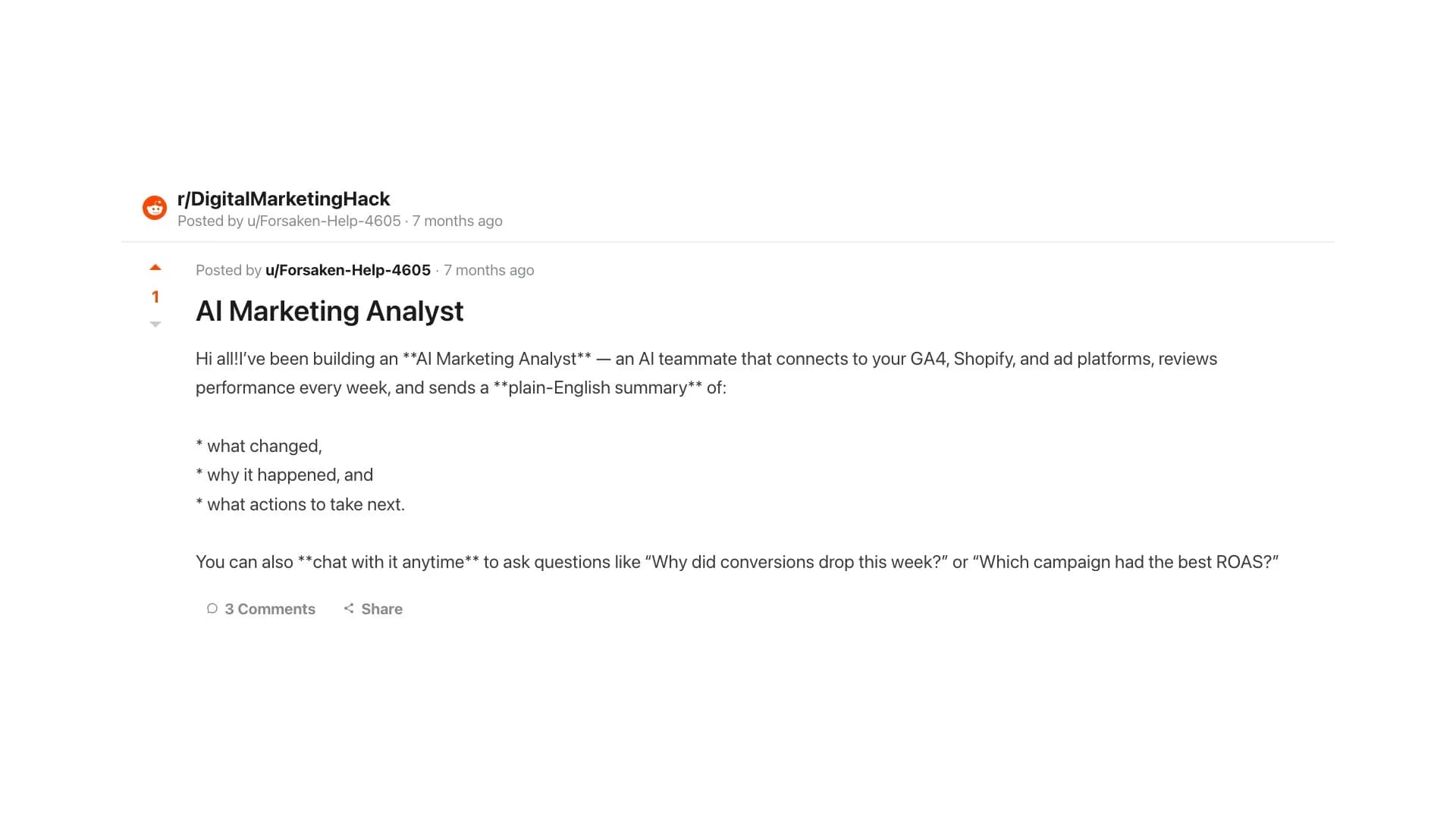
The cleanest description came from a builder on r/DigitalMarketingHack who described their project as an "AI teammate that connects to your GA4, Shopify, and ad platforms, reviews performance every week". That is the right mental model: not a chatbot, not a dashboard, a teammate that lives across your stack and answers questions that span it.
Why this category appeared in 2026
Three things lined up.
1. Marketing data sprawl crossed a usability cliff. The average B2B marketing team now touches twelve to twenty SaaS tools. Growth marketers describe spending thousands a month on tooling and still feeling like they are drowning. Each tool has its own UI, its own export limits, its own definition of a conversion. The warehouse is the only place the data even comes close to unifying — and getting at it still requires either SQL or yet another modeling layer.
2. Frontier models can now reason across many sources at once. A 2024 model could pull a clean answer out of one schema. A 2026 model can hold GA4's event schema, HubSpot's deal pipeline, Stripe's charge model, and your warehouse's metrics layer in the same context, decide which combination answers your question, and assemble the result. The capability that matters for marketing is multi-source reasoning — not query generation on a single table.
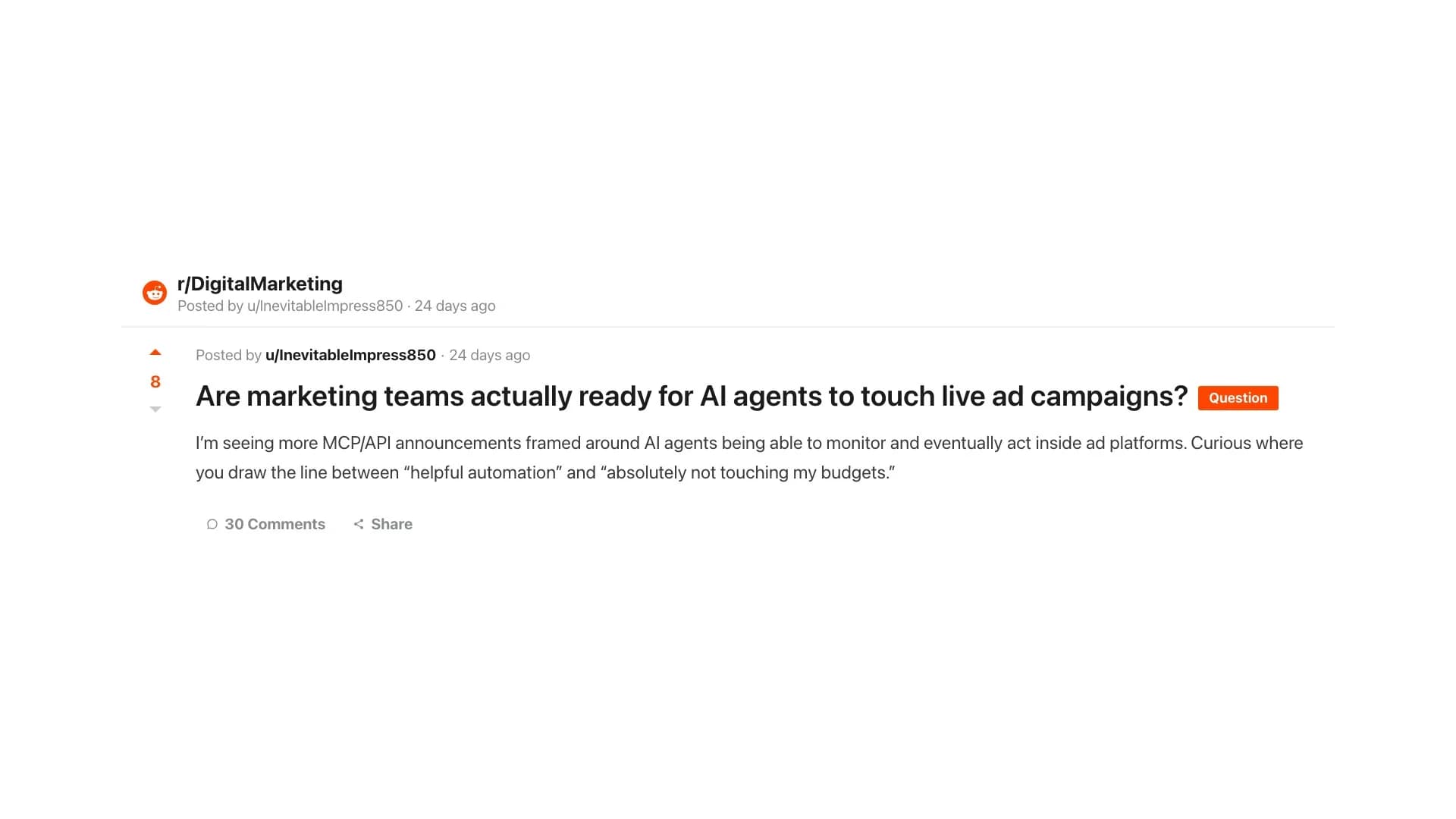
3. MCP made it safe to plug agents into live data. The Model Context Protocol standardized how AI tools connect to databases and SaaS APIs, with read-only access and per-query auditing built in. One r/DigitalMarketing thread caught the shift early, noting that more "MCP/API announcements [are] framed around AI agents being able to monitor and eventually act inside ad platforms."
The combination changed what was possible. A marketer with no SQL background can now ask a question, get an answer in seconds that references real production data, and trust the agent enough to share the result with their CMO.
How a marketing AI agent works under the hood
The mechanics are straightforward in outline, and the interesting work happens across tools — not inside any one of them.
-
Connect to the tools where the data lives. Ad platforms (Google Ads, Meta Ads, LinkedIn), CRMs (HubSpot, Salesforce), product analytics (GA4, Mixpanel, Amplitude), billing (Stripe), and the warehouse (BigQuery, Snowflake, Postgres) all plug in once. The agent reaches each one through its native API or a database connection. No central ETL is required.
-
Map each source. The agent learns each tool's structure — that
conversions.utm_sourcelives in GA4, thatdeals.amountlives in HubSpot, thatcharges.amount_capturedlives in Stripe — and remembers which entities link across them (email, customer_id, anonymous_id). -
Understand the question across sources. When you ask "blended CAC last week by channel," the agent decomposes it: ad spend from Google Ads and Meta Ads, deal-stage transitions from HubSpot, revenue from Stripe to validate. The decomposition step is what separates an agent from a chatbot on a single tool.
-
Pull the data from each tool. Sometimes that's a SQL query against the warehouse, sometimes an API call to GA4, sometimes both in parallel. The agent picks the right interface per source rather than forcing everything through one query layer.
-
Stitch the answer together at query time. Joining HubSpot deals to Stripe revenue to Google Ads spend happens in the moment, without an upstream data model. This is the capability that pre-built dashboards cannot match — every cross-tool question is a new join, and the agent decides the join.
-
Show the answer and the work. A number, table, or chart, with every query and API call exposed so a curious user can audit. Read-only credentials per source mean the agent can never accidentally change anything. Our secure database AI agents guide covers the access patterns.
-
Carry context across follow-ups. "Now break that down by week" should reuse the previous answer's logic, not start over. The conversation memory is what makes the agent feel like a teammate instead of a search box.
What you can actually ask a marketing AI agent
The use cases break into four buckets.
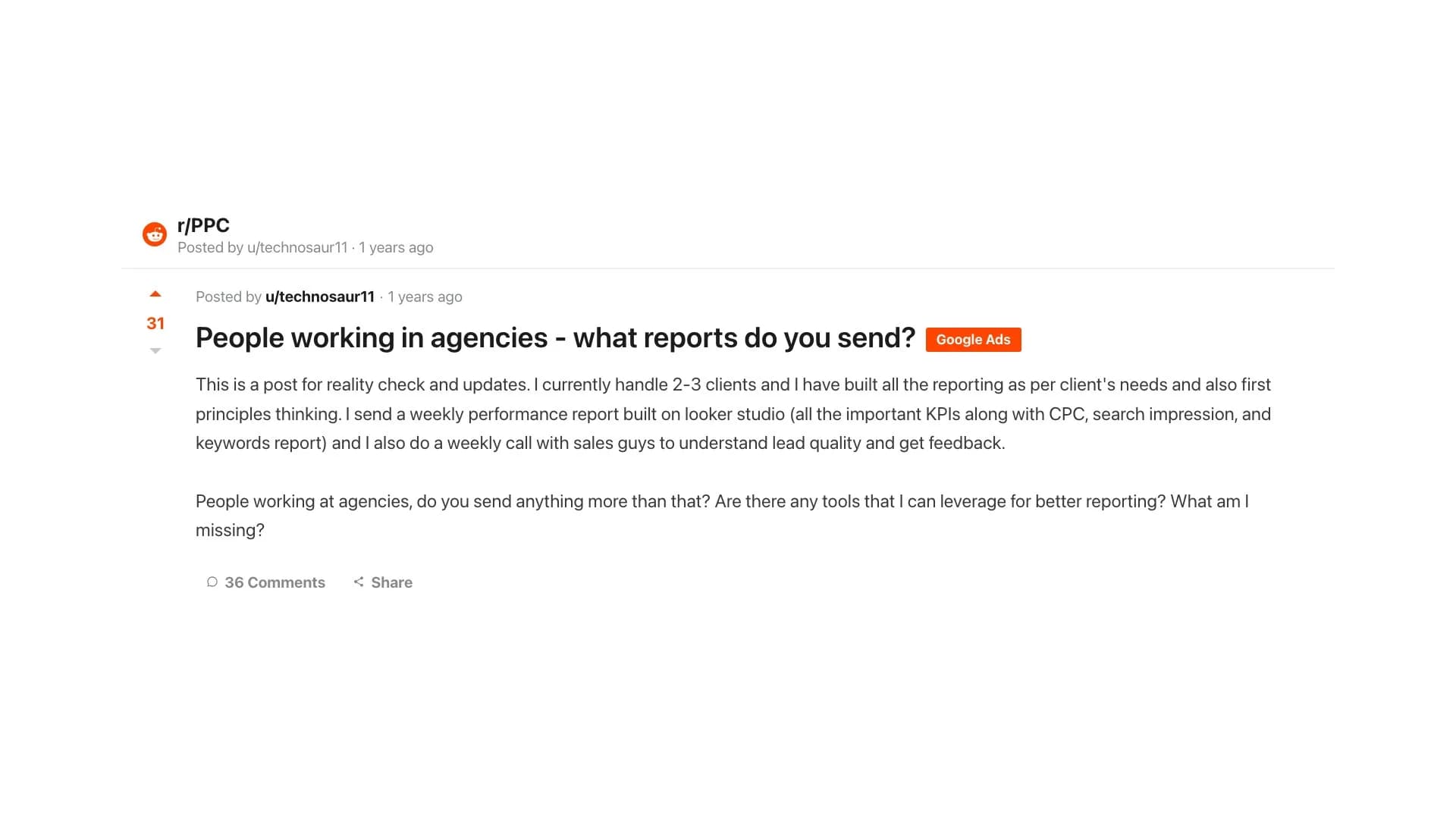
Reporting and weekly rollups. The repetitive part of every marketing job. One r/PPC veteran admitted that at a previous agency they built reports for "only the first 4 days of the month" because "the reports weren't read". An agent collapses the work to a prompt, runs it on a schedule, and posts the result to Slack.
Attribution and channel ROI. Cross-source questions that are awkward in any single platform. "Which paid campaigns drove HubSpot opportunities last quarter and what was the Stripe revenue tied to them?" An agent joins across the three systems on email or customer_id and returns one table.
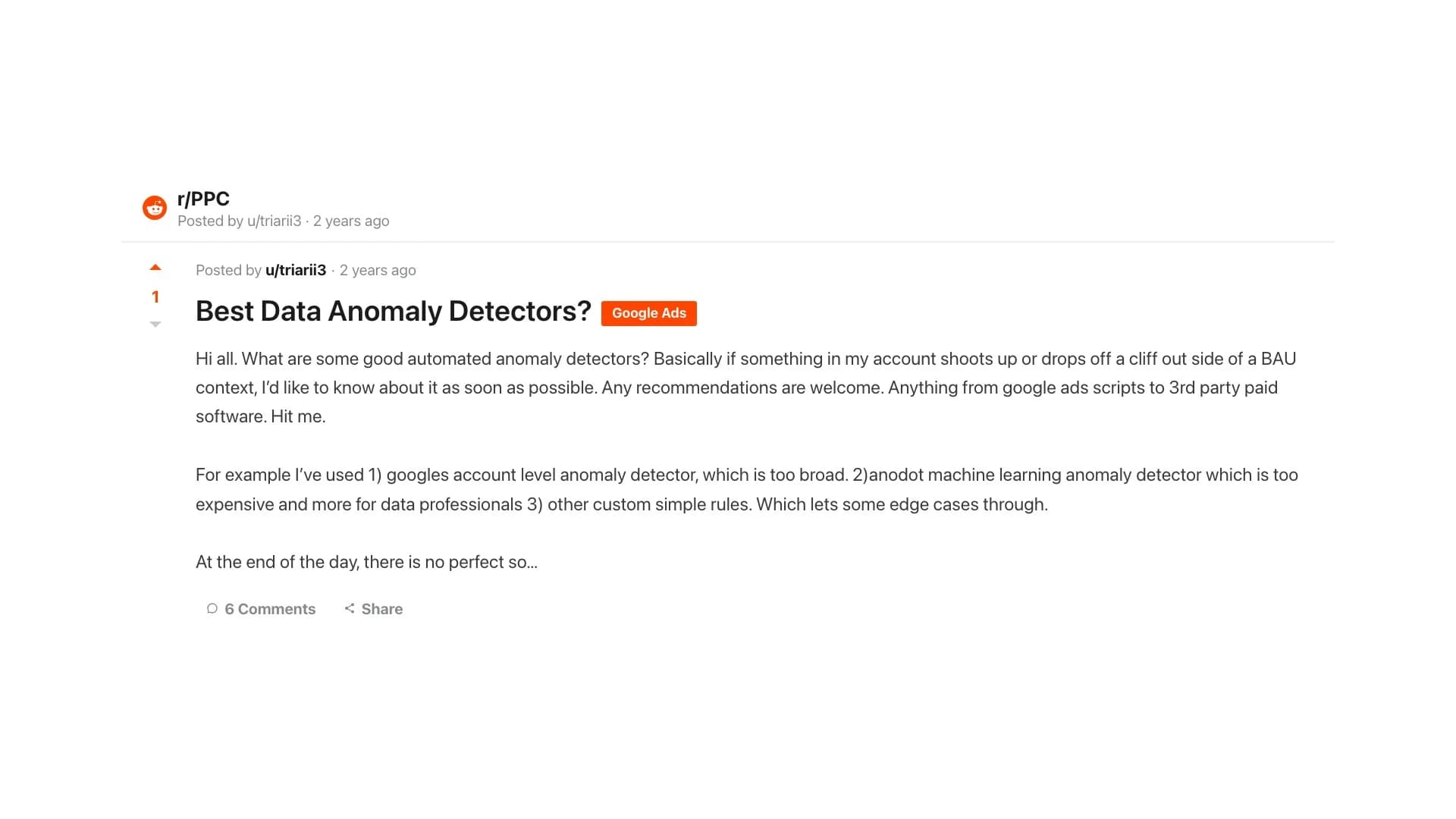
Anomaly detection and campaign health. Marketers have been asking for this for years. One r/PPC thread put it directly: their best ad-account monitor today is "a simple Google Ads dashboard of daily key stats" eyeballed for 15 seconds every morning. An agent runs the daily diff for you and surfaces what changed.
Self-serve answers for the rest of the team. Product marketing wants funnel numbers. Sales wants lead quality. Customer success wants churn by acquisition channel. Each of them currently files a ticket. A marketing AI agent makes the question self-serve, which is the data democratization story marketing has wanted for a decade.
Marketing AI agent vs marketing analytics platform
The two categories solve different problems, and most teams will use both.
| Capability | Marketing analytics platform | Marketing AI agent |
|---|---|---|
| Pre-built dashboards | Yes | No (or optional) |
| Ad-hoc questions | Requires new report | Answer in seconds |
| Skill floor | SQL or modeled metrics | Plain English |
| Data joins across sources | Modeled in advance | At query time |
| Time to a new answer | Hours to days | Seconds |
| Best for | Recurring KPIs leadership reviews | Investigative questions, weekly reports, anomaly chasing |
| Failure mode | Dashboards that nobody opens | Generated queries that need a human spot-check |
A common pattern in 2026 is to keep one or two leadership dashboards in Looker or Tableau and route every other question through the agent. The dashboards anchor the regular review cadence. The agent eats the long tail.
For a deeper comparison, see AI data analyst vs BI tools.
What a marketing AI agent cannot do
Honesty matters here. Several Reddit threads make the limits clear.
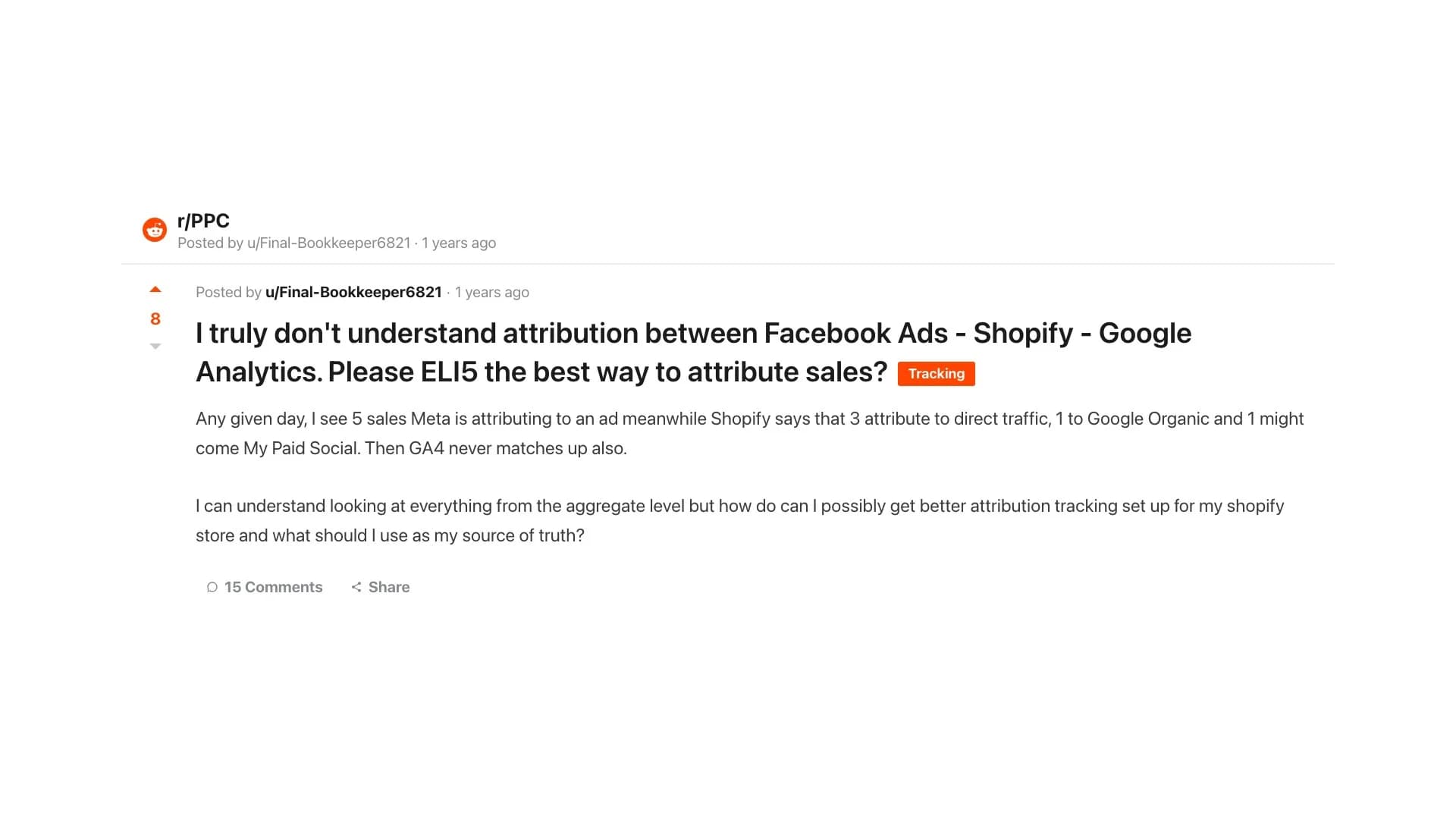
It cannot make your tracking less broken. If your conversion pixel fires twice on Shopify, the agent will faithfully report the inflated number. The fix is in the tracking layer, not the agent. One r/PPC thread captured the underlying pain: Meta and Shopify routinely disagree by 60 percent on the same campaign. An agent can show you the disagreement; it cannot reconcile reality.
It cannot answer questions your data does not capture. "Why did organic traffic drop overnight" requires Search Console and GA4 to both be connected, and even then, the agent can only suggest the diagnostic: algorithm update, technical regression, or indexation drop. A human SEO still owns the call.
It cannot replace causal modeling. Multi-touch attribution is a probabilistic exercise. As one r/SaaS commenter put it, the "real challenge isn't the conversational layer. It's data integration and trust." For board-level revenue attribution, MMM or holdout testing still beats any agent.

It cannot push spend or pause campaigns by default. Agents in 2026 are read-only for a reason. The day they take write actions inside ad platforms, the security model needs to change. That is coming, but it is not the default in the products you can buy today.
How to pick a marketing AI agent
Six questions to ask any vendor.
-
What does it connect to? GA4, HubSpot, Google Ads, Meta Ads, Stripe, and your warehouse should all be on the list. If they only connect to one BI layer, you are buying a BI chatbot, not an agent.
-
Does it generate SQL you can read? The answer should always be yes. If the vendor cannot show you the query, you cannot audit the answer.
-
What is the access model? Read-only by default, with per-source credentials and audit logs. See MCP security and governance for the access patterns to expect.
-
How does it handle schema changes? Marketing data evolves. The agent needs to re-introspect schemas without a manual reset.
-
Can it run on a schedule? A weekly report agent that requires a human to type the prompt is half a product.
-
How well does it handle cross-source questions? Ask the vendor to demo a question that needs three sources joined on the fly — "which Meta campaigns produced HubSpot opportunities that closed in Stripe last quarter." If the answer is "we recommend modeling that in your warehouse first," you are buying a chatbot, not an agent.
For a comparison of the actual products in the market, see our roundup of the best marketing AI agents in 2026.
The honest takeaway
The category is real, the technology is mature enough to use in production, and the gap between teams that adopt and teams that don't is going to widen fast over the next year. The marketers who started using ChatGPT for ad-hoc analysis last year already cut their brief-to-insight time roughly in half. A marketing AI agent that actually connects to GA4, HubSpot, Stripe, and the warehouse goes further. It answers cross-source questions that no individual tool can answer, and it does it without a ticket.
The teams who win with this are the ones who treat the agent as a teammate, spot-check its work the way you would a junior analyst, and design their data stack so the agent can reach the sources it needs. If you are evaluating, start with one source, ask the questions you wish you could already answer, and see whether the agent earns the seat.
Sequel is the marketing AI agent we built for exactly this. It connects to GA4, HubSpot, Stripe, Google Ads, Meta Ads, BigQuery, Snowflake, and a dozen more, answers questions in plain English against the data directly, and shows you every query it runs. Try it on one source and one question, then decide.
Use Sequel from Claude Code (or any MCP client)
If you already use Claude Code, you can connect Sequel's MCP server with a single command:
claude mcp add --transport http sequel https://api.sequel.sh/mcp \
  --header "Authorization: Bearer sql_your_api_key"
Claude Code now has read-only access to every source connected to your Sequel workspace — GA4, HubSpot, Stripe, Google Ads, Meta Ads, your warehouse, and the rest — so you can ask cross-source marketing questions from inside the editor without leaving your existing workflow. Auth, schema introspection, and read-only safety are handled by Sequel.
For Cursor, ChatGPT, or any other MCP-aware client, see the full Sequel MCP server guide.