
Tableau and Looker are excellent at one thing: showing a metric you check every day, the same way, to the whole company. They are slow at a different thing: the question you have exactly once, right now.
That gap is the whole story. A BI tool assumes you already know what to build. An AI data analyst meets you at the question and writes the SQL on the spot. This piece lays out the real difference, when to reach for each, what happens when you swap one for the other, and why the answer for most teams is both.
What each one is built for
A BI platform is a modeling and dashboarding layer. You define metrics, build dashboards, and govern who sees what. It rewards upfront work with repeatable, trusted views.
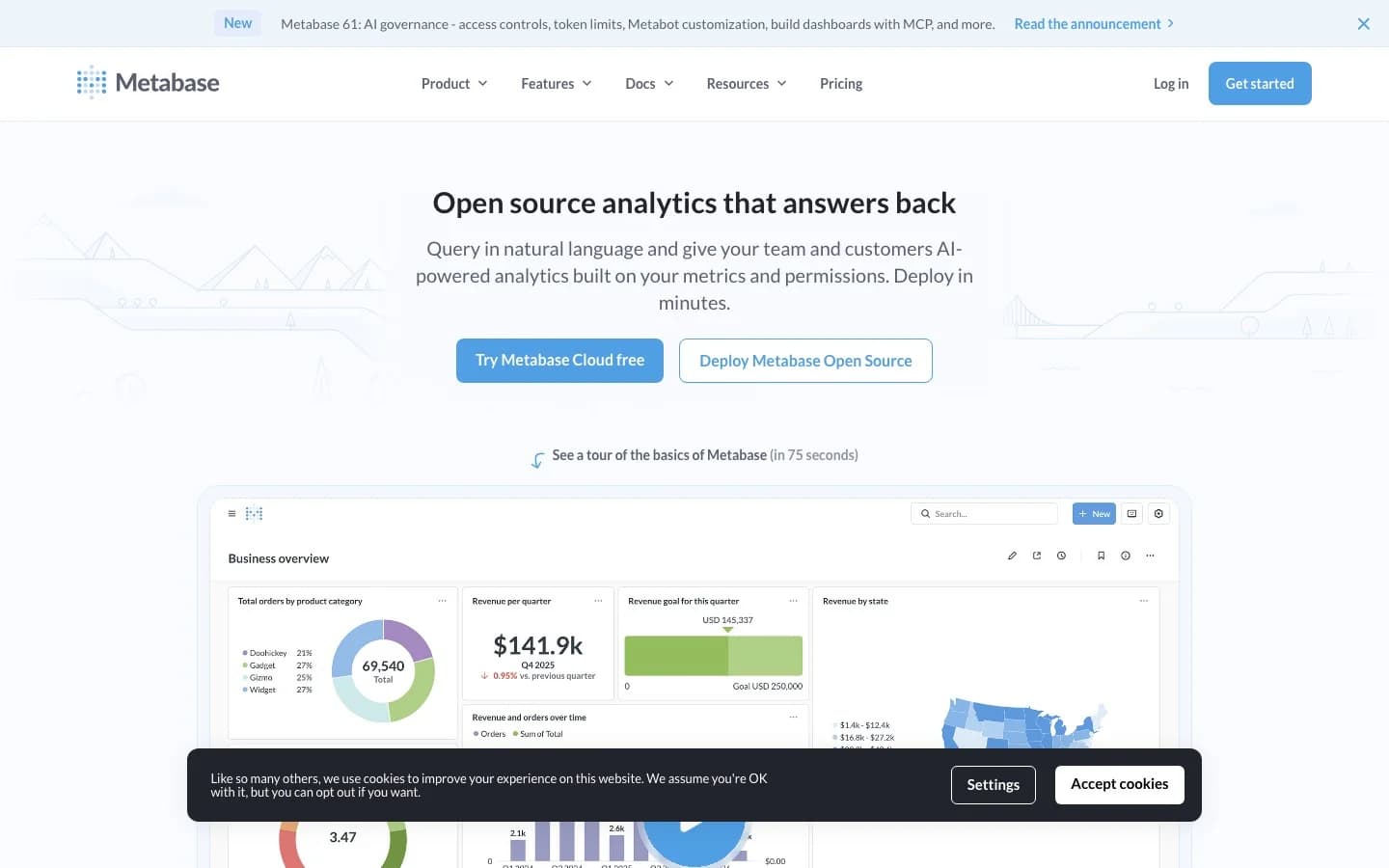 A traditional BI tool like Metabase centers on modeled metrics and prebuilt dashboards.
An AI data analyst is a question-answering layer. You ask in plain English, it generates and runs SQL, and it charts the result. It rewards speed on questions you did not plan for.
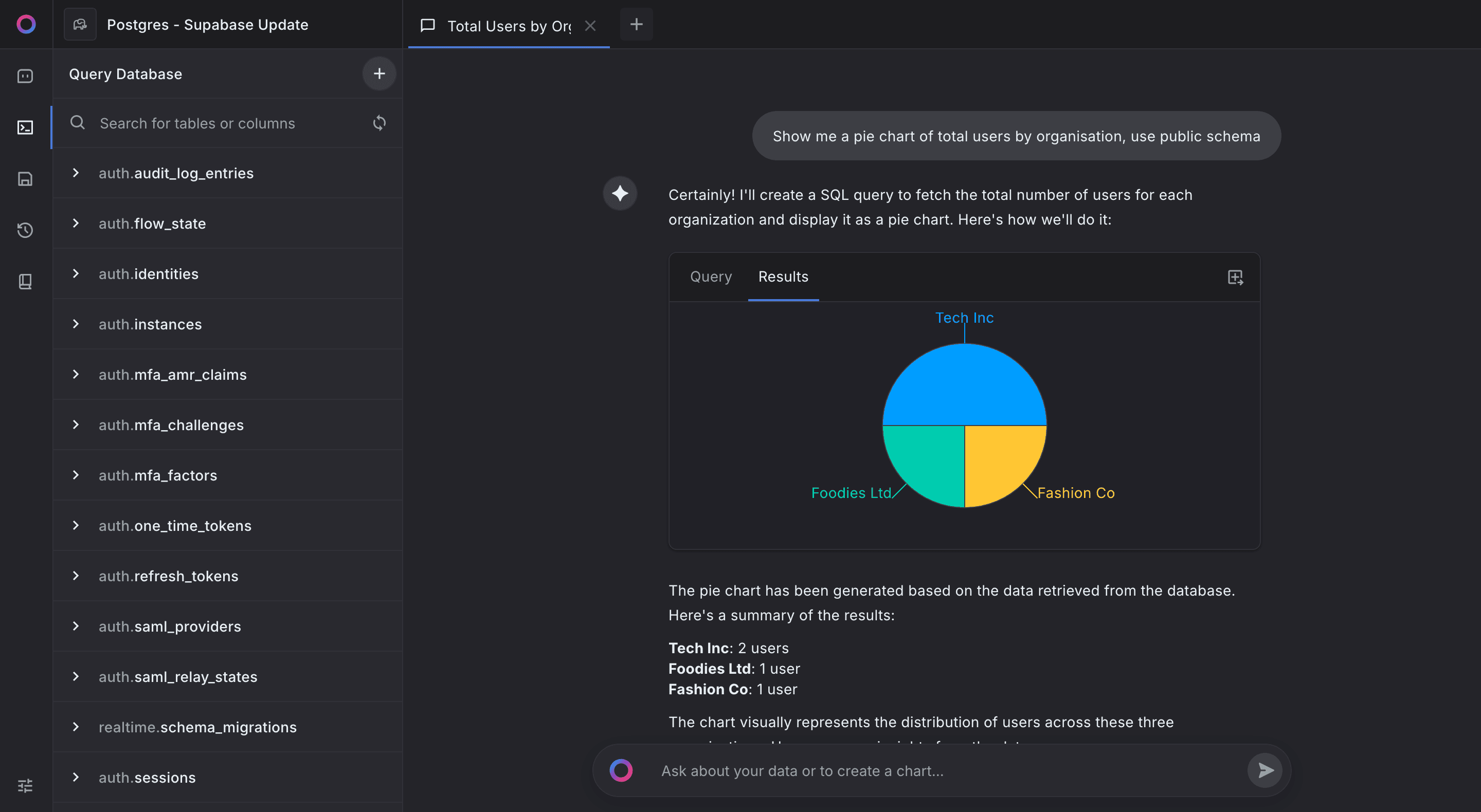 An AI data analyst like Sequel answers a plain-English question and charts the result on the spot.
Neither is "better." They solve different problems. The trouble starts when you use one for the other's job.
The core tradeoff: planned vs unplanned questions
Here is the split that decides which tool fits.
| Dimension | AI data analyst | Traditional BI tool |
|---|---|---|
| Best for | One-off, unplanned questions | Standing, repeated metrics |
| Interface | Plain English | Drag-and-drop, modeled fields |
| Time to first answer | Seconds | Hours to days for a new view |
| Who can use it | Anyone on the team | Usually analysts and power users |
| Upfront setup | Connect and ask | Model data, build dashboards |
| Governance | Read-only access, query logs | Mature row-level security, certified metrics |
| Lives in | Slack, AI tools, the browser | A BI portal |
A dashboard is the right home for revenue you watch daily. It is the wrong home for "did that one campaign last Tuesday actually convert," because nobody built that chart and nobody will.
Why dashboards stall on ad-hoc work
The friction is structural, not a flaw. A dashboard answers the questions you imagined when you built it. A genuinely new question means a new query, which usually means a ticket to whoever owns the BI tool.
That request joins a queue. By the time the chart is ready, the moment that prompted it may have passed. This is the analyst bottleneck that slows marketing, finance, and product teams every week. An AI data analyst removes the round trip for that class of question. We wrote about the broader pattern in traditional data tools holding your business back.
What happens when you swap BI for raw AI
The opposite mistake is just as costly: ripping out a BI tool and telling everyone to "just ask the AI." A widely upvoted r/analytics thread captured how that plays out.
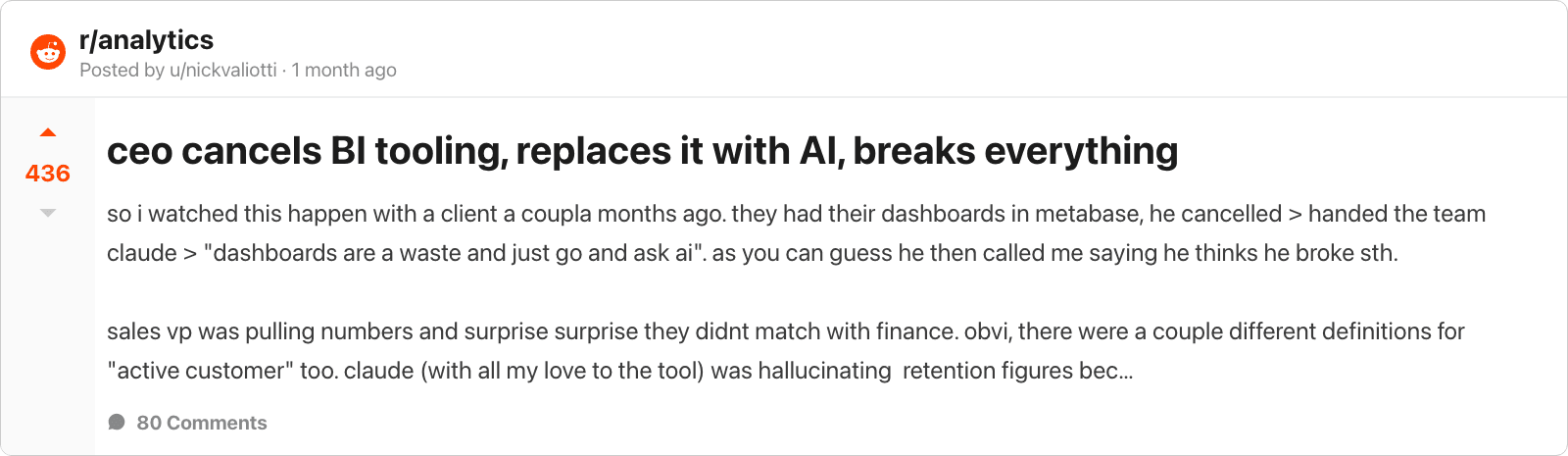 An r/analytics post on a CEO who cancelled Metabase, handed the team Claude, and watched the numbers stop matching.
The most useful comment in that thread explains exactly why it broke:
"people are treating ai like it can replace the whole analytics stack when really it only works if the underlying data is already clean and the metrics are defined. tools like Metabase force companies to agree on what 'active customer' actually means."
That is the real tradeoff. The modeling step in a BI tool is annoying, but it forces shared definitions. Skip it, and an AI will happily produce confident, inconsistent answers. The fix is not "AI instead of BI." It is AI for the long tail of questions, on top of data your team has actually defined.
Where BI tools still win
Be fair to the incumbents, because they earn their place.
- Governed metrics. A certified "revenue" definition the whole company trusts.
- Row-level security. Fine-grained control over who sees which rows.
- Executive dashboards. Polished, always-on views built to a spec.
- Heavy modeling. Semantic layers that encode complex business logic once.
If your need is a metric a hundred people watch every morning, a BI tool is the right call. An AI data analyst is not trying to replace that.
Where an AI data analyst wins
- Speed on unplanned questions. Seconds, not a ticket.
- Access for non-analysts. Plain English instead of modeled fields. Even product managers who know some SQL move faster asking in English.
- Cross-database questions. Join across Postgres, BigQuery, and Snowflake in one ask.
- Lives where you work. Answers in Slack or inside your AI tools through MCP, not behind another login.
One r/dataengineering commenter described selling this to investment shops and "compressing their research time by 80% compared to a fixed dashboard." That is the unplanned-question speedup in one sentence.
Most teams need both
The honest recommendation: keep your BI tool for standing dashboards, add an AI data analyst for the long tail of one-off questions. They share the same underlying databases, so this is not an either-or migration.
The split frees your analysts. Routine questions get self-served. The deep, modeled work that actually needs an expert lands on their desk instead of a pile of ad-hoc requests. For a tool comparison across the AI side, see the best AI data analyst tools in 2026.
Curious how the question-first workflow feels next to your dashboards? Get started free or see the features.