
In November 2024, Anthropic released a standard almost no one noticed. A year later, OpenAI, Google, Microsoft, AWS, and others had adopted it, the community had built thousands of servers for it, and it had become the default way AI tools connect to the outside world.
That standard is MCP, the Model Context Protocol. If you run a data team, it is the reason an AI tool can now read your database schema and answer questions about your data. This guide explains what MCP is, how it is built, and why it matters for the work your team does.
What MCP is, in plain terms
MCP is an open standard for connecting AI applications to external systems. Those systems can be databases, files, APIs, or internal tools. The protocol gives every connection one shared shape, so any AI tool can talk to any data source that supports it.
Anthropic's own analogy is the clearest one. MCP is "a USB-C port for AI applications". USB-C standardized how devices plug together. MCP standardizes how an AI model plugs into your data.
Before it existed, every AI-tool-to-data-source pairing needed its own custom integration. That is the M×N problem: five tools and five sources could mean twenty-five integrations. MCP turns that into M plus N. Each side implements the standard once.
Who built it, and why it spread
Anthropic created MCP and open-sourced it on November 25, 2024. The authors are David Soria Parra and Justin Spahr-Summers. The launch shipped the spec, SDKs, and reference servers for Google Drive, Slack, GitHub, and Postgres.
What made it stick was rival adoption. A standard owned by one company is a product. A standard your competitors adopt is infrastructure.
| Date | Milestone |
|---|---|
| Nov 25, 2024 | Anthropic open-sources MCP |
| Mar 26, 2025 | OpenAI adopts MCP across its Agents SDK and ChatGPT desktop |
| Apr 9, 2025 | Google says Gemini will support MCP |
| May 19, 2025 | Microsoft ships broad MCP support across GitHub, Windows, and Azure |
| Nov 25, 2025 | MCP registry hits ~2,000 entries, up 407% in three months |
How MCP is built: host, client, server
MCP uses a client-server architecture with three participants. Understanding them takes two minutes and makes everything else clear.
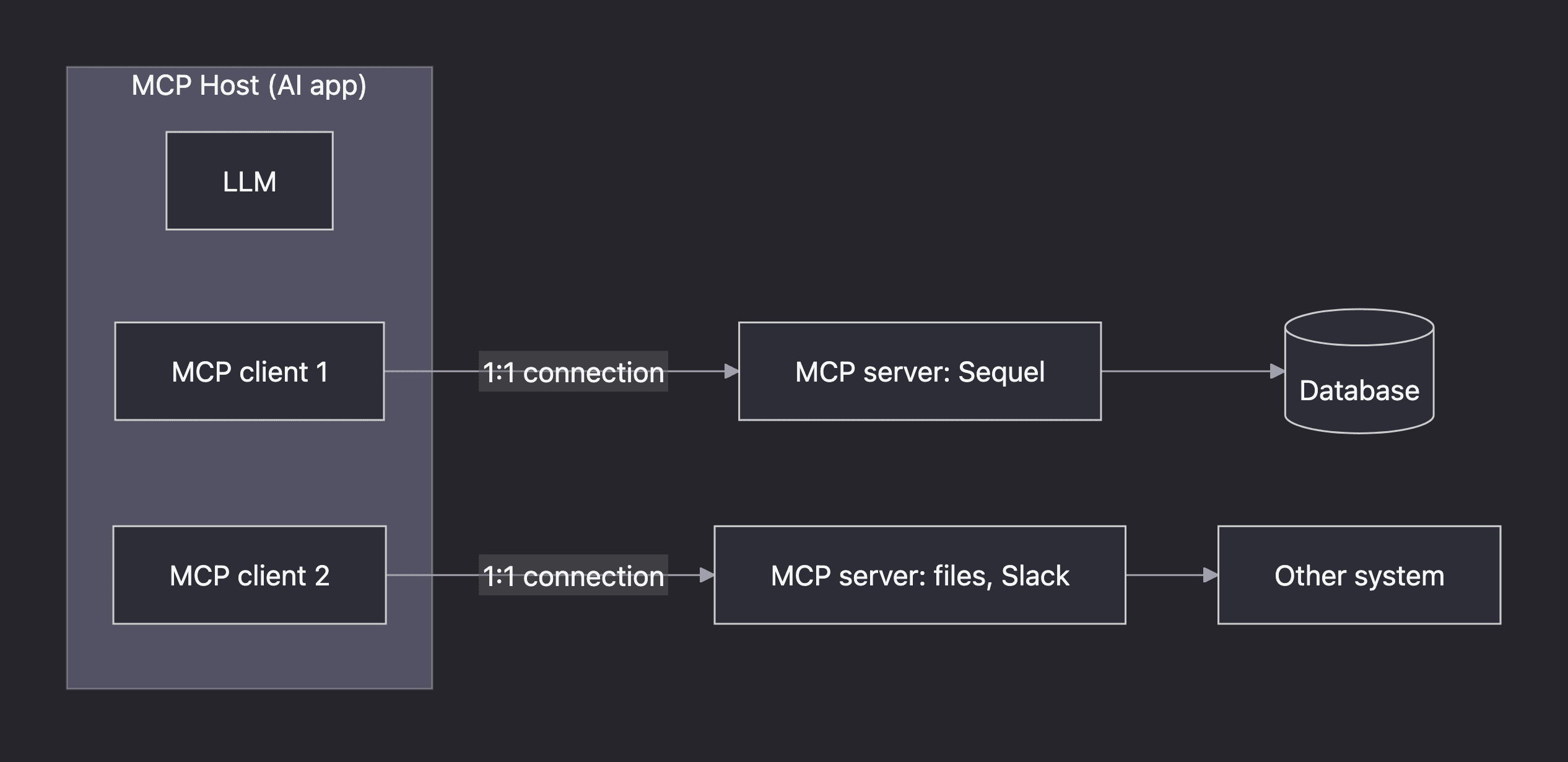
The three roles are:
- Host. The AI application you use, like Claude Desktop, Cursor, or ChatGPT. It runs the model and coordinates the connections.
- Client. A connector inside the host. It keeps a dedicated, one-to-one link to a single server.
- Server. A program that exposes capabilities to the host. A database server like Sequel exposes your schema and query tools.
The host creates one client per server. Connect to Sequel and a files server at once, and the host spins up two clients. Each minds its own connection.
What a server exposes: tools, resources, prompts
An MCP server offers capabilities through three primitives. This is the part that matters most for data work, because it defines what an AI tool can actually do with your database.
| Primitive | What it is | Database example |
|---|---|---|
| Tools | Functions the model can call | Run a read-only SQL query |
| Resources | Read-only data for context | Your database schema |
| Prompts | Reusable templates | Few-shot query examples |
For a database, the schema is exposed as a resource, and query execution is exposed as a tool. The model reads the schema for context, then calls the query tool with the SQL it generated. We trace that full flow in MCP for databases.
How MCP talks under the hood
You do not need this layer to use MCP, but it helps when you evaluate tools. MCP messages use JSON-RPC 2.0. The connection is stateful: the client and server negotiate capabilities when they connect, then exchange requests and notifications.
There are two standard transports:
- stdio. The host launches the server as a local subprocess. Good for running on your own machine.
- Streamable HTTP. For remote servers, with optional streaming over Server-Sent Events. It replaced the older HTTP+SSE transport.
The spec is versioned by date. The current version is 2025-11-25, with 2025-06-18 and 2025-03-26 as recent prior revisions.
Why data teams should care
MCP is the reason plain-English database access stopped being a feature locked inside one product. It is now a connection any AI tool can make.
That changes the supply-and-demand math on your team. Data questions have always outrun the people who can write SQL. We covered that gap in why traditional data tools hold teams back. MCP lets an AI data analyst sit inside the tools your colleagues already use, so they can answer routine questions themselves.
Connect your database to Sequel once, and that connection works from Claude, Cursor, or ChatGPT. The same schema understanding and natural-language-to-SQL follow you across tools. To see the whole round trip, read how to query your database with AI using MCP.
Is MCP secure?
It can be, and it introduces real risks worth naming. Because an AI model cannot reliably tell instructions from data, untrusted content can carry hidden commands. This is prompt injection, and it is the dominant concern in the MCP community.
The spec addresses authorization with an OAuth 2.1 model for remote servers. For databases specifically, the controls that matter are read-only access, scoped permissions, and logging every query the AI runs. We cover all of it in MCP security and governance.
MCP vs an API: the question everyone asks
On Reddit and Hacker News, the most common pushback is "isn't MCP just a wrapper around an API?" It is a fair question with a real answer.
| API | MCP | |
|---|---|---|
| Built for | A specific integration | AI models to use at runtime |
| Discovery | Read the docs, write code | The model lists tools automatically |
| Reuse | Per tool, per pairing | One server, many AI tools |
| Audience | Developers | AI hosts and agents |
An API assumes a developer wires it up ahead of time. MCP assumes an AI model discovers and uses the capability live. They are not enemies. An MCP server often wraps an API. The difference is that the model can find and call it without a custom build for each tool.
The short version
MCP is the standard that lets AI tools connect to your systems through one shared interface, and in 2026 it is how AI reaches your database. You do not have to master the protocol to benefit from it. Connect your data once and ask questions from any tool. Get started free or explore Sequel's MCP server.