
TL;DR
| Question | Answer |
|---|---|
| What's the real problem? | Not missing data. Missing decisions. |
| What do dashboards do? | Tell you what happened. |
| What do AI agents do? | Tell you what to do next. |
| Who feels this most? | Every marketing team that already has BI. |
| What's the proof? | Gartner: analytics influence only 53% of marketing decisions. |
| What's the fix? | A decision layer on top of the data layer. |
Ryan Deiss, founder of DigitalMarketer, posted a thread in March 2026 that sums up the state of marketing analytics in two profiles. CEO A spends $50K on fancy BI tools, has dashboards nobody trusts, and argues with teammates about feelings instead of facts. CEO B uses a Google Sheet, tracks metrics weekly, and reviews the whole business in 15 to 30 minutes. He asked which one scales to $20M.
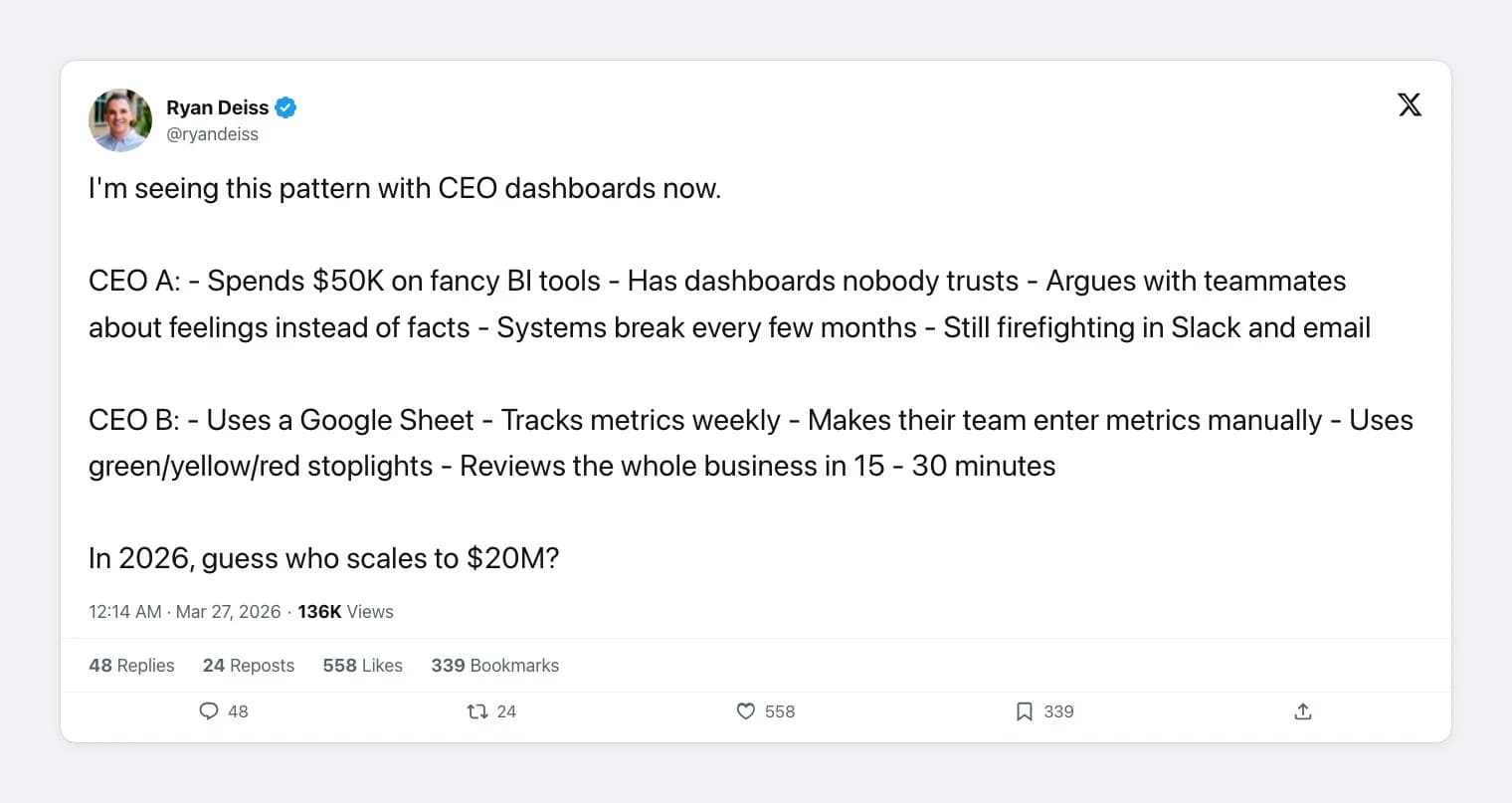
The post hit because it described what most marketing leaders feel and can't say out loud. The problem isn't that there isn't enough data. The problem is that the data isn't doing anything.
This is the decision problem. It is already here, it is already costing your team, and the next platform layer is not more dashboards.
The 53% problem
In late 2022, Gartner surveyed 377 senior marketing analytics leaders and asked a single, sharp question. How much do marketing decisions actually use the analytics work being done?
The answer was 53%.
Half the marketing decisions at the surveyed companies were made with no analytics input at all. Of the half that did get analytics input, the picture was worse than it looks.
- 26% of decision makers did not review the analytics provided
- 24% rejected the recommendations
- 24% relied on gut instinct anyway
- One in three actively cherry-picked the data to support a conclusion they had already reached
This is the headline number for the decision problem. Gartner's own analyst Joseph Enever put it plainly. "Better data won't increase marketing analytics' decision influence alone." The bottleneck isn't supply. It is the gap between supply and act.
Why dashboards stop short
Ask any BI engineer what happens after they ship a dashboard. The most-upvoted thread of the year on r/PowerBI captured it perfectly. The analyst builds the dashboard, the executive opens it, and a cascade begins.
What does this mean? After you answer, what should we do about it? After you answer, how should we do that? After you answer, why aren't you just running the company?
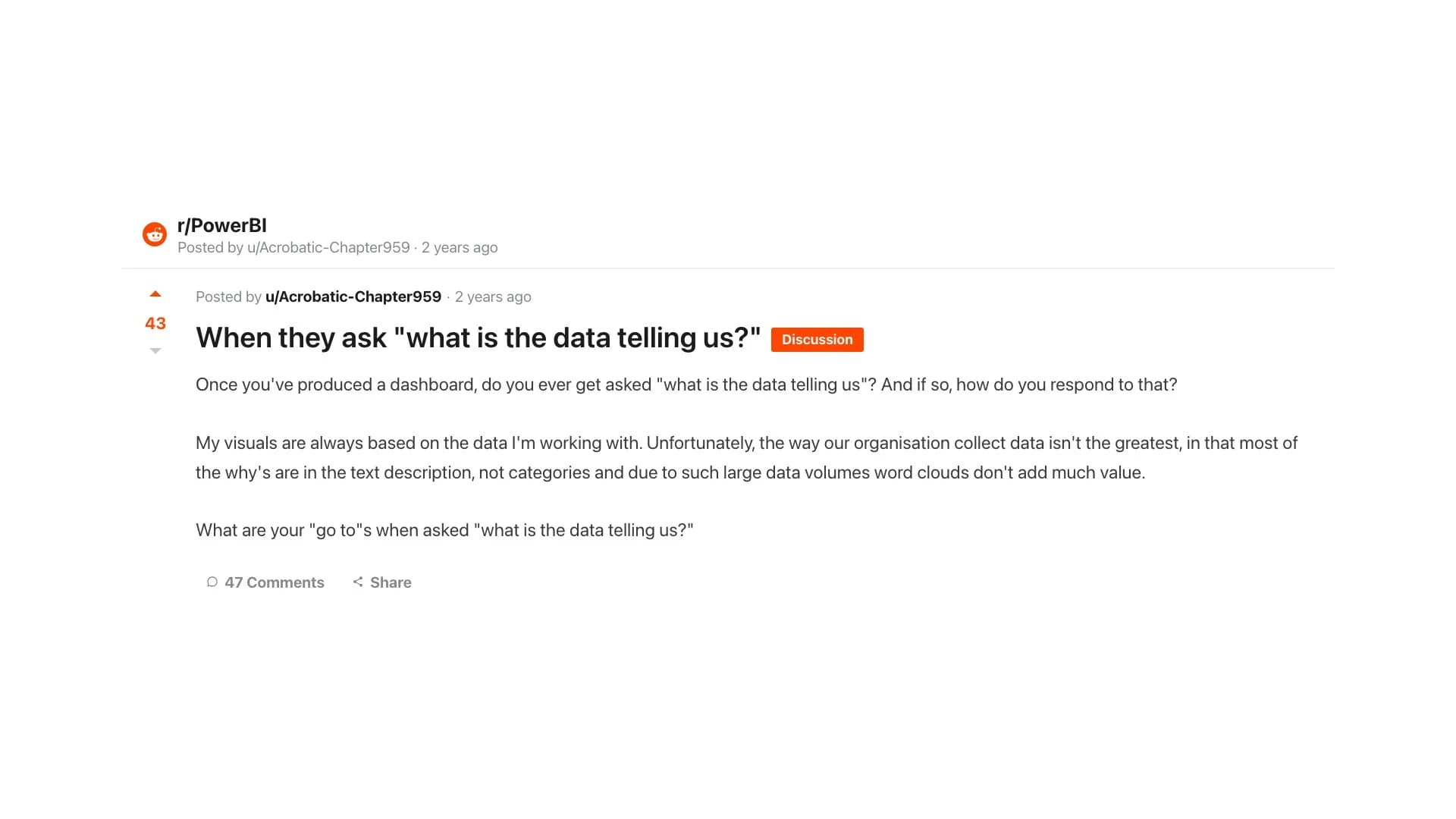
The dashboard answered what happened. Everything past that lives somewhere else. And right now that somewhere else is in the analyst's head, on the back of an envelope, or in a meeting that hasn't started yet. The chart is the start of the conversation, not the end.
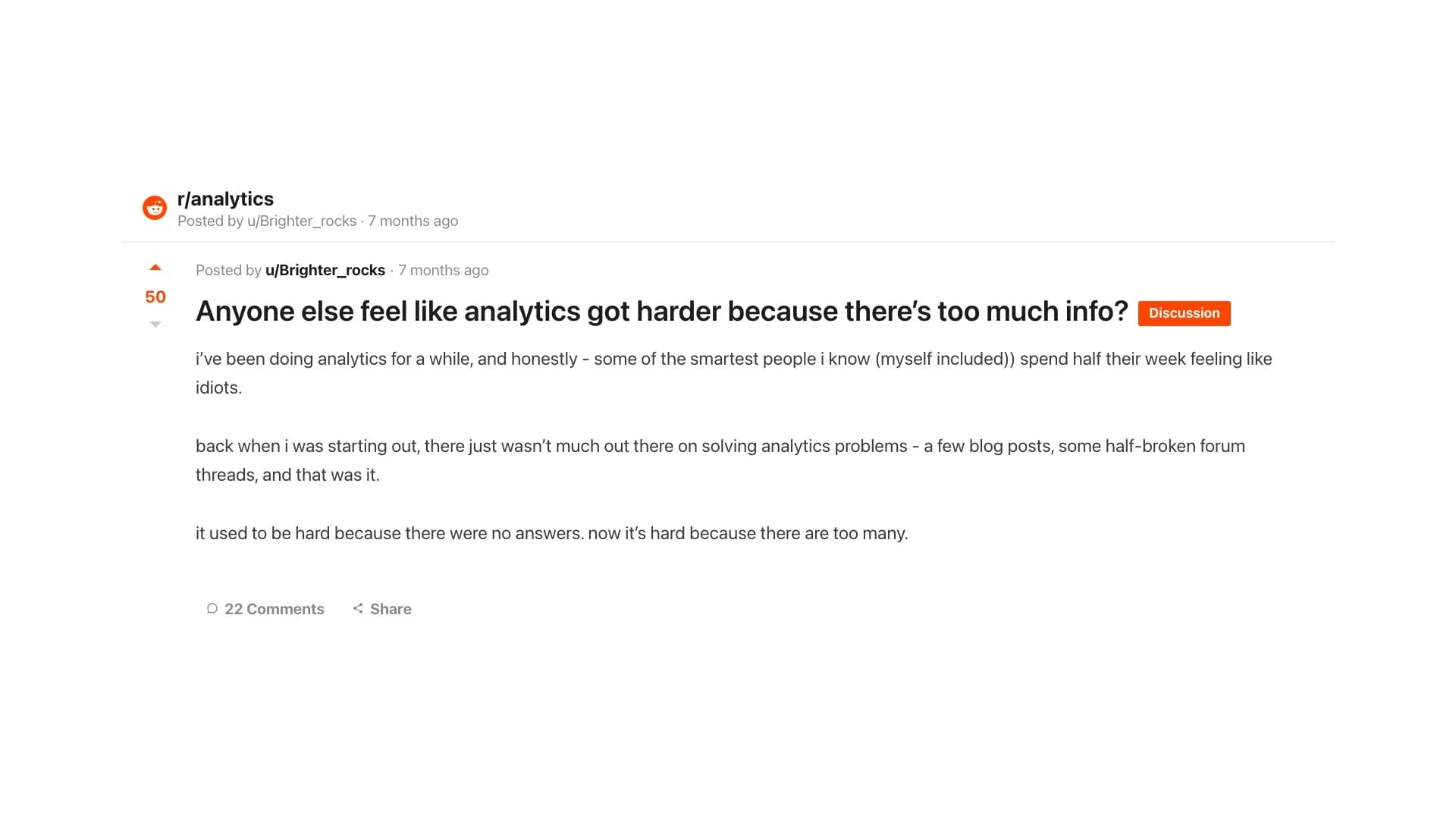
Marketers feel this the same way. An r/analytics thread last month framed the half nobody talks about. "A lot of people just request data because it feels like the right thing to do. Weekly reports, dashboards, whatever, and then nothing really happens afterward. No decisions, no experiments, no changes. The data just kind of sits there looking pretty."
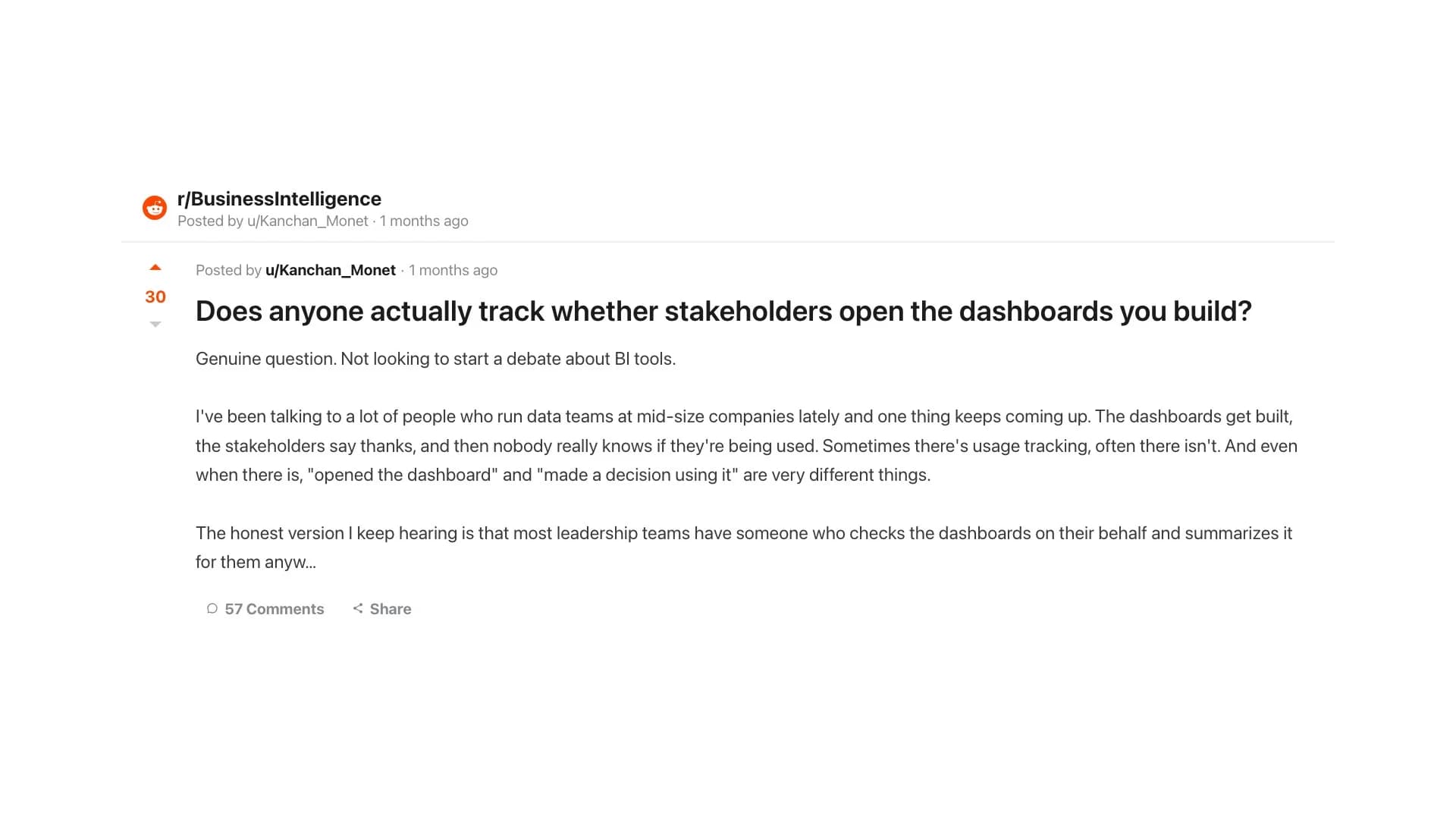
You can quantify this. One BI engineer ran the numbers on their own work. They built a flagship Power BI report for a 35-person firm. Six weeks in, the usage tracker showed 300 views. "Drilled in. 285 were me." Three out of thirty-five colleagues had opened it once.
The thread that taught the BI world how to see this was Charity Majors' Notes on the Perfidy of Dashboards, surfaced on Hacker News with 93 points and a healthcare comment that still hits. The team ran RCTs comparing dashboard-driven interventions to non-dashboard approaches. "Dashboard groups had worse patient outcomes. Non-dashboard approaches had 20 to 100 percent better patient outcomes." The dashboard format wasn't neutral. It was actively harmful in that case.
The pattern shows up in marketing the same way. A separate Hacker News thread on the broader pain, with 698 points and 299 comments, called the failure rate of new data projects "0%, and that 0% includes projects which had launch parties." Dashboards get built. They don't get used. Nobody acts on what they show.
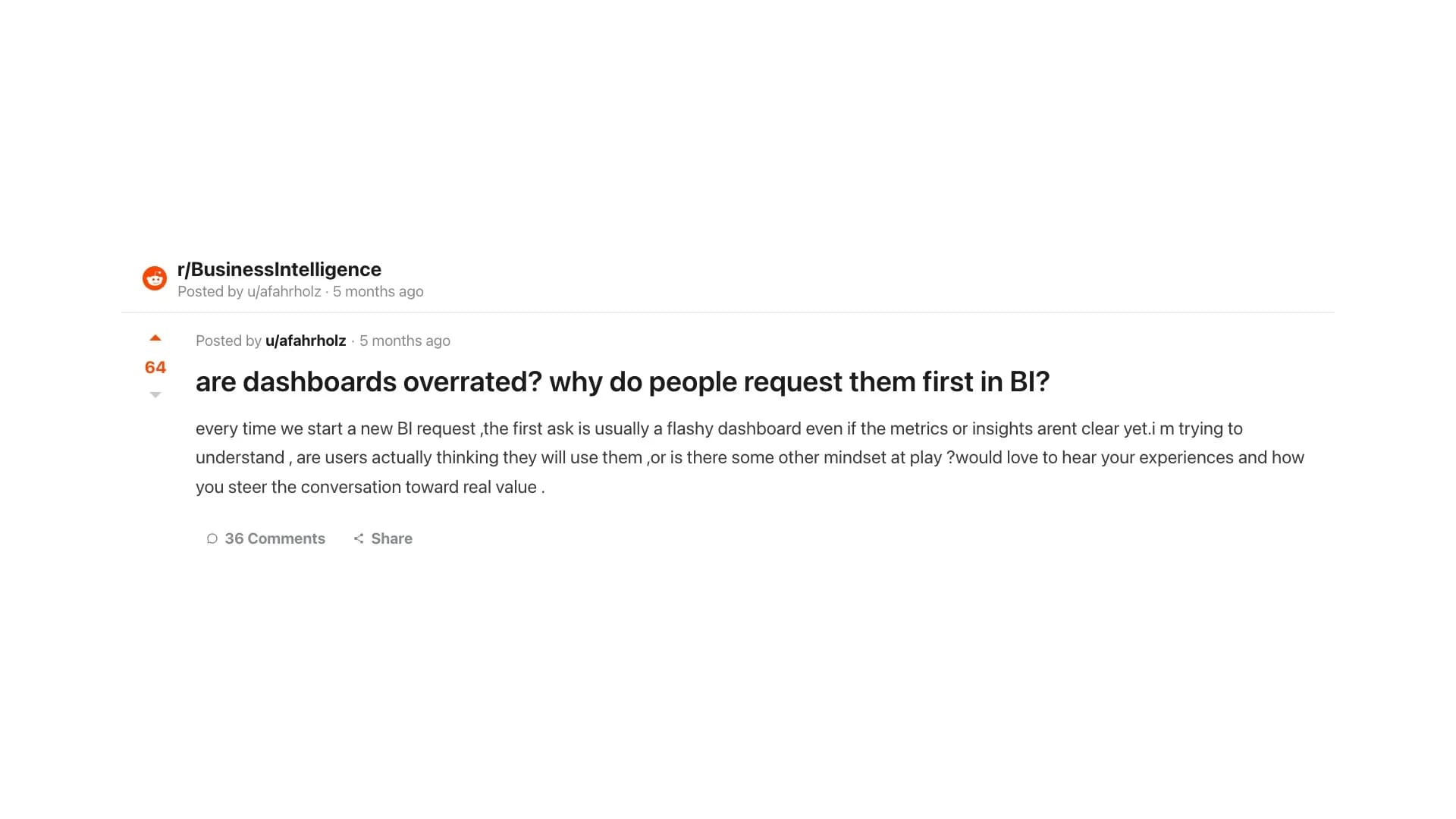
Another BI thread asked a sharper question: are dashboards just overrated? The top reply spelled out the dynamic. Non-technical stakeholders request dashboards because they feel tangible and safe, even when the underlying question isn't defined yet.
The "more dashboards" trap
Marketing's response to this for the last decade has been to ship more dashboards.
Scott Brinker's 2025 martech landscape now counts 15,384 tools, a 100x increase from the 150 tools that existed in 2011. Every one of those tools comes with at least one dashboard. Most come with three.
The result is more data, more silos, more places to look. Salesforce's 10th State of Marketing report, surveying 4,450 marketers in late 2025, found the average marketing organization juggles 7 data sources. 98% of marketers hit data-related barriers to personalization. 75% have adopted AI somewhere in the stack. 84% admit they still ship generic campaigns anyway.
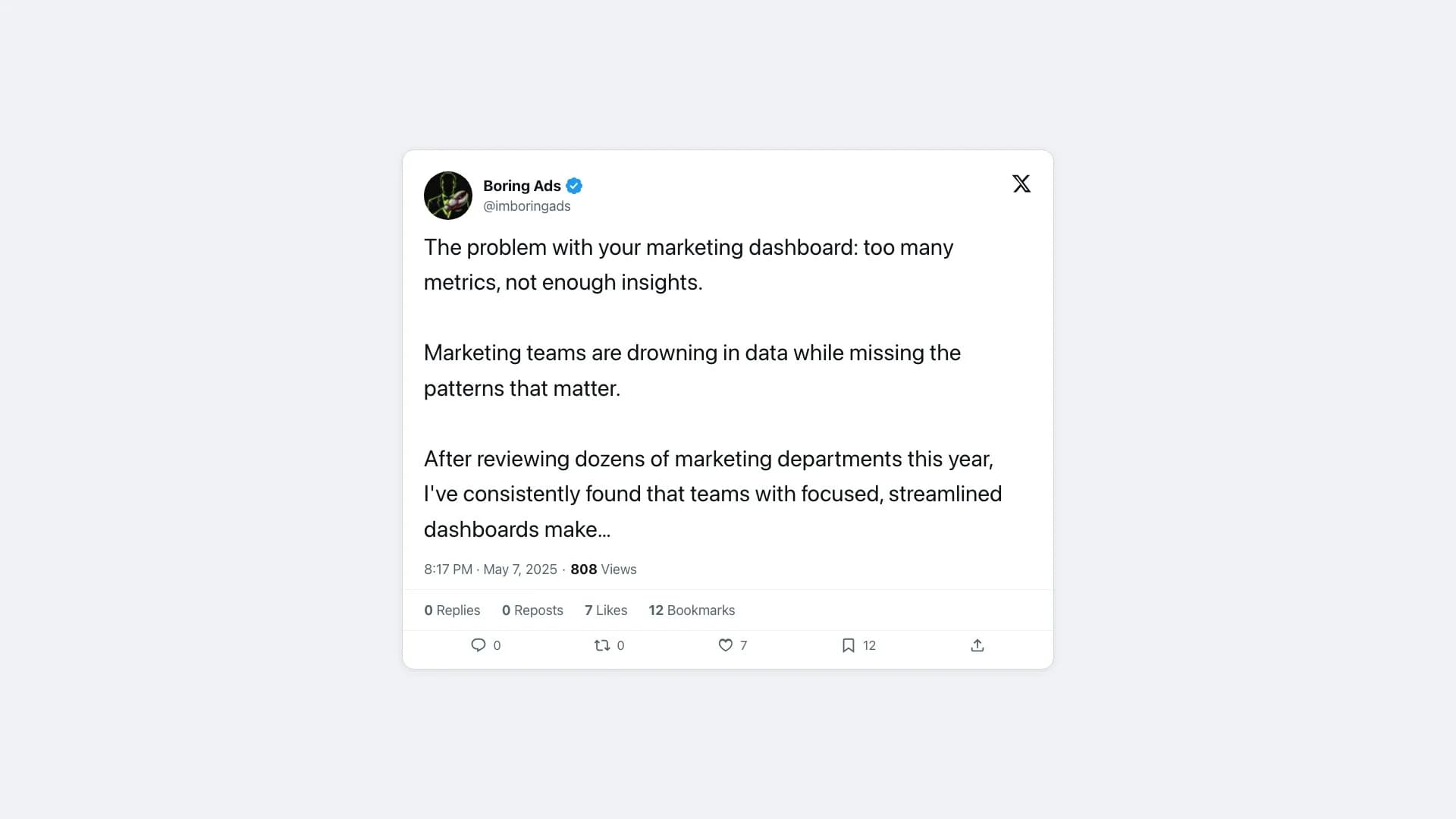
A marketing strategist on X called this out in 2025. "Marketing teams are drowning in data while missing the patterns that matter. Monthly reports become show-and-tell exercises where nobody takes action."
The plumbing problem mostly got solved. The warehouse exists. GA4 exists. HubSpot exists. The connectors between them exist. And on the other side of that infrastructure, the gap is wider than it was.
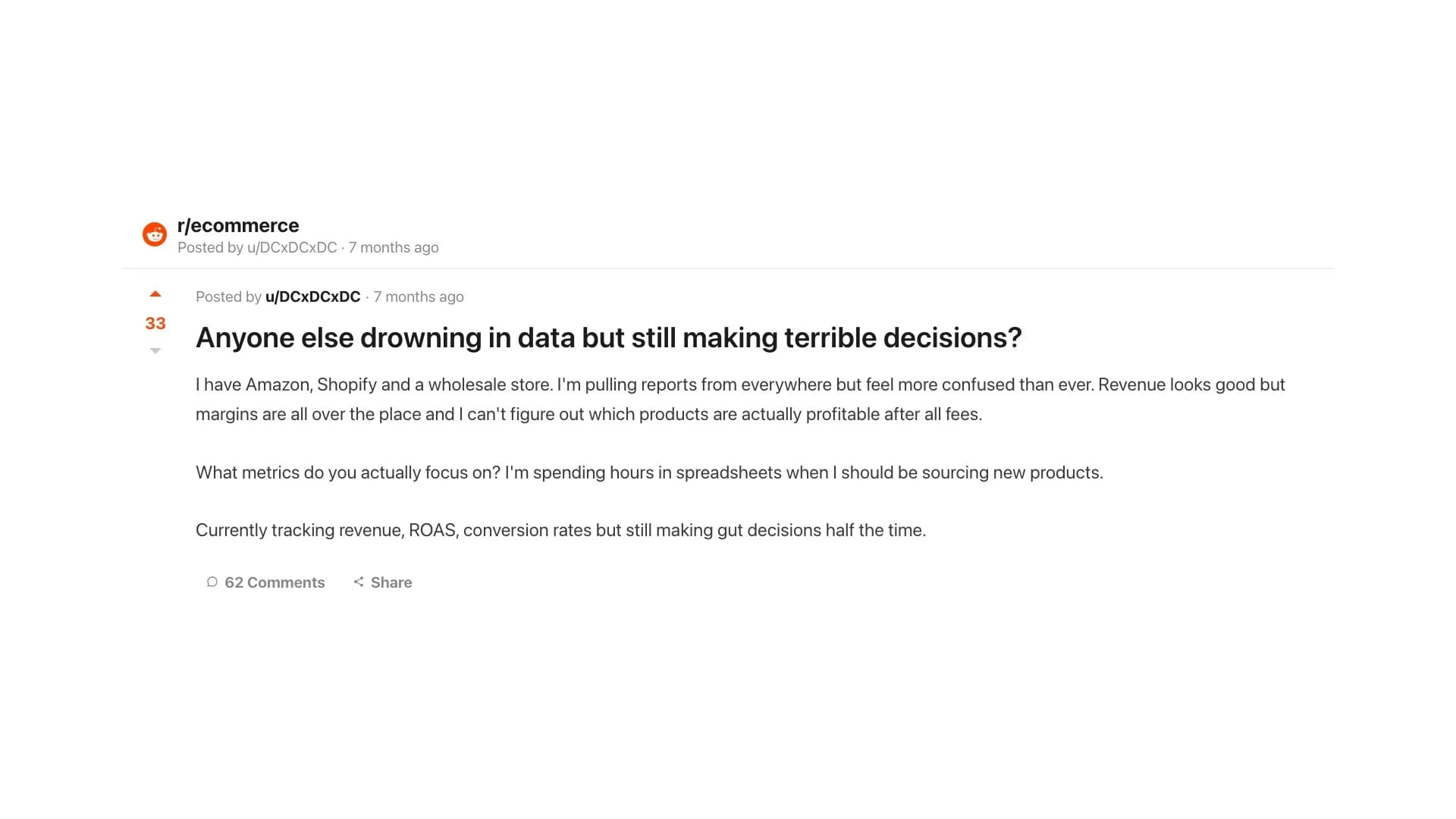
The cleanest e-commerce version of the same frustration showed up on r/ecommerce last month. "You're not drowning in data, you're drowning in noise disguised as certainty. Every platform's dashboard is built to make you feel in control, not to help you decide. All dopamine, zero direction."
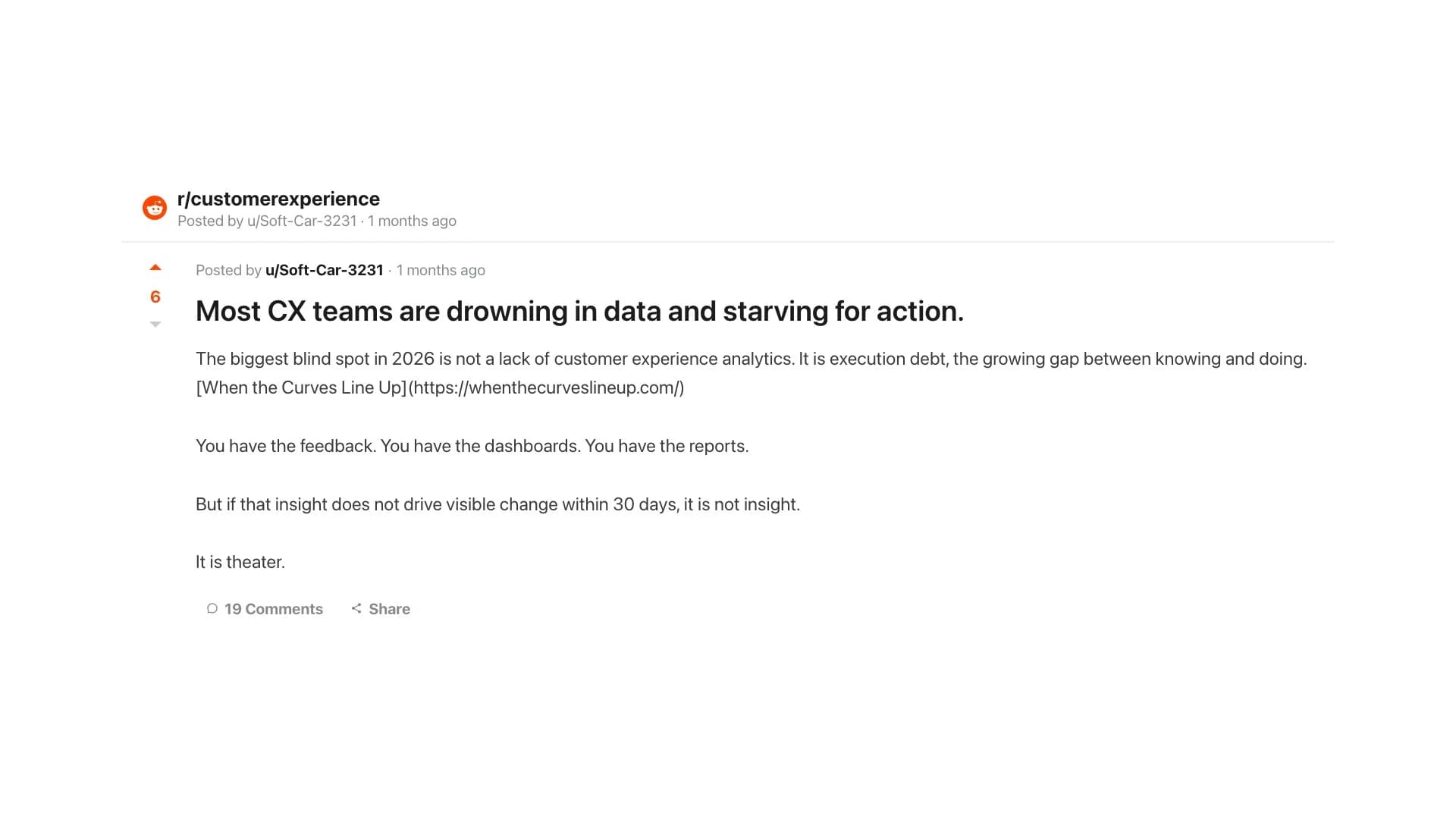
A CX thread crystallized the same complaint in one phrase that should be printed on the wall of every dashboard team. "Data maturity is common now. Execution maturity is still rare." The team called it "reporting theater" instead of a decision system.
Analytics tells you what happened. AI agents tell you what to do next.
Forrester's data maturity framework lays out three tiers. Data-aware orgs collect. Data-driven orgs build dashboards and reports. Insights-driven orgs make recommendations the business actually acts on. Forrester found insights-driven firms are 8.5 times more likely to report 20%+ annual revenue growth than firms still in the beginner stage.
Dashboards alone keep you on the second rung. The third rung is something else. It looks across sources, frames the question for the human, and proposes the next action.
This is the work AI agents are designed to do.
MIT Sloan, citing a Spring 2025 MIT SMR and BCG survey, reported that 35% of surveyed organizations had already deployed AI agents by 2023, with another 44% planning to in short order. Sinan Aral, the MIT professor running the work, said it plainly. "The agentic AI age is already here. We have agents deployed at scale in the economy to perform all kinds of tasks."
Gartner's August 2025 forecast puts a number on the trajectory. By end of 2026, 40% of enterprise applications will embed task-specific AI agents, up from less than 5% in 2025. The decision layer is the next platform.
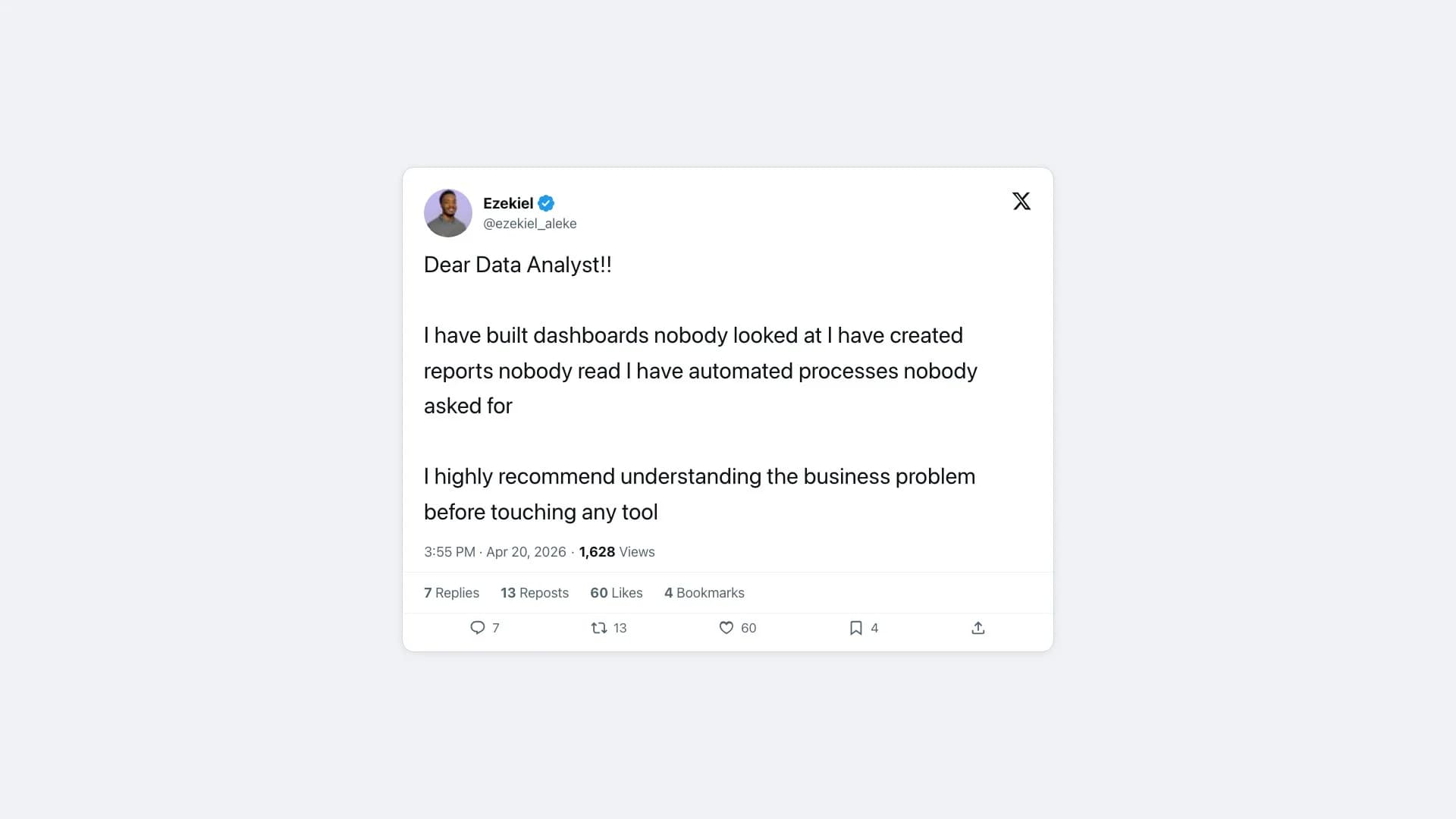
A data analyst wrote what most analysts won't, on X. "I have built dashboards nobody looked at. I have created reports nobody read. I have automated processes nobody asked for. I highly recommend understanding the business problem before touching any tool." That's the role pivot happening right now. From making the artifact, to closing the loop.
What the decision layer actually looks like
A practitioner on r/MarketingAutomation described what their team built when they got tired of building dashboards. "Decision-level insights beat metric-level reports. The goal was 'what should I do next,' not 'what's my CTR.'"
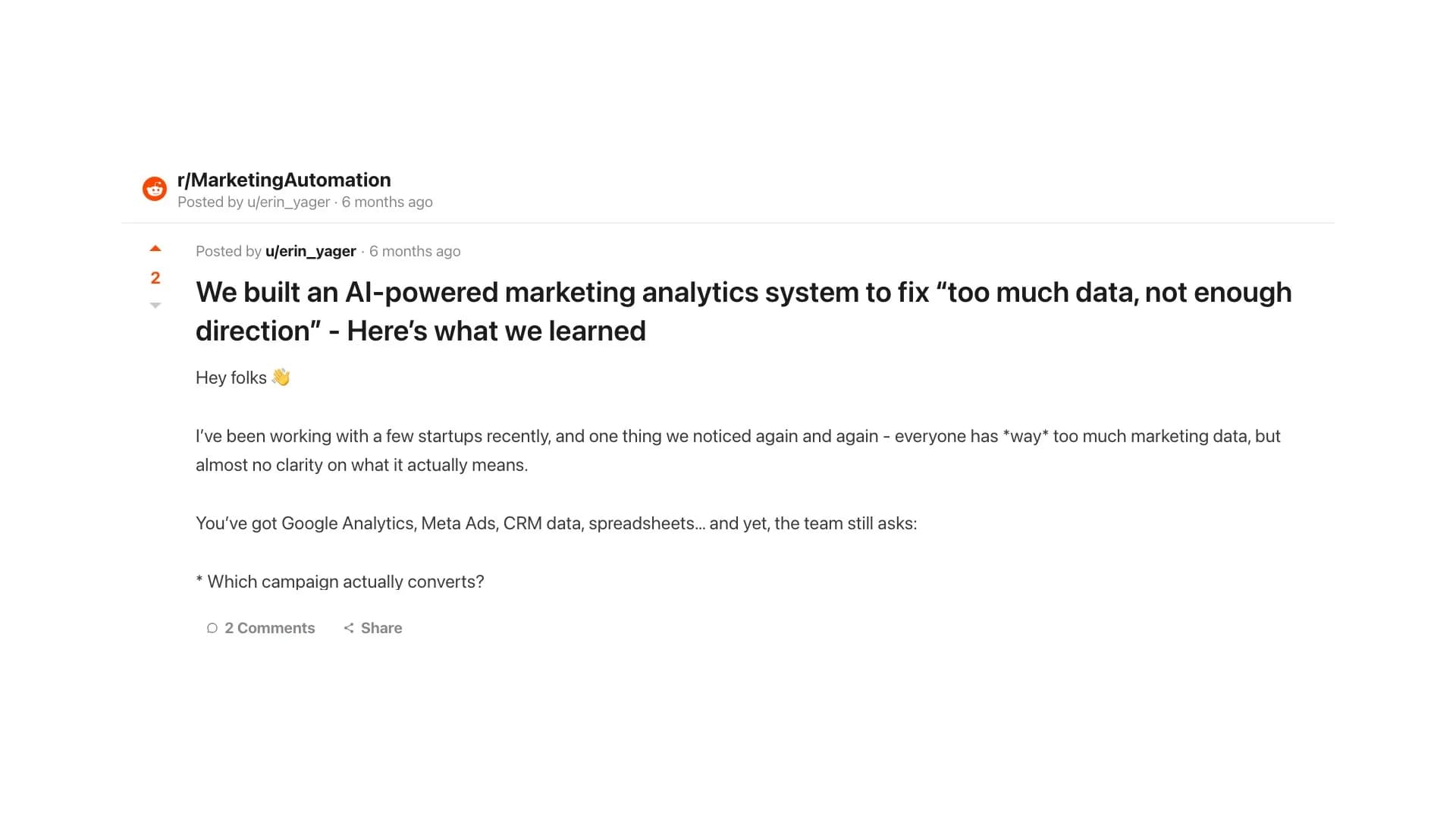
That's the shape. Not a chart. Not a dashboard with one more filter. A short answer to the next question, with the work shown.
In practice, the decision layer does four things a dashboard cannot.
- It reads across sources at query time. GA4, HubSpot, Stripe, Google Ads, Meta Ads, and the warehouse all in the same answer, joined on email or customer_id without a pre-built model.
- It recommends an action, not a chart. "CPA on Meta is up 28% week over week. The biggest contributor is the new audience test on campaign X. Pause it or reduce budget by 40%."
- It runs on a schedule, not on a click. Weekly reports get drafted and posted to Slack before the meeting. Daily anomaly checks run while you sleep.
- It shows the underlying query. Every recommendation comes with the SQL or API call exposed, so a human can audit before approving. This is what makes the decision layer trustworthy. Nothing is hidden behind the chat box.
This is what we mean when we talk about marketing AI agents that read your data directly. Not a chatbot bolted to a dashboard. Not a co-pilot inside one tool. A separate layer above the stack.
The dashboards-aren't-dead crowd is right
Both Tableau and Hex have published their own response to this thesis in the last six months. Tableau's December 2025 post argued that no executive will approve a $10M budget shift based on output they cannot personally verify. Hex's February 2026 essay called dashboards "demoted, not dead."
They are both right.
The decision layer does not replace the verification layer. It sits above it. Agents propose. Dashboards confirm. Humans approve. The shift is in which layer drives the decision and which layer audits it, not the death of either.
What changes is the time spent. Today, the dashboard is the first thing the marketer opens, scans, interprets, debates, and decides on. Tomorrow, the agent posts the recommendation, the dashboard is open for fifteen seconds to verify, and the meeting is twenty minutes shorter.
But most marketing teams aren't even instrumented yet
The harder counter-argument is that most marketing teams aren't drowning in data, they are missing it.
Salesforce's same State of Marketing report puts the number of marketers fully satisfied with their ability to unify customer data sources at 31%. That's a real constraint. If your customer ID lives in five tools and none of them agree, no decision layer can build a clean recommendation.
This is real. It is also segmented.
For mid-market and enterprise marketing teams that already have a warehouse, where the GA4 export hits BigQuery and the HubSpot data lives in Snowflake and the Stripe charges land in Postgres, the bottleneck has moved. The plumbing exists. What is missing is the layer that turns it into action.
For under-instrumented teams, the answer is also not "build another dashboard." The answer is to stand up a warehouse-backed agent that connects to what you already have, even if that is only two tools, and grow from there. The decision layer is cheaper to add than a fresh dashboard practice.
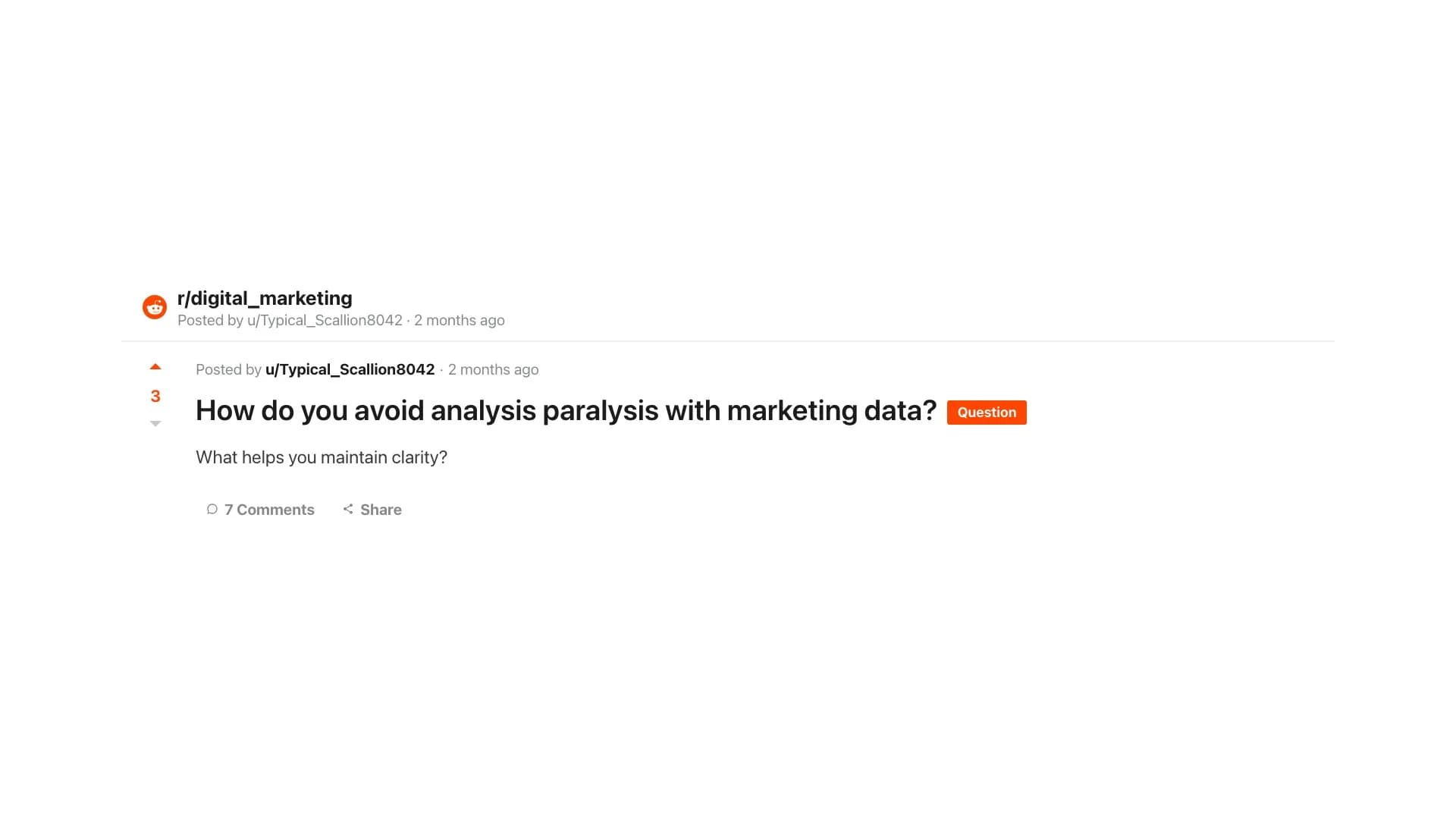
This is also the trap underneath the analysis-paralysis complaints. r/digital_marketing had a thread last month with a sharp framing. Analysis paralysis is rarely a data problem. It is the absence of a decision framework that turns the data into a yes or no.
The Gartner hype cycle warning
The last honest counter-argument is the loudest. Gartner predicted in June 2025 that more than 40% of agentic AI projects will be canceled by end of 2027, citing escalating costs, unclear business value, and inadequate risk controls. Anushree Verma, the Gartner analyst, was even sharper. "Gartner estimates only about 130 of the thousands of agentic AI vendors are real."
She is right. Most agent products on the market today are demos. A lot of them will not survive 2027.
What survives is the bounded case. Not a fully autonomous agent making spend decisions without review. A recommendation agent that proposes the change, exposes the query, runs on the schedule, and sits inside the verification layer the marketer already uses. Benn Stancil, writing on his Substack, framed the trust gap honestly. "The far bigger problem seems to be that there is no way to know if the work is right."
The way to know is to expose the work. Read-only access. Every query shown. Every API call logged. A human in the loop for any decision that moves money. The decision layer that wins isn't the most autonomous one. It is the most auditable.
What this looks like with Sequel
Sequel is the marketing AI agent we built for the decision layer.
It is warehouse-native and channel-agnostic. It connects to GA4, HubSpot, Stripe, Google Ads, Meta Ads, Mixpanel, Amplitude, BigQuery, Snowflake, Redshift, ClickHouse, Postgres, MySQL, and more. You ask in plain English. It reaches across the sources it needs, joins them at query time, and returns the answer with the underlying query exposed. It runs read-only by default. Every query and API call is shown before execution.

It also lives where you work. Sequel ships an MCP server that brings the same querying into Claude Code, Cursor, ChatGPT, and any other MCP-aware client. If you use Claude Code, the install is one command.
claude mcp add --transport http sequel https://api.sequel.sh/mcp \
  --header "Authorization: Bearer sql_your_api_key"
Claude Code now has read-only access to every source connected to your Sequel workspace. Ask the cross-source question. Get the answer. See the query. For Cursor, ChatGPT, or another client, see the full Sequel MCP server guide.
If you are evaluating, the complete guide to AI agents for marketing analytics covers the category from the top. The comparison of 25 marketing AI agents in 2026 covers the alternatives. And AI data analyst vs BI tools explains the verification-versus-decision-layer shift in more depth.
The next move
The decision problem is not new. The Gartner stat is from 2022. The Reddit threads go back further. What is new is that the tools to close the gap finally exist.
Marketing teams that wait for the next "more data" project will be in the same place in 2027 they are today. The teams that win the next twelve months will be the ones that stop adding dashboards and start adding the layer above them.
Get started free and put your hardest marketing question to it.