
TL;DR
| Dashboards | AI agents |
|---|---|
| Built for humans | Built for outcomes |
| Describe what happened | Prescribe what to do |
| Require interpretation | Deliver decisions |
| Pull model (you go look) | Push model (it tells you) |
| Output is a chart | Output is an action |
| Reports | Recommendations |
| Verification layer | Decision layer |
Jason Lemkin, founder of SaaStr, posted a thread on X in March 2026 about how he runs a $10M revenue company with twenty-plus AI agents. The line that stuck. "The Salesforce data doesn't sit in a dashboard waiting for someone to open a tab. Two executive-level agents read it continuously, reason over it, and push the answer to the team."
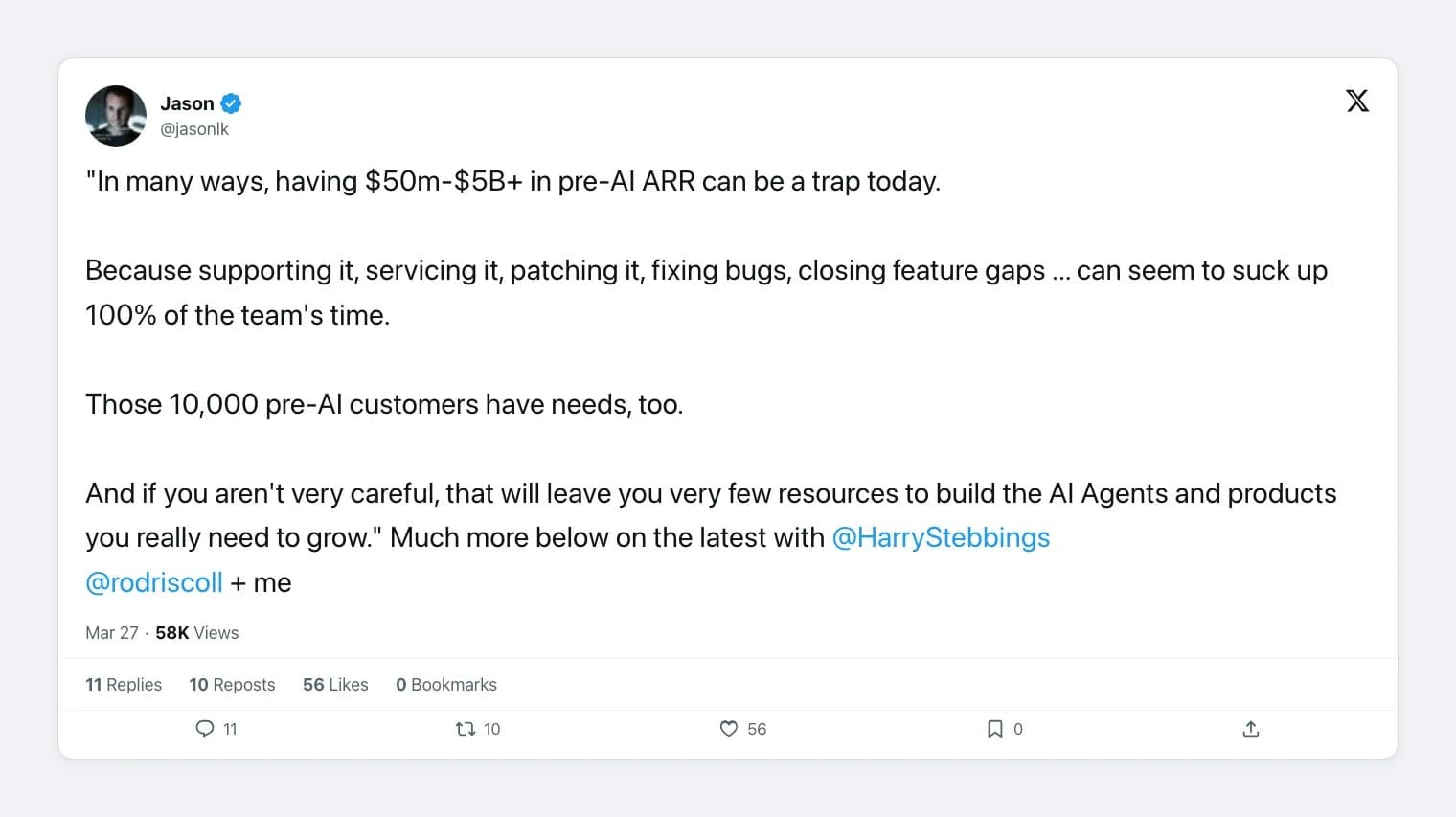
That single sentence reframes what a marketing analytics stack is for. The dashboard isn't the product. The decision is. Slot 1 of this series argued that marketing's bottleneck moved from data to decisions. This piece picks up where that one ended. Why the dashboard format itself stops short, and what the next layer looks like.
Why dashboards exist at all
Dashboards are not natural. They are a designed format with a specific origin.
The term "business intelligence," in the sense the industry uses today, was coined by Howard Dresner in 1989 at Gartner Group. The phrase already existed. IBM researcher H.P. Luhn used "Business Intelligence" in a 1958 paper, but Luhn's version described a push system for distributing "action points" to relevant readers. Not a pull dashboard. The pull-based dashboard came later, optimized for a human eye scanning a static report.
The format hardened in the 1980s with Executive Information Systems. EIS gave senior leaders simplified access to KPIs. The metaphor was a car dashboard. Gauges, dials, stoplights, a quick scan before the meeting. Stephen Few wrote the canonical guide on this, Information Dashboard Design, where he frames the dashboard as a perception artifact. Edward Tufte's own notebook thread on executive dashboards attacks the gauges-and-stoplights metaphor as fundamentally limited.
The format was built for what eyes can scan. Not for what decisions need.
That distinction is the whole story. A chart is good at showing a human what happened. It is not good at telling that human what to do. And it is even worse at telling an autonomous system what to do, because an autonomous system doesn't need pixels. It needs a recommendation.
The "so what" wall
Ask any BI engineer or marketing analyst what happens after they ship a dashboard. The answer is the same in every subreddit. The chart hits a wall called "so what."
The clearest version is an r/dataengineering thread on live data. One practitioner cuts straight to it. "Overall, dashboards are....stupid. Business is not interested in dashboards, they are interested in the thing after the dashboard. Next steps to fix what the dashboard says."
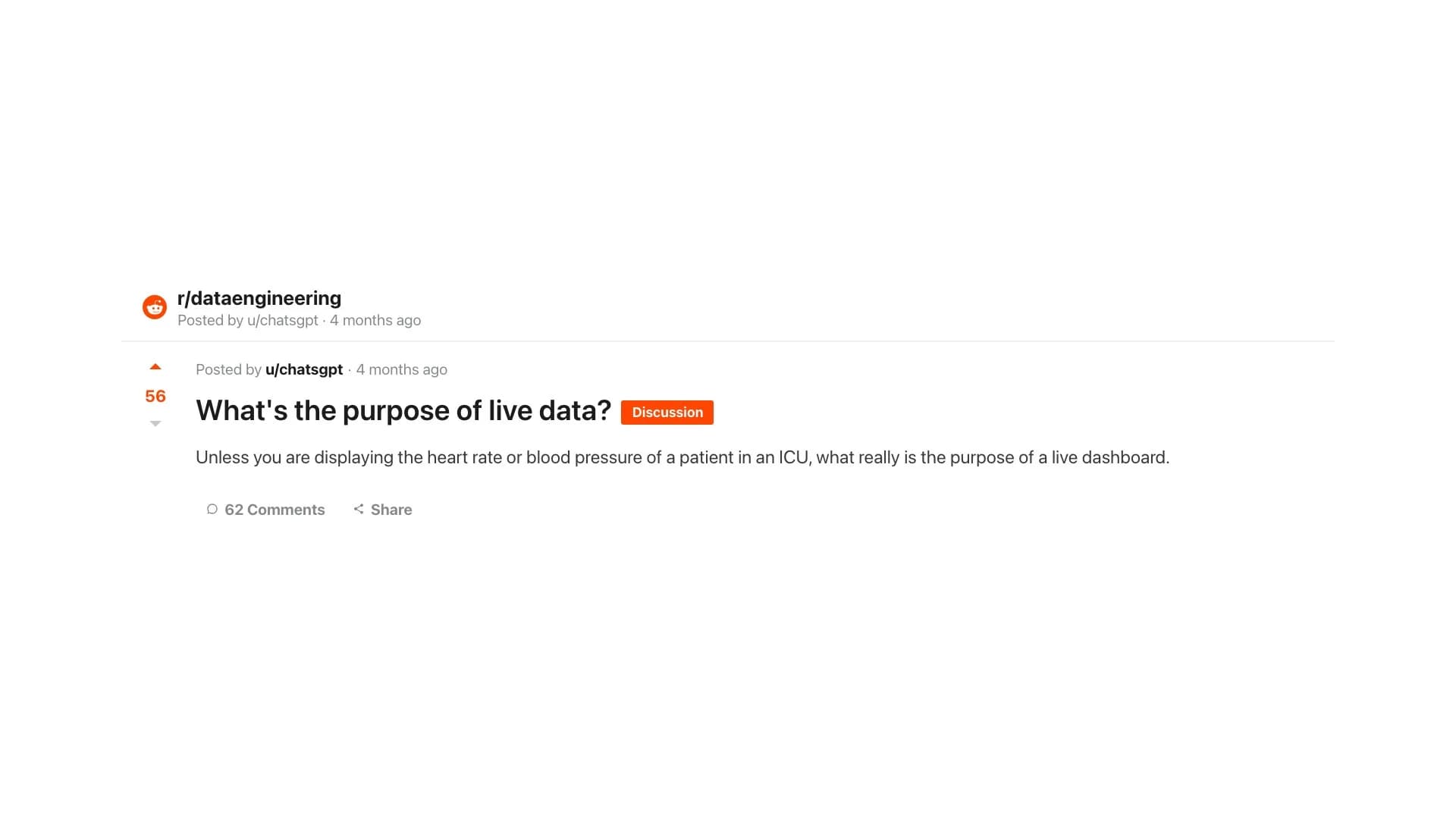
This isn't anti-dashboard sentiment. It is a structural observation. The chart answers one question. The business asks four. Another thread on r/analytics puts the structural limit even more plainly. "Dashboards are static, but business questions come in pairs. What changed, why, where, so what. Dashboards answer the first, then stall."
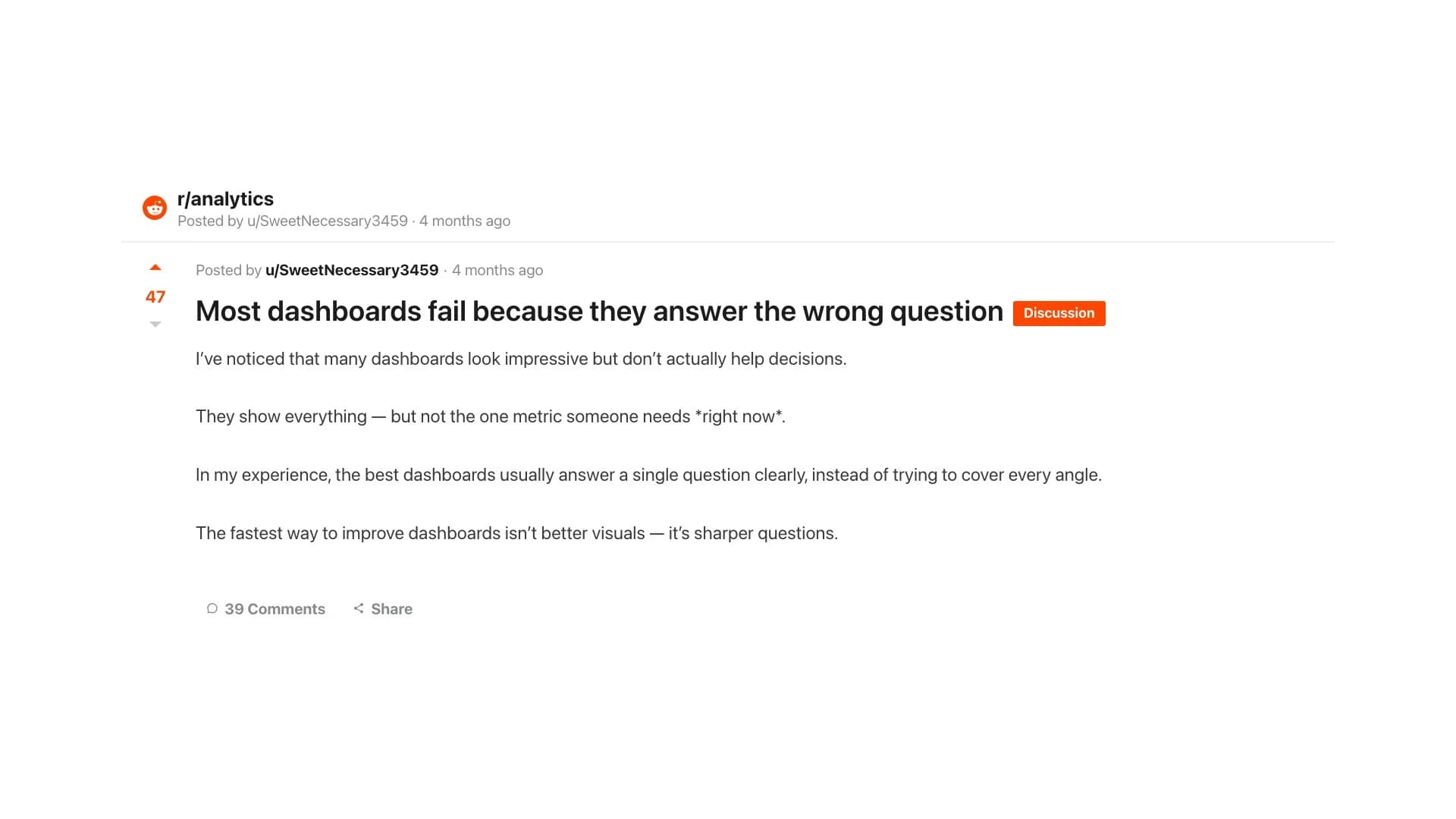
That stall is the gap the agent layer fills. The dashboard isn't wrong. It is just incomplete. Every dashboard ends a thought right where the business needs a follow-up.
The dashboard-fatigue framing is now common enough that r/analytics has a thread titled exactly that. The most-upvoted comment in that thread captures the desired alternative. "Half the time people don't need more charts. They need one place that explains what changed, why it matters, and what to check next."
That is a recommendation. Not a chart.
What recommendations look like in production
Recommendation engines are not theoretical. They are how most of the consumer internet already runs.
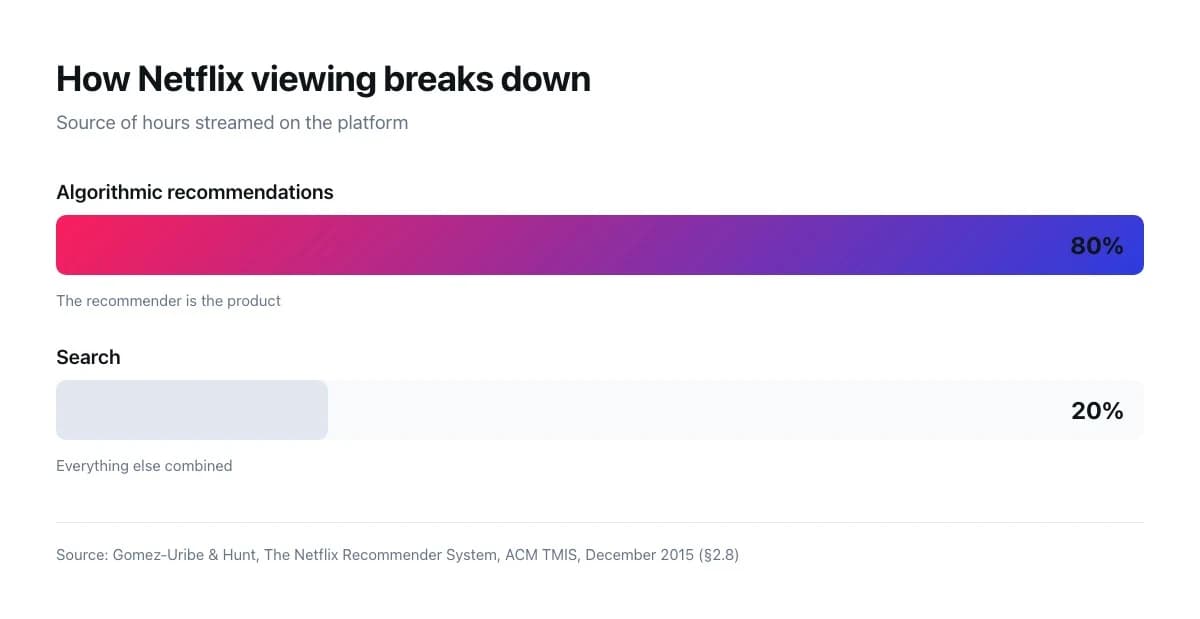
Netflix engineers Carlos Gomez-Uribe and Neil Hunt published a paper in 2015 on the Netflix recommender. The headline number from §2.8 of that paper. About 80% of hours streamed on Netflix come from algorithmic recommendations. The other 20% come from search. The recommender is the product.
McKinsey's 2013 retail report "How retailers can keep up with consumers" put the same lens on commerce. 35% of what consumers buy on Amazon and 75% of what they watch on Netflix already come from algorithmic recommendations. YouTube has gone further. The YouTube official blog reported in 2021 that recommendations drive more viewership than channel subscriptions or search combined. The system processes 80 billion signals per day.
Spotify Discover Weekly is the format made human. The Spotify Engineering blog described the launch as delivering 75 million unique mixtapes every Monday. Every user gets a personal one. The output is a list of songs, not a dashboard about songs.
The same pattern works in marketing. Persado has been running the test at scale for years. The Persado x JPMorgan Chase pilot saw click-through rates lift up to 450% versus human-written copy, with most variants landing between 50% and 200% lift. JPMorgan's then-CMO Kristin Lemkau put her name on the deal.
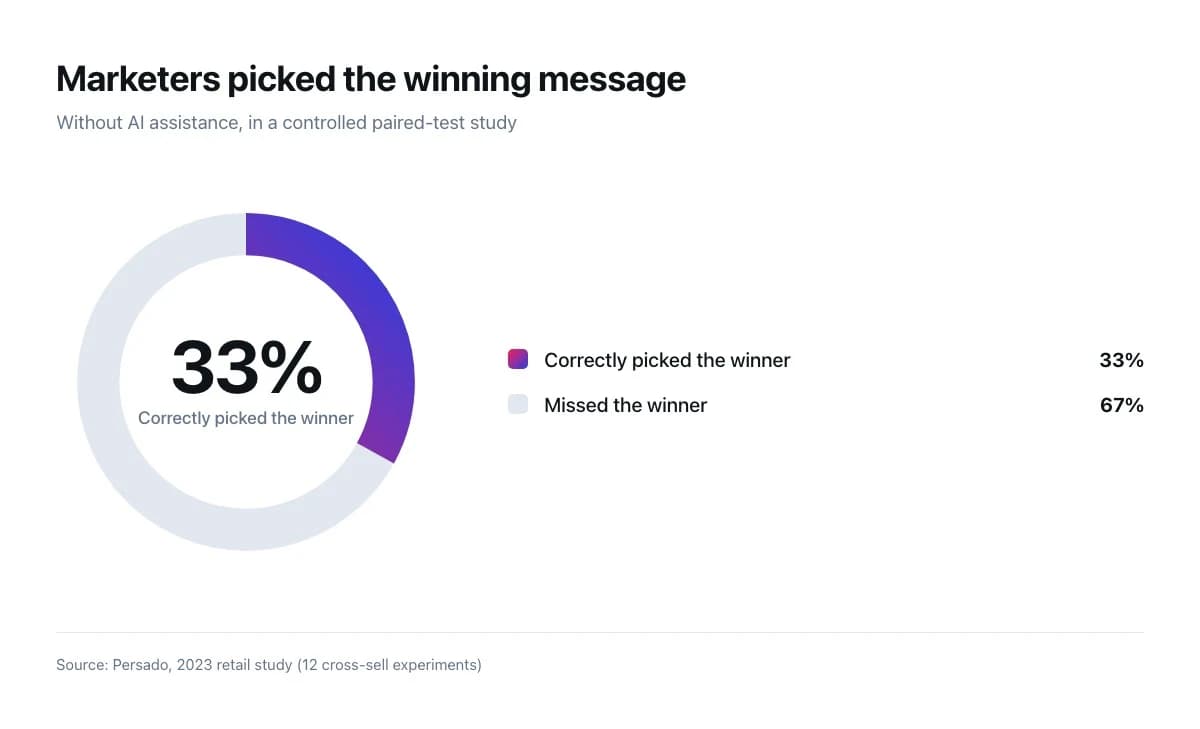
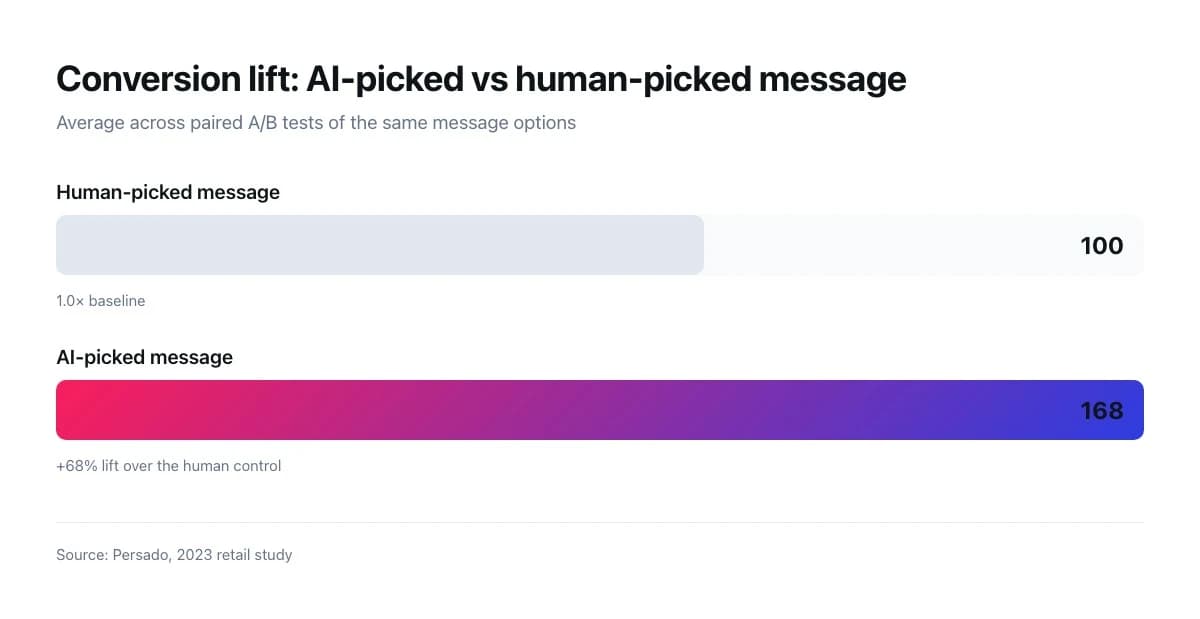
The most thesis-aligned number is from Persado's 2023 retail study. Marketers picked the highest-converting message correctly only 33% of the time without AI assistance. The AI-picked winner produced a 68% uplift over the human control. The skill being augmented is judgment, not effort.
Persado x Ally Financial drove a 57% lift in new Ally Invest accounts, a 2x CTR lift, and 16% conversion lift across 12 cross-sell experiments. Named exec on record. These are recommendations, not reports.
McKinsey's broader 2021 personalization research puts the average revenue lift from personalization at 10% to 15%, with a range of 5% to 25%. Faster-growing companies generate 40% more of their revenue from personalization than slower peers. Recommendations are a growth-rate variable, not a UX feature.
The shift from describing to prescribing
The analyst-firm consensus has moved. Gartner's data and analytics overview frames the maturity ladder as descriptive, diagnostic, predictive, prescriptive. Prescriptive is the top rung. As Gartner puts it, prescriptive "aims to drive action."
Forrester's Mike Gualtieri defined prescriptive analytics the same way. "Prescriptive analytics is about using data and analytics to improve decisions and therefore the effectiveness of actions. Isn't that what all analytics should be about?" That is the entire bet of this article in one rhetorical question.
McKinsey's Data-Driven Enterprise of 2025 projects forward. Decisions get automated. Employees focus on the human work. McKinsey's earlier Periscope white paper put it more pointedly. Same-store sales rise 2% to 5% when prescriptive analytics put real recommendations into category managers' hands.
The category has a name now. Cassie Kozyrkov, Google's former Chief Decision Scientist, coined "decision intelligence" and defined it as "the discipline of turning information into better actions at any scale." That's the operating definition. Information is the input. Action is the output. Everything in between has to earn its place.
The clearest signal that this is now a buyable software category. Gartner is upgrading Decision Intelligence from a Market Guide to a full Magic Quadrant on December 3, 2025. Market Guides cover emerging categories. Magic Quadrants cover established ones. The promotion is the proof point.
From pull to push
The dashboard is pull. You log in, you go look. The decision layer is push. The recommendation finds you.
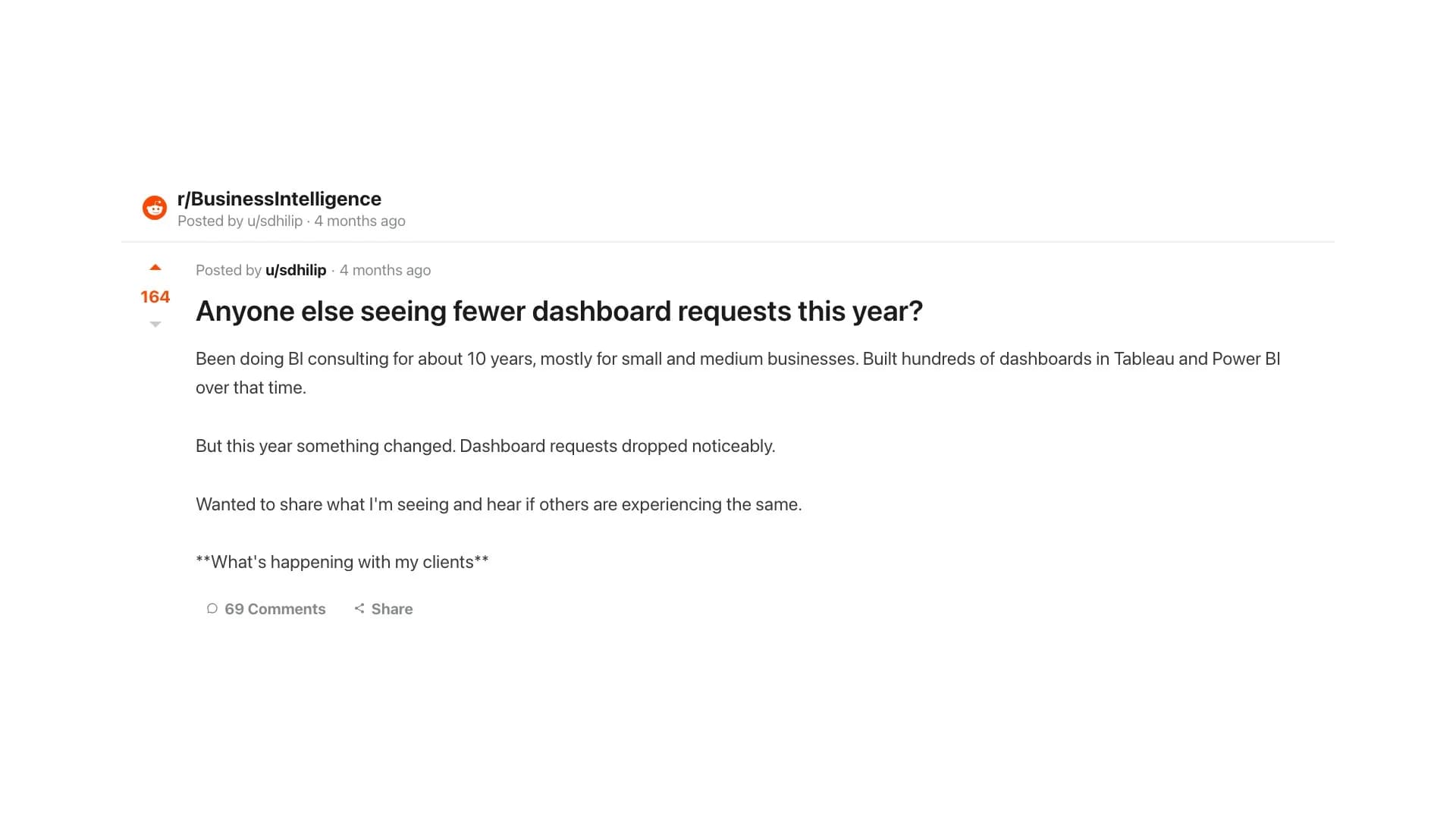
A 10-year BI consultant on r/BusinessIntelligence noted the shift in their book of work. Fewer dashboard requests this year. More agent-style work. "It feels like insights are moving from pull, log in, find the report, to push, data comes to you. Leadership doesn't want another login. They want key numbers delivered before their morning coffee."
A separate BI thread, on automated Slack reporting, spells out the delivery channels. "There is a general tendency to just throw dashboards at problems but slowly everyone is realizing that this is not working. Data should come to the people, not the other way around."
This is the same idea CRM teams already articulate. An r/CRM thread on the biggest value of LLMs ends with one practitioner saying the quiet part out loud. "Things like 'summarize this account or campaign history and tell me next best action' feel way more useful than most AI demos."
Adobe's 2026 AI and Digital Trends Report, surveying 3,000 executives and 4,000 customers in late 2025, makes the forward bet concrete. 78% of organizations expect agentic AI to handle "about half" or more of customer-support interactions within 18 months. 58% expect AI agents to support sales with autonomous product recommendations or lead qualification. The push side is where the next eighteen months of spend goes.
The dashboards-aren't-dead crowd has a real point
The honest counter to this thesis is not "dashboards work." It is "you can't audit a recommendation."
ThoughtSpot's 2026 guide on AI-generated insights lays out the verification problem. "Many AI tools generate answers without showing their work, making verification impossible. Modern AI systems don't just get things wrong. They do it with the same confidence as if they were right." The piece cites Deloitte data that 47% of leaders have made a major business decision based on an AI hallucination. That is the credibility tax recommendation agents inherit by default.
The same concern shows up in finance. Improvado's CFO accountability framework lays out the audit chain. The CFO quotes a number off an AI dashboard at a board meeting. Six weeks later someone runs the math by hand. The number is wrong by 22%. The CFO signed the attestation, the attestation relied on the AI output, the AI output was wrong. The chain ends at the CFO's desk.
The right response is concession plus design. Recommendations have to ship with receipts. The query, the data slice, the confidence, all exposed for the human to audit before they act. Glass-box prescription, not opaque agents. This is exactly the line that separates a serious agent from a chatbot bolted to a dashboard.
The skepticism is visible inside vendor categories too. The Salesforce subreddit has a thread titled "Why am I not impressed by anything Einstein AI?", where one developer writes. "I don't understand why we need to predict things when we can achieve the same with certainty? I am looking at the predictions and thinking, I can do with flows or apex to get the same result if not more accurate." That is a fair shot at first-wave recommendation engines. They were predictions without traceable reasoning.
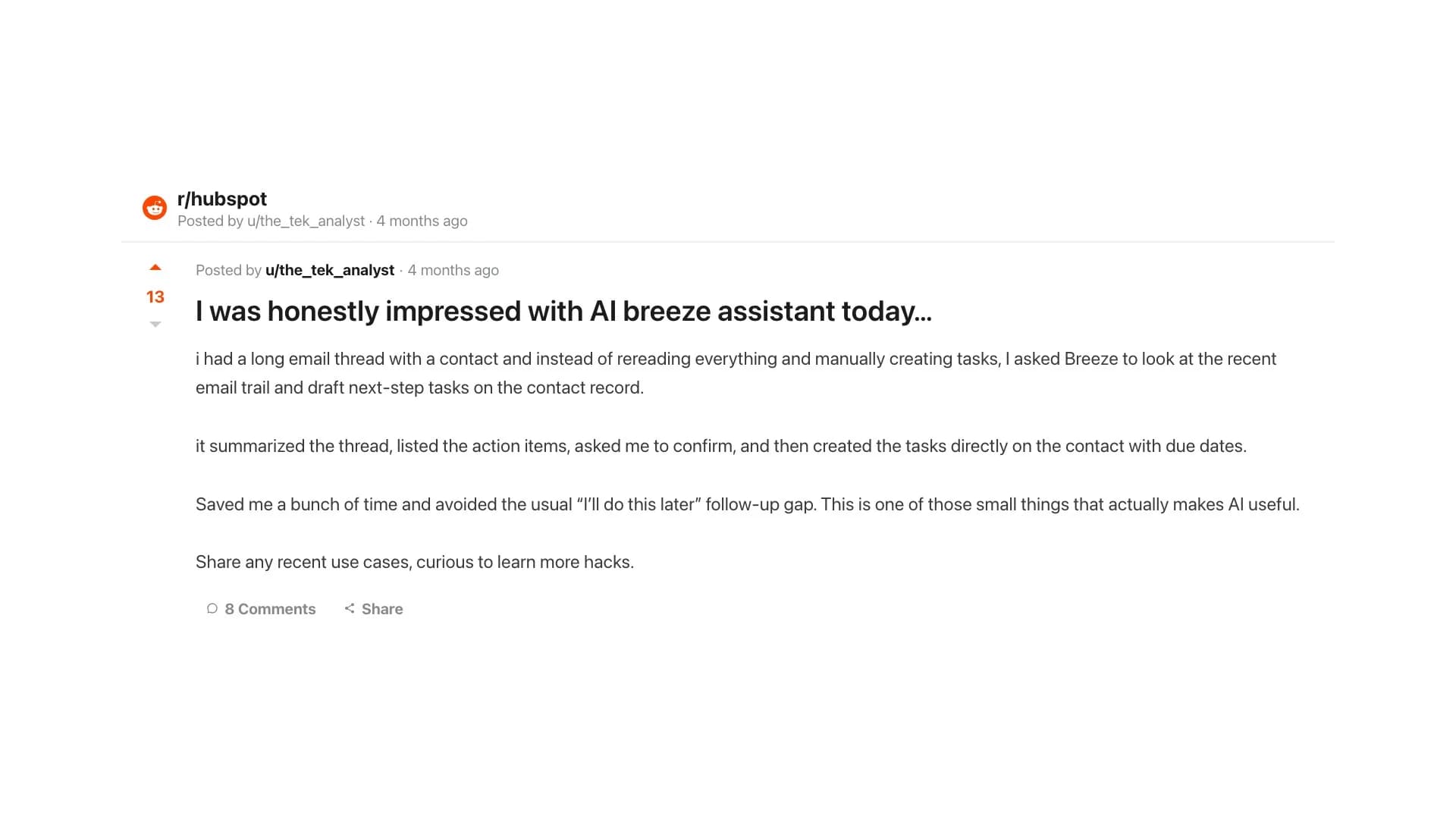
The newer wave reads differently. An r/hubspot thread on Breeze AI describes a concrete next-best-action loop that worked. "I asked Breeze to look at the recent email trail and draft next-step tasks on the contact record. It summarized the thread, listed the action items, asked me to confirm, and then created the tasks directly on the contact with due dates." Recommend, confirm, act. Receipts visible. This is the shape the category is converging on.
The other three counters in one paragraph each
Kozyrkov's "context beats orders" is the most important steelman. Marketers don't want a one-line prescription. They want to understand the move. Her writing on AI-first decision making frames the question as which decisions a model can make, which still need a person, and which need a rewritten process. The honest answer is the agent surfaces the recommendation alongside the causal chain. The counterfactual, the confidence interval, what data it used. Context is the agent's job, not the human's.
Notification fatigue is real. Microsoft's 2025 Work Trend Index found knowledge workers are interrupted every two minutes on average, with 275 pings per workday. 48% of employees and 52% of leaders say work feels chaotic and fragmented. Push-based agents land in the same Slack channels that already produce that chaos. The fix is not more agents. It is fewer, better signals. Collapse 47 dashboards into one to three recommendations per role per week with strict confidence thresholds. Anything less disciplined just adds to the noise.
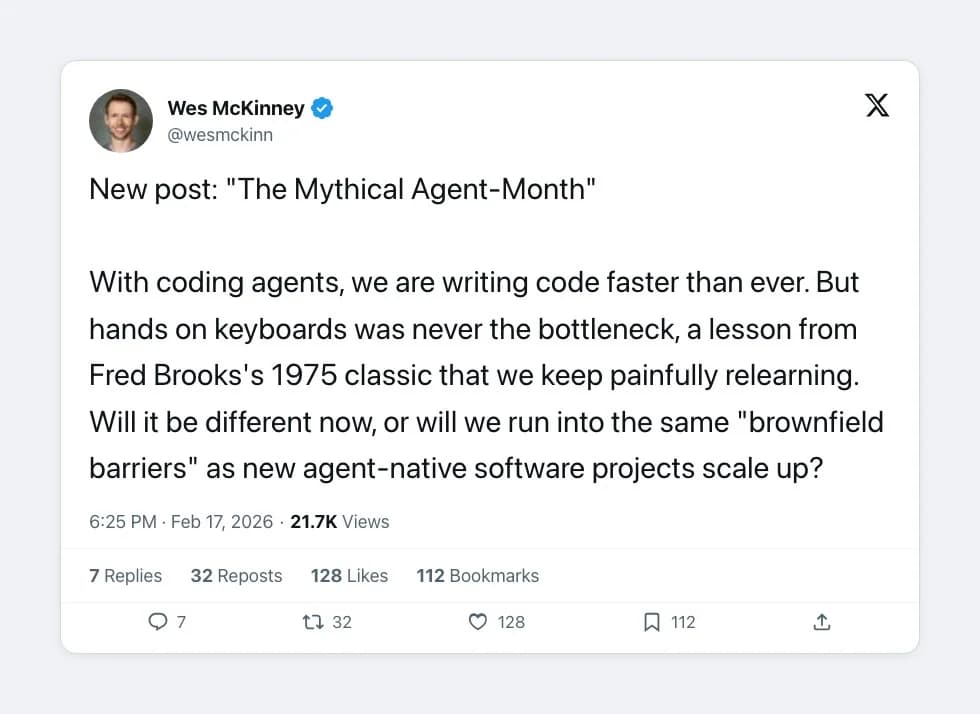
Wes McKinney, who built Pandas, made the broader point on X. "With coding agents, we are writing code faster than ever. But hands on keyboards was never the bottleneck." The same logic applies to dashboards. Building more of them was never the bottleneck. Acting on what they showed was.
The "just collaborative filtering rebranded" critique deserves one sentence. The algorithmic lineage is twenty years old. What's new is the closed loop between recommendation, action, and outcome inside the same system, fed by a warehouse-native data layer that can reach across marketing sources instead of one product catalog.
What this looks like with Sequel
Sequel is the warehouse-native, channel-agnostic marketing AI agent built for this layer.
It connects to GA4, HubSpot, Stripe, Google Ads, Meta Ads, Mixpanel, Amplitude, BigQuery, Snowflake, Redshift, ClickHouse, Postgres, MySQL, and more. You ask in plain English. It reaches across the sources it needs, joins them at query time, and returns the answer with the underlying query exposed. It runs read-only by default. Every query and API call is shown before execution. The recommendation always ships with the receipts attached.
It also lives where you work. Sequel ships an MCP server that brings the same querying into Claude Code, Cursor, ChatGPT, and any other MCP-aware client. If you use Claude Code, the install is one command.
claude mcp add --transport http sequel https://api.sequel.sh/mcp \
  --header "Authorization: Bearer sql_your_api_key"
Claude Code now has read-only access to every source connected to your Sequel workspace. Ask a cross-source question. Get the answer. See the query. For Cursor, ChatGPT, or another client, see the full Sequel MCP server guide.
If you are evaluating the category, the complete guide to AI agents for marketing analytics covers it from the top. The comparison of 25 marketing AI agents in 2026 is the alternatives walkthrough. And the previous piece in this series sets up why the decision layer exists at all.
The next move
The dashboard format was built for a 1980s executive scanning a paper report. It still works for that. It does not work as the place where decisions get made.
The teams that win the next 18 months will be the ones who stop adding dashboards and start adding the layer above them. Get started free and ask the agent your hardest cross-source marketing question.