
AI2SQL vs Sequel: Which AI Data Analyst Is Right for Your Team?
AI2SQL built a clear niche: take a plain-English question, hand back a SQL query, done. At $9/month it is the cheapest entry into AI-assisted SQL in the market, and for a solo developer who just wants query suggestions, that value proposition is real.
But most teams do not stop at a query. They want a chart. They want an answer. They want their analyst tool to understand what "monthly active users" means in the context of their specific data model, not just generate syntactically valid SQL and leave the rest to them.
That is where Sequel starts. It generates the query, runs it against your database, renders the result as a chart automatically, and improves its understanding of your schema and business logic each time it works. The two products occupy the same category label - "AI and SQL" - but they are aimed at fundamentally different problems.
This comparison walks through both honestly so you can pick the one that actually fits your workflow.
Quick comparison
| Feature | AI2SQL | Sequel |
|---|---|---|
| Starting price (As of April 2026) | $9/month | Free (3 seats) |
| SQL generation | Yes | Yes |
| Runs queries automatically | No | Yes |
| Auto-renders charts | No | Yes |
| Multi-source joins | No | Yes |
| Agent learning over time | No | Yes |
| Team collaboration | Limited | Yes (up to 25 seats on Startup) |
| Database connectors (free tier) | No (Pro+ only) | Yes (1 source on Free) |
| Free tier | No (7-day trial only) | Yes |
| Vendor stability | Solo founder, bootstrapped | Bootstrapped, actively developed |
What is AI2SQL?
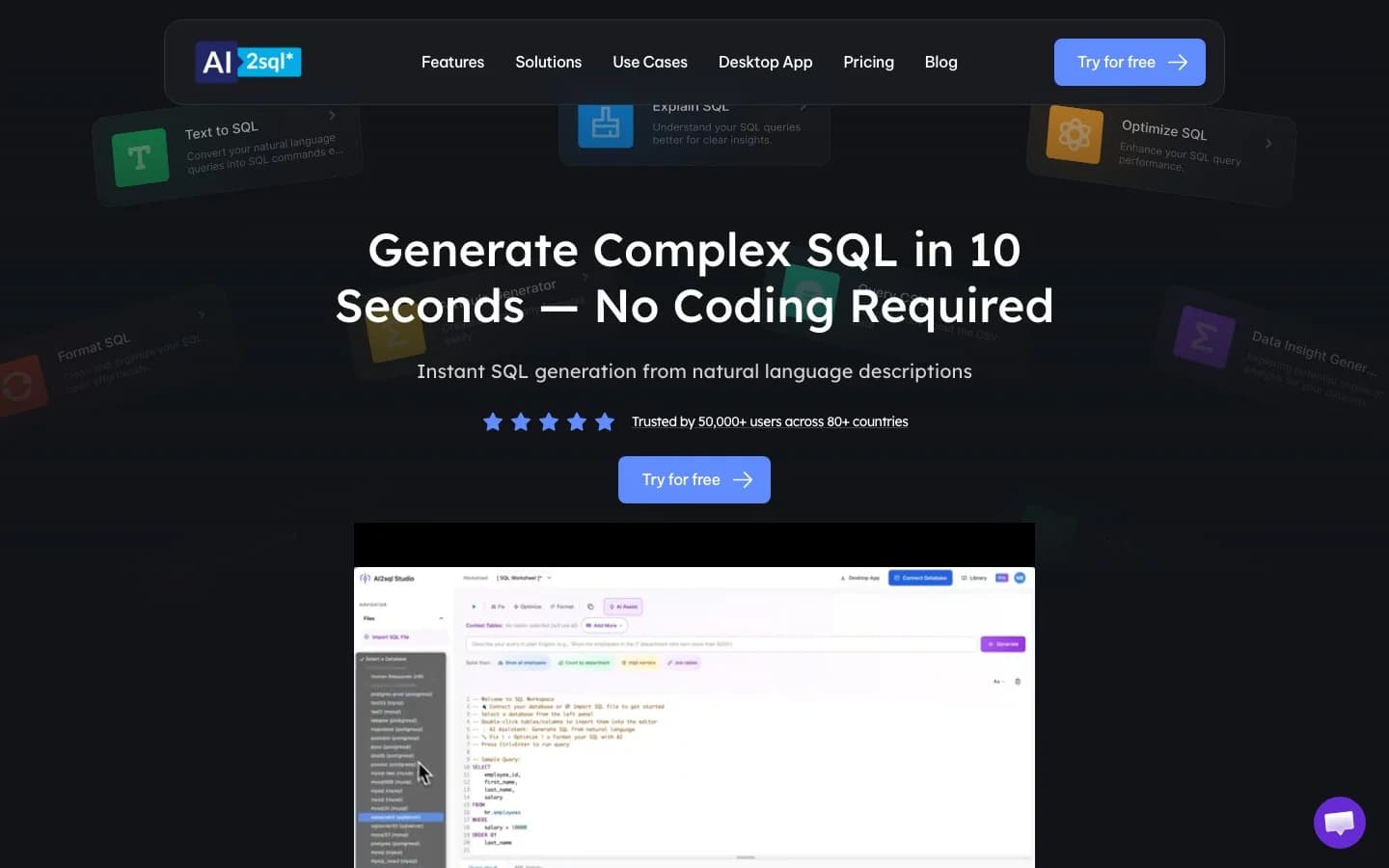
AI2SQL launched on Product Hunt in October 2021, built by Mustafa Ergisi, a solo founder based in Jacksonville, FL. The pitch was straightforward: describe a query in plain English, get valid SQL back. Over time, the product added ER diagram generation, SQL file upload, formula helpers, and direct database connectors (on paid tiers).
The product has attracted 50,000+ registered users and holds a 5.0 rating on Product Hunt, with fans who have followed it since version 1.0. It supports a broad set of databases: MySQL, PostgreSQL, BigQuery, Oracle, MongoDB, Snowflake, MariaDB, Redshift, and more, depending on which tier you are on.
What AI2SQL does well:
- Generates syntactically valid SQL from a natural language prompt
- Supports a wide range of database dialects
- Offers ER diagram generation and formula helpers as utilities
- Very low price floor - $9/month puts it within reach of freelancers and individual analysts
- Simple, focused interface with a short learning curve
Where AI2SQL stops:
The product is a query generator, not an analyst. Once the SQL is in your clipboard, AI2SQL's job is finished. Running that query, interpreting the results, building a chart, sharing a dashboard, or teaching the tool anything about your business are all outside its scope.
A Substack review from Non-Brand Data put it plainly: "It doesn't provide more advanced data analysis as the purpose is only to generate SQL queries." AppSumo buyers from AI2SQL's 2022 lifetime deal noted that "some SQL and DB knowledge would be helpful," and flagged a lack of integrations as a recurring gap. Futurepedia lists "dependency on AI accuracy" as a key limitation, which matters particularly on complex multi-table joins where generated SQL tends to degrade without human review.
Pricing (As of April 2026):
| Tier | Price | Queries/month | Tables |
|---|---|---|---|
| Start | $9/month | 100 | 10 |
| Pro | $24/month | 300 | 50 |
| Business | $39/month | 1,000 | Unlimited |
| Enterprise | Custom | Custom | Custom |
The Start tier includes a 10-table cap, which limits usability on real-world production schemas. Database connectors (direct DB access, rather than manual schema input) are Pro and above only. The 100-query limit on the entry tier is tight - a single active analyst can exhaust it in a few days.
One practical consideration worth naming: AI2SQL is a one-person company at roughly $60K ARR with no employees, no funding, and no investors. Any disruption to the founder's availability means no support, no updates, and no roadmap. For personal use or experimentation, this risk is easy to accept. For teams with production data workflows, it is worth weighing.
What is Sequel?
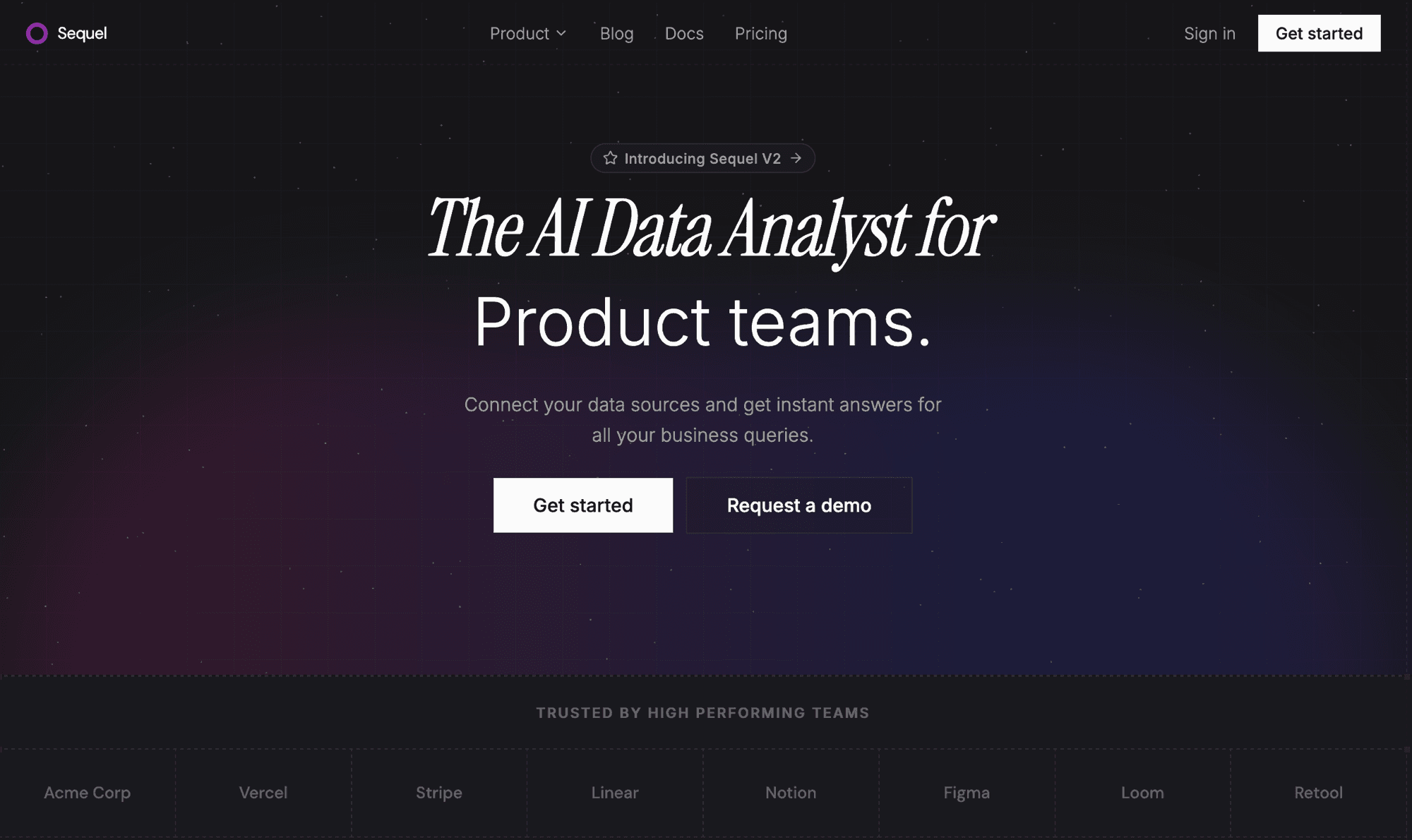
Sequel launched publicly in September 2024 as an AI-native data analyst platform. The core idea goes beyond SQL generation: Sequel is built to be the analyst at the table, not just the query writer.
When you ask Sequel a question about your data, it generates the SQL, runs it against your connected database, and automatically renders the result as a chart, all in one step. There is no copy-paste handoff. The loop is closed inside the tool.
What makes Sequel distinct is what happens over time. Sequel's agents are self-learning and self-improving. They build up context about your schema, your business terminology, and the questions your team asks regularly. A question like "show me churn by cohort for Q1" gets smarter as Sequel learns what "churn" and "cohort" mean in the context of your actual data model, not just SQL theory. Teams get better answers the longer they use it, without any manual configuration.
Key capabilities:
- Generates SQL from natural language and runs it immediately
- Auto-renders query results as charts and visualizations
- Self-learning agents that build context about your data model and vocabulary over time
- Self-improving agents that refine accuracy based on user feedback and results
- Multi-source joins: one question can span multiple connected databases or APIs
- Multi-agent systems that build and retain business context across sessions
- Slack integration for questions without leaving your team's workspace
- MCP server support for use inside Claude and Cursor
Pricing (As of April 2026):
| Tier | Price | Seats | Data sources | AI credits |
|---|---|---|---|---|
| Free | $0/month | 3 | 1 | Up to $10/month |
| Pro | $99/month | 10 | 10 | Up to $25/month |
| Startup | $999/month | 25 | Unlimited | Up to $250/month |
| Enterprise | Custom | Unlimited | Unlimited | Bring your own keys |
The Free tier is a genuine on-ramp: three seats, one data source, real AI credits included, no trial clock running. Pro unlocks ten sources and premium models. The Startup tier removes source limits entirely. Enterprise supports self-hosted deployments with bring-your-own-model keys, meaning teams in regulated environments control their own data and costs end to end.
Database support (As of April 2026): PostgreSQL, MySQL, ClickHouse, Turso, Cloudflare D1, and MotherDuck are live. BigQuery, Snowflake, MongoDB, and Redshift are on the roadmap.
Head-to-head: five dimensions
1. Query limits and value at scale
AI2SQL's entry tier caps at 100 queries per month. That is a hard ceiling that will stop an active analyst mid-week. Moving to 300 queries costs $24/month; 1,000 queries costs $39/month. Every tier is also limited to a fixed number of tables.
Sequel's limits are structured around seats and data sources, not individual query count. The Free tier includes AI credits up to $10/month, which covers a meaningful volume of queries. Self-hosted Enterprise deployments with bring-your-own keys have no practical query ceiling.
2. Visualization and analysis
AI2SQL's output is text: a SQL statement. What you do with it is your responsibility. If you want a chart, you run the query in your database client, export the result, and open a BI tool.
Sequel closes the loop. The query runs, the result loads, the chart renders, all inside the same interface. For teams whose goal is an answer rather than a query, this matters a great deal.
3. Team collaboration
AI2SQL is built around a single-user workflow. There is no concept of shared workspaces, saved questions that teammates can reuse, or role-based access to data sources.
Sequel's plans are seat-based by design. The Free tier covers three seats, Pro covers ten, Startup covers twenty-five. Shared context, shared data source connections, and shared query history mean the whole team benefits from what any individual teaches the system.
4. Agent learning over time
AI2SQL has no memory between sessions. Each query is generated against whatever schema you provide at that moment. The tool does not learn that your team calls revenue "GMV," that your user table uses uid not user_id, or that "monthly actives" in your company's context excludes a specific cohort.
Sequel's agents accumulate that context. Over repeated use, the system builds a model of your data vocabulary, your schema patterns, and the questions your team asks most. That means fewer clarifications over time, fewer manually corrected queries, and answers that get more accurate as adoption grows.
5. Vendor stability
AI2SQL is a one-person bootstrapped project at roughly $60K ARR. The product works, but the continuity risk is real. A single point of failure for support, updates, and roadmap decisions is a legitimate consideration for any team putting this in a production workflow.
Sequel is also bootstrapped and early, but it is actively developed, has a growing integration roadmap, and is built by a team with a longer-term product vision. Enterprise deployments are self-hosted, which insulates customers from any vendor-side disruptions entirely.
Who should choose AI2SQL
AI2SQL makes the most sense for:
- Individual developers or analysts who want a quick SQL generator and already know how to validate the output
- Solo users who are comfortable with a one-tool workflow: paste the SQL, run it yourself
- Experimenting with AI-assisted query writing at the lowest possible cost
- Cases where a simple database dialect conversion or ER diagram utility is the primary need
If you need a query suggestion tool and nothing more, AI2SQL delivers that at a price that is hard to argue with.
Who should choose Sequel
Sequel is the right choice for:
- Teams that need answers, not just queries - full analyst output including visualization
- Data teams who want to stop re-explaining their schema and business terminology every session
- Organizations connecting multiple databases or data sources in a single workflow
- Companies in regulated industries or with strict data handling requirements (Enterprise, self-hosted)
- Any team that wants an analyst tool that gets genuinely better over time rather than staying static
The free tier is a zero-friction starting point: three seats, one source, real credits, no expiration.
Conclusion
AI2SQL is honest about what it is: a query generator. At $9/month, it delivers that narrow capability at a price that almost anyone can justify. If you know SQL, can validate the output yourself, and do not need the tool to do anything beyond hand you a statement, it is a reasonable choice.
Sequel is built for the team that wants the actual answer. The query generation is just the first step. Running it, rendering it, learning your business, joining across sources, improving with feedback, those are the capabilities that turn a text-to-SQL tool into something that functions like a real analyst embedded in your workflow.
If you are evaluating both, the free tier on Sequel costs nothing to test. Connect your first database, ask a question about your own data, and see what a full analyst loop looks like compared to a query generator.