
Basedash vs Sequel: Which AI Data Analyst Is Right for Your Team?
Two AI-native BI platforms walk into the same market. Both promise to answer business questions in plain English. Both connect to your databases and render charts automatically. Both have Slack integrations and MCP servers. On the surface they look nearly identical.
The real split is underneath: how their AI actually works, who the pricing is built for, and how much runway a team gets before costs become a real conversation. If you are evaluating both right now, here is an honest breakdown of where each one fits.
Quick comparison
| Basedash | Sequel | |
|---|---|---|
| Starting price | $250/month (2 users) | $0/month (3 users) |
| Free tier | No | Yes |
| AI model | OpenAI models | Multi-model, BYO keys on Enterprise |
| Self-learning agents | No | Yes |
| Cross-source joins | Growth plan only | All paid plans |
| Data sources | 750+ (Growth/Enterprise) | 6 live, more coming |
| SOC 2 | Type II | Enterprise |
| Self-hosted | Enterprise | Enterprise |
| MCP server | Yes | Yes |
| Slack integration | Yes | Yes |
What is Basedash?
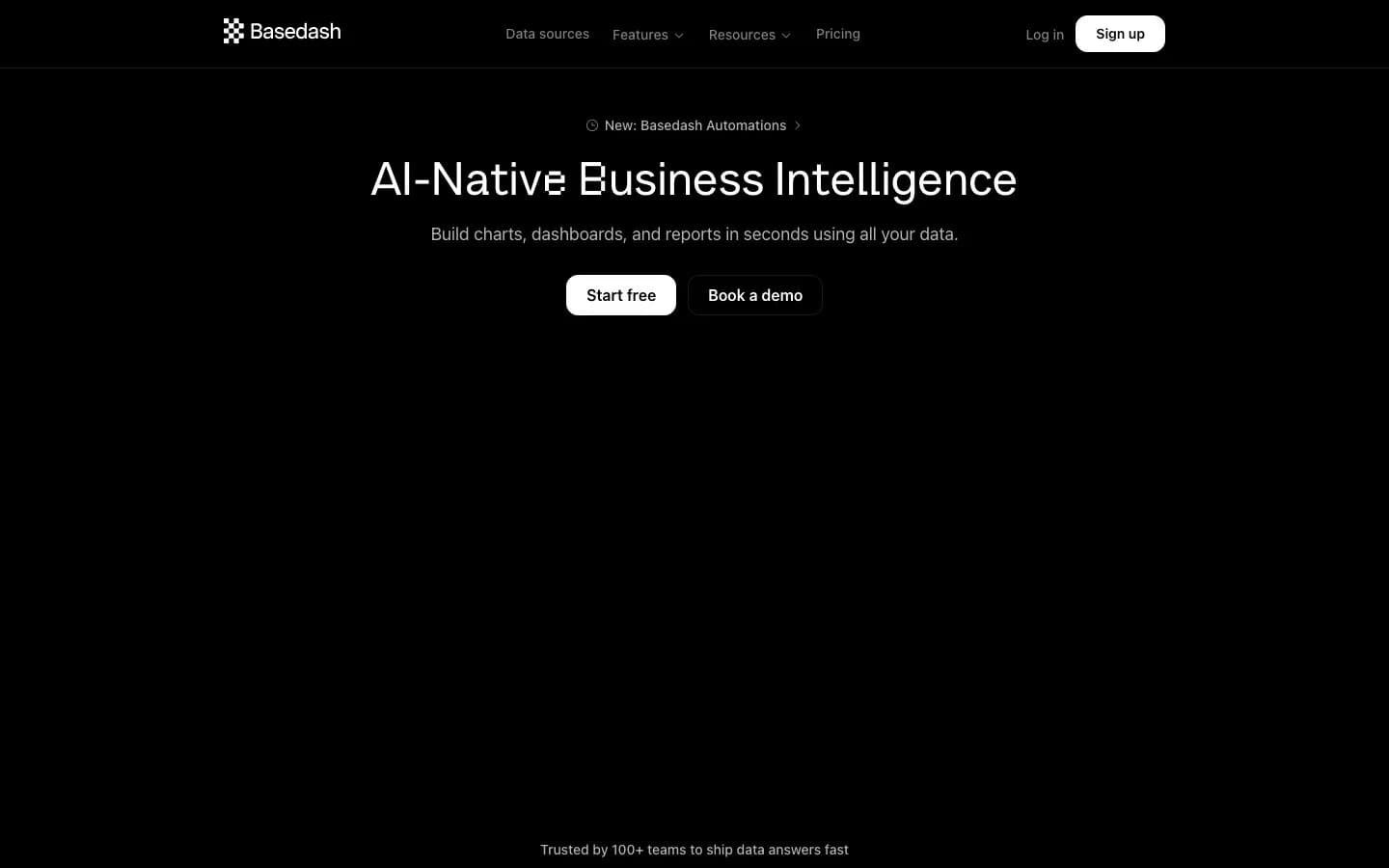
Basedash started in 2020 as a YC S20 company building what they described as a spiritual successor to Django Admin - a database GUI for developers managing internal data. For three years that was the product. In 2024, the team made a full pivot to AI-native BI, relaunching as the platform it is today.
That pivot brought a new direction: natural language queries, AI-generated dashboards, Automations, a Slack app, and an MCP server that connects Basedash to Claude and Cursor. The team is 7 people, bootstrapped, with roughly $1M ARR as of 2024. On Product Hunt, Basedash has 14 total launches including a Dashboard Agent launch on April 30, 2026, with a 5.0 rating from early users.
Where Basedash is strong:
- SOC 2 Type II certification with encryption in transit and at rest
- Customer data is never used to train AI models
- Automations for scheduling and triggering data workflows
- 14 Product Hunt launches since 2020
- MCP server brings Basedash into Claude and Cursor contexts
- 750+ data source integrations on the Growth plan
Pricing (As of April 2026):
| Tier | Price | Users | AI credits |
|---|---|---|---|
| Basic | $250/month | 2 | $25/month included |
| Growth | $1,000/month | 25 | $100/month included |
| Enterprise | Custom | Custom | Custom |
The entry point is $250/month for just 2 users. There is no free tier. The 14-day trial gives full access without a credit card, but once the trial ends, you are committing $3,000/year before a third person can log in. Growth tier unlocks the full data source library and jumps to $1,000/month. AI credit overages apply on both paid plans once the monthly allowance runs out.
One thing worth knowing: Basic is limited to SQL sources only. If your stack includes non-SQL databases, you need Growth to access them.
What is Sequel?
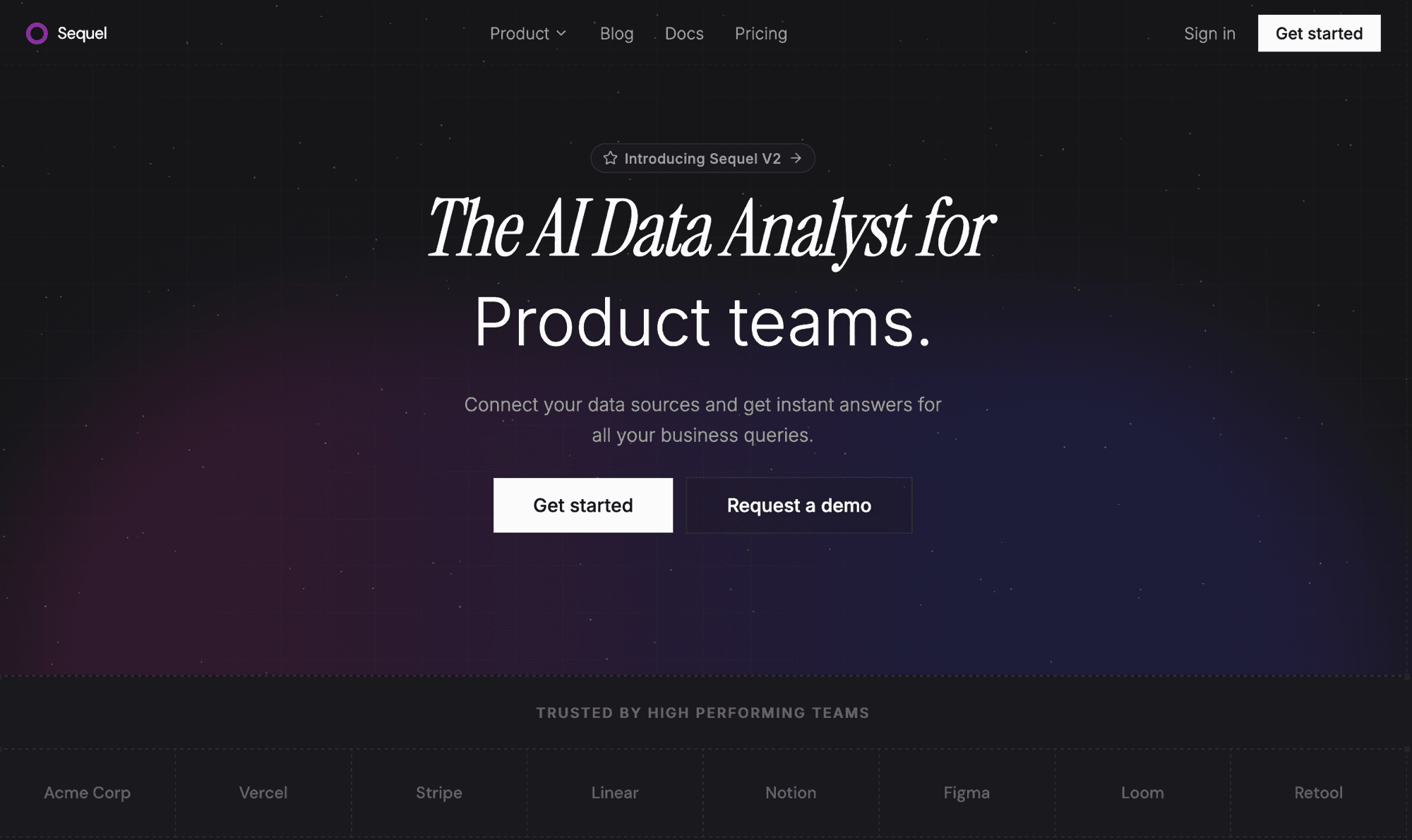
Sequel is an AI data analyst built around the idea that asking a question about your data should feel like asking a coworker, not writing a query. You connect your databases, ask questions in plain English, and Sequel generates the SQL, runs it, and renders the result as a chart or table. The platform launched publicly in September 2024.
What makes Sequel different from most AI query tools is what happens after you ask the first question. The agents do not reset. They observe your schema, your query patterns, and the corrections and feedback your team gives over time. Each session makes them more accurate. They learn your business's terminology, your KPIs, and how your tables actually relate to each other. Over weeks and months, the gap between "AI tool" and "data analyst who knows your stack" closes.
What Sequel's agents do:
- Self-learning - agents build and refine understanding of your schema and query patterns over time
- Self-improving - agent behavior updates based on results and feedback, without manual retraining
- Cross-source joins - one question can span multiple connected databases and APIs simultaneously
- Multi-agent systems - coordinated agents that develop shared context about your business data model, not just individual queries
Pricing (As of April 2026):
| Tier | Price | Seats | Data sources | AI credits |
|---|---|---|---|---|
| Free | $0/month | 3 | 1 | Up to $10/month |
| Pro | $99/month | 10 | 10 | Up to $25/month |
| Startup | $999/month | 25 | Unlimited | Up to $250/month |
| Enterprise | Custom | Unlimited | Unlimited | Bring your own keys |
The Free tier is a real starting point, not a feature-limited sandbox. Three seats, one data source, and $10/month in AI credits is enough for a small team to genuinely evaluate whether the agents are delivering value before committing a dollar.
Pro at $99/month is aimed at early-stage teams that have outgrown a single source. Ten seats, ten data sources, and priority support. Startup at $999/month matches Sequel's pace with Basedash's Growth tier in seat count while covering unlimited data sources.
Enterprise is where Sequel separates from most tools in this category. Self-hosted deployment, bring-your-own API keys, and a dedicated Slack channel. For teams with strict data residency requirements, the self-hosted path means Sequel never touches your data at all.
Head-to-head: 5 dimensions
1. Pricing model and accessibility
Basedash has a $250/month floor for 2 users. Sequel has a $0/month tier for 3 users. For teams that want to validate an AI BI tool before budgeting for it, that difference is the whole conversation.
Even comparing paid tiers, Sequel's Pro plan at $99/month undercuts Basedash Basic at $250/month while providing more seats (10 vs 2) and more data sources.
2. Agent intelligence
Basedash uses AI primarily for generating visualizations and helping fix SQL errors in queries that users are often still writing themselves. It does not expose a self-learning or self-improving agent architecture.
Sequel's agents accumulate context. They learn schema, terminology, and KPIs over time. A question asked in week 8 benefits from everything the agent observed in weeks 1 through 7. For teams that want an AI analyst that gets better the longer they use it, this is the core architectural difference.
3. Multi-source querying
On Basedash's Basic plan, you are limited to SQL sources. Cross-database connections require the Growth plan at $1,000/month.
Sequel's agents can join across multiple connected sources on any paid plan. A single natural language question can pull data from a PostgreSQL instance and a ClickHouse warehouse simultaneously, without any manual query construction.
4. Data source breadth
Basedash has a broader current catalog: 750+ data sources on Growth/Enterprise. Sequel's live integrations cover PostgreSQL, MySQL, ClickHouse, Turso, Cloudflare D1, and MotherDuck, with BigQuery, Snowflake, MongoDB, and Redshift coming soon.
If your stack is already on one of Sequel's supported databases, coverage is not a limiting factor. If you rely heavily on SaaS sources or non-standard integrations, Basedash's Growth tier catalog is wider today.
5. Self-hosting and data residency
Both platforms offer self-hosting at the Enterprise tier. Sequel's Enterprise plan adds bring-your-own-keys, meaning customers provide their own AI model API keys. Usage is practically unlimited and entirely controlled by the customer. Basedash Enterprise offers custom AI model configuration as well, but does not expose a BYO keys model on documented lower tiers.
Who should choose Basedash
Basedash suits teams that prioritize compliance certification today, want a broad data source catalog from day one, and have the budget to start at $250/month without needing a free evaluation period. If your organization runs SOC 2 audits, Basedash's Type II certification is already in place. If you need to connect to dozens of disparate sources immediately on Growth, the 750+ catalog is a real advantage.
Basedash also fits teams that want Automations - scheduled and triggered data workflows - alongside their AI queries. That layer exists today and is available from the Basic plan.
The honest consideration: if you have 3 or 4 people who need access, you are paying for 2 seats and someone will not have a login, or you jump immediately to the $1,000/month Growth plan. There is no middle tier.
Who should choose Sequel
Sequel fits teams that want to start without a budget commitment, scale gradually, and work with an AI analyst that improves over time rather than resetting with each session.
For early-stage teams, the Free tier removes the evaluation risk entirely. For teams that have moved past a single database, Pro at $99/month is a meaningful step up without a four-figure monthly line item.
The self-learning agent architecture is the most important differentiator for teams thinking long-term. If you want an AI tool that develops real familiarity with your data model, terminology, and query patterns over weeks and months, Sequel is built for that outcome in a way Basedash is not.
For teams with data residency requirements, the Enterprise self-hosted path with BYO keys means Sequel can operate entirely within your own infrastructure.
You can see how Sequel compares to Basedash in detail at https://sequel.sh/blog/sequel-vs-basedash-ai-business-intelligence or read more at https://sequel.sh/blog/basedash-alterntives.
Conclusion
Basedash has SOC 2 compliance and a wide source catalog on higher tiers. The main limitation is cost structure: $250/month for 2 seats, no free tier, and a $1,000/month jump to the next plan.
Sequel starts free, scales affordably, and is built around agents that get smarter the longer your team uses them. Cross-source joins work from the first paid plan. Enterprise gives full control over infrastructure and AI model costs.
If you want to start today without a financial commitment, the answer is straightforward. Try Sequel free at sequel.sh - three seats, no credit card, no time limit on the free tier.