
Hex vs Sequel: Which AI Data Analyst Is Right for Your Team?
Most companies have the same problem. The data team is good at answering data questions. They just can't answer all of them fast enough. Marketing wants a number before the meeting. Sales wants to know which accounts are at risk. The exec wants a trend that wasn't in last week's dashboard. Every request lands in a queue that never fully clears.
Two tools are trying to solve this from different angles.
Hex is a collaborative data platform for analysts and engineers. It combines SQL notebooks, Python support, and agentic AI. It raised a $70M Series C in 2025 and reports more than 1,500 teams using it.
Sequel is built for the other side of the equation. Natural language in, SQL out, results rendered as charts automatically. The goal is not to give data teams a better workbench. It is to make every person on the team capable of answering their own data questions, without routing anything through the data team at all.
The right choice depends on who in your organization is actually going to use it.
Quick comparison
| Hex | Sequel | |
|---|---|---|
| Best for | Data engineers and analysts | Technical and non-technical users alike |
| Interface | SQL + Python notebooks | Natural language chat |
| AI approach | Code generation, agentic notebooks | Self-learning and self-improving agents |
| Learning curve | Steep (requires coding knowledge) | Minimal (plain English questions) |
| Starting price | Free (limited); $36/editor/month | Free (3 seats); $99/month (10 seats) |
| Self-hosted | Enterprise (custom) | Enterprise plan |
| Multi-source joins | Yes, within notebooks | Yes, across connected sources in one query |
| Pricing model | Per editor seat + compute add-ons | Flat monthly tiers |
What is Hex?
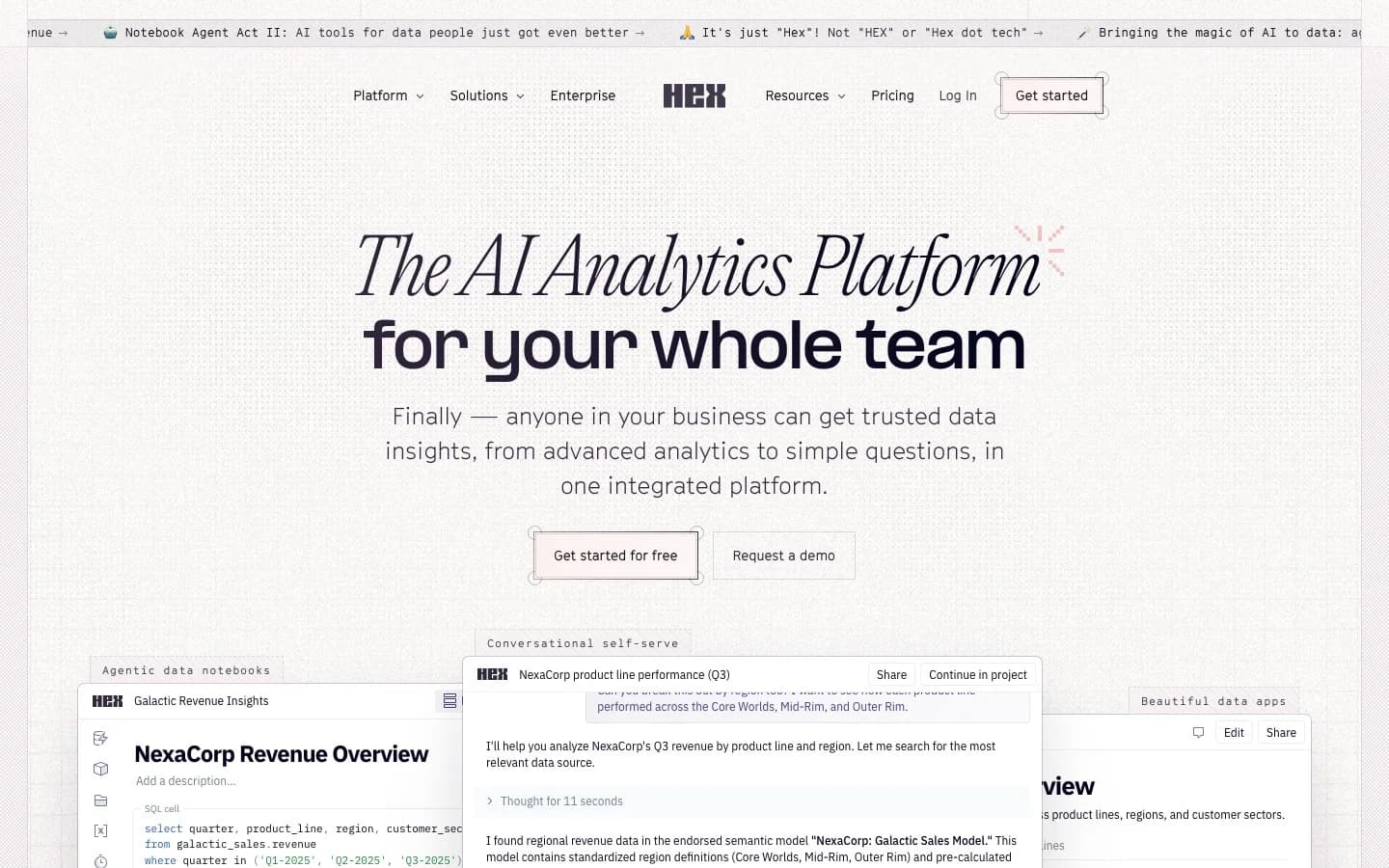
Hex launched in 2021 with a clear thesis: data work belongs in collaborative notebooks, not siloed tools. The product combines SQL and Python in a single notebook interface, lets teams publish results as shareable data apps, and layers AI assistance throughout so analysts can generate and edit code faster.
In 2025 Hex moved hard into agentic analytics. The Notebook agent writes and runs multi-step analysis inside notebooks autonomously. The Threads agent handles conversational Q&A for data exploration. The Semantic model agent helps define and maintain a shared layer of business logic across the team. Hex reports over 1,500 teams and $19.8M in revenue in 2024. The Hashboard acquisition in April 2025 added BI visualization and semantic modeling. The $70M Series C a month later included Snowflake, a16z, Sequoia, and Amplify.
For teams already working in Python and SQL, the notebook environment is familiar.
Pricing, as of April 2026:
| Tier | Price | What you get |
|---|---|---|
| Community | Free | 5 notebooks, 5 apps, limited AI credits |
| Professional | $36/editor/month | Unlimited notebooks, Notebook agent |
| Team | $75/editor/month | Threads agent, Semantic model agent, scheduling |
| Enterprise | Custom | SSO, HIPAA, single-tenant, embedded analytics |
Compute-heavy work adds hourly charges: $0.32/hr for 16 GB RAM, $0.65/hr for 32 GB, up to $4.06/hr for A10G GPU instances. AI features run on a credit system that is still rolling out across paid plans.
Where Hex works best: Data engineering teams, analyst-heavy organizations, and companies where the primary goal is giving skilled users a more powerful and collaborative workspace. It is a technical tool. It is designed for people who know what they are doing with data, and want to do it faster and more collaboratively.
What to keep in mind: Hex is not designed for non-technical users. Business stakeholders can view published apps, but creating or modifying any analysis requires coding knowledge. Community feedback on Reddit points to ToS data handling concerns that have slowed enterprise procurement at some larger companies. The per-editor seat model gets expensive when organizations have mixed technical and non-technical staff who all need access, because viewer roles and editor roles are priced differently and compute costs sit on top.
What is Sequel?
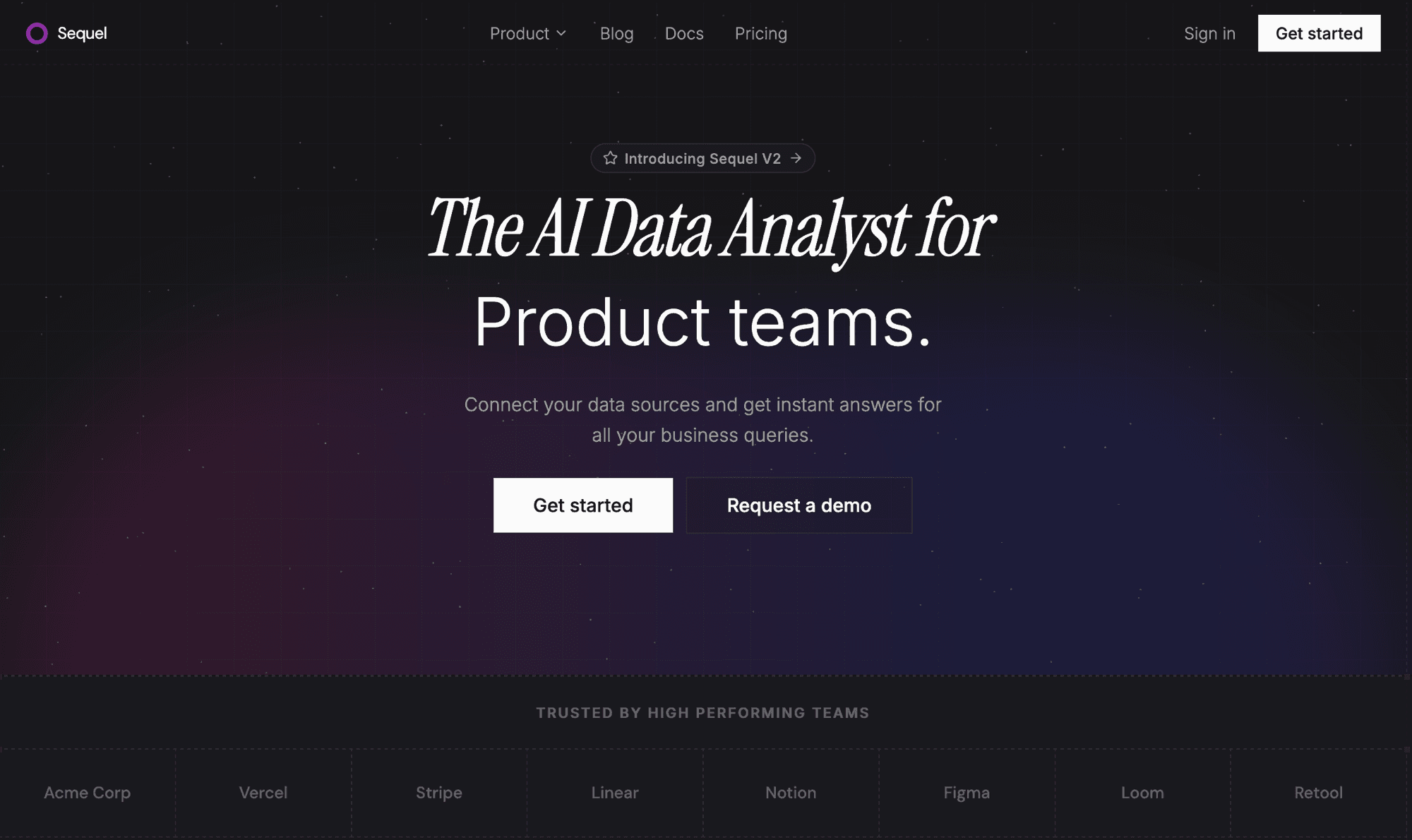
Sequel is an AI-native analyst built around a different premise: what if anyone on your team, regardless of technical background, could ask questions about your data and get accurate, chart-ready answers in seconds?
The interface is conversational. You ask a question in plain English. Sequel translates it into optimized SQL, runs it against your connected databases, and renders the result as a chart or table automatically. There is no notebook to manage, no Python environment to configure, no schema to memorize. The person asking the question just asks.
What separates Sequel from simpler text-to-SQL tools is the agent architecture underneath. Sequel's agents are self-learning: they build up a picture of your schema, your query patterns, and the way your team talks about your business over time. They are self-improving: feedback from results loops back into better query generation. The agents accumulate business context, which means the more your team uses Sequel, the more it understands about your company's data model, your KPIs, and the terminology your teams actually use.
Sequel also handles something that causes real pain in most organizations: joins across data sources. A single natural language question can pull from two different connected databases and combine the results, without the user needing to know those sources are separate or write any union logic themselves.
For teams that need Sequel inside their existing workflows, there is a Slack integration for querying data in channels and a Model Context Protocol server for use inside Claude and Cursor.
Pricing, as of April 2026:
| Tier | Price | Seats | Data sources | AI credits |
|---|---|---|---|---|
| Free | $0 | 3 | 1 | Up to $10/month |
| Pro | $99/month | 10 | 10 | Up to $25/month |
| Startup | $999/month | 25 | Unlimited | Up to $250/month |
| Enterprise | Custom | Unlimited | Unlimited | Bring your own keys |
The Enterprise tier supports self-hosting with your own infrastructure and API keys. There are no practical usage limits when self-hosted because teams control their own costs directly.
Head-to-head: five dimensions
Who actually uses it
Hex is built for data analysts and engineers. The value proposition only holds if your users know SQL or Python. Non-technical team members can see the outputs, but they cannot create or modify analyses themselves. That works fine in organizations where the data team is the bottleneck and you want to give them a better tool. It does not solve the problem of giving business users direct data access.
Sequel was purpose-built for the full range of users, from data engineers who want to inspect the generated SQL to product managers and sales reps who just want an answer. There is no learning curve for most questions. If you can type a sentence, you can query your data.
Learning curve
Getting productive in Hex takes real time. You need to understand notebook cells, SQL syntax, Python libraries, and how Hex's reactive DAG model works. The AI features help experienced users move faster, but they do not remove the underlying prerequisite of coding literacy.
Sequel's onboarding is connecting a database and typing a question. The agent handles the rest.
Pricing structure
Hex charges per editor. At $75/editor/month on the Team plan, a team of ten analysts costs $750/month before compute. Add in GPU or extra-memory compute jobs and the bill scales unpredictably. For organizations trying to extend data access beyond the core data team, the per-seat model creates a real cost decision every time someone new needs access.
Sequel uses flat monthly tiers. The Pro plan at $99/month covers ten seats and ten data sources. The Startup plan at $999/month covers 25 seats with unlimited data sources. The cost of adding a business user to Sequel is zero as long as you have seat headroom, which changes the math on who gets access.
Self-service analytics
Hex's Threads agent and Explore feature move toward self-service BI, but they sit on top of a platform that was designed for notebooks first. The path from "business question" to "answer" in Hex still typically requires a data team member to build the analysis or configure the semantic model.
Self-service is Sequel's core function. The intent is that anyone with a business question can get to an answer without involving the data team at all.
Data source coverage
Hex connects to a wide range of warehouses and databases: Snowflake, BigQuery, Redshift, Databricks, Postgres, MySQL, ClickHouse, and more. Given Snowflake's investment position, that integration runs deep.
Sequel currently supports PostgreSQL, MySQL, ClickHouse, Turso, Cloudflare D1, and MotherDuck, with BigQuery, Snowflake, Redshift, and MongoDB coming. If your data lives in Snowflake or BigQuery today, Hex has native support now. Sequel's roadmap covers those sources, but the integrations are not live yet.
Who should choose Hex
Hex is the right fit when your data team is the primary user and they need a more powerful collaborative workspace. If your analysts are already writing SQL and Python, already building notebooks, and want better collaboration, faster AI-assisted code generation, and agentic automation inside their existing workflow, Hex delivers. It is particularly strong for teams running on Snowflake, given the strategic investment relationship.
Hex also makes sense for organizations building internal data apps. The notebook-to-app publishing flow is mature, and the Hashboard acquisition adds visualization depth. If you need analysts to build tools that other teams consume, Hex is designed for that workflow.
Who should choose Sequel
Sequel is the right fit when the goal is making your entire organization data-capable, not just your data team. If you have a sales lead who needs to know close rates by region, a product manager who wants to track activation by cohort, or a founder who needs weekly KPIs without waiting on an analyst, Sequel can serve all of them from day one.
It is also a strong fit for teams that want to eliminate the data request queue entirely. When business users can ask their own questions and get accurate answers immediately, the data team spends less time on one-off queries and more time on high-leverage analytical work.
For organizations with sensitive data environments, the self-hosted Enterprise plan keeps everything on your own infrastructure with your own model keys, which changes the security conversation entirely.
Conclusion
Hex and Sequel take different approaches. Hex gives data teams a collaborative notebook environment. Sequel gives everyone on the team a way to ask questions without writing code. Natural language questions, self-learning agents, multi-source joins, flat pricing, and a free tier that costs nothing to try.
If you want to see what Sequel looks like for your team, you can connect your first database and start asking questions in minutes.