
Best Basedash Alternatives for AI Data Analysis in 2026
TL;DR
| Alternative | Best for | Starting price |
|---|---|---|
| Sequel | Teams wanting self-learning agents across multiple sources | Free ($0, 3 seats) |
| Julius AI | Individuals analyzing files with occasional DB queries | Free ($0, file-based) |
| Hex | Data teams building collaborative SQL/Python notebooks | Free community tier |
| BlazeSQL | Enterprise teams needing privacy-first desktop analysis | $39/month (1 user) |
| AI2SQL | Developers who want a quick SQL query generator | $9/month (1 user) |
| Chat2DB | Open-source fans who want a self-hosted SQL client | $8/user/month |
Basedash is a YC S20-backed AI BI platform with 14 Product Hunt launches. Teams whose workflow matches what it offers report faster dashboard creation. But a meaningful number of teams hit friction before they get there.
The pricing structure is the first thing people notice. $250/month covers exactly 2 users, with $25 in AI credits included. If your team grows, or you run heavy queries, you jump straight to $1,000/month for 25 seats. There is no middle tier and no free plan. The 14-day trial gives you enough time to evaluate the product, but the jump from $0 to $250 with no runway is steep for early-stage teams.
Then there is the pivot. Basedash started as a database GUI that multiple teams integrated deeply into their workflows. In 2024, the team made the decision to shift entirely to AI-native BI. That was the right call strategically, but it meant the original product was effectively deprecated, and teams that had built on it had to reconsider. The new product is better in some ways, but it is a different product.
The team is 7 people, bootstrapped, with roughly $1M ARR. They are shipping. They just launched a Dashboard Agent on April 30, 2026. But at $250/month per account, the math suggests a few hundred paying customers. For a BI platform, that is a modest foundation, and it raises fair questions about long-term support capacity and roadmap.
If you are looking at Basedash and the pricing, seat limits, or continuity questions are giving you pause, here are the strongest alternatives available as of April 2026.
What is Basedash?
Basedash is an AI-native BI platform for startups and growing teams. It connects to SQL databases and data sources, generates dashboards and insights using AI, and exposes a Slack app, an MCP server, and an Automations feature for recurring data workflows.
The product started in 2020 as a "spiritual successor to Django Admin," a collaborative database GUI built for developers. After a full product pivot in 2024, it repositioned as an AI-first analytics platform. The original admin panel functionality is no longer the focus.
Pricing (As of April 2026):
| Plan | Price | Seats | AI credits |
|---|---|---|---|
| Basic | $250/month | 2 | $25/month |
| Growth | $1,000/month | 25 | $100/month |
| Enterprise | Custom | Custom | Custom |
SQL sources are available on Basic. The full 750+ source library (including non-SQL) requires Growth. SOC 2 Type II certified. Customer data is not used to train models.
For a direct comparison with Sequel, see Basedash vs Sequel. The broader Basedash alternatives page covers additional options.
Comparison overview
| Tool | Starting price | Free tier | Data sources | Best for |
|---|---|---|---|---|
| Sequel | $0 | Yes (3 seats, 1 source) | PostgreSQL, MySQL, ClickHouse + more | Teams wanting natural language queries with self-learning agents |
| Basedash | $250/month | No (14-day trial) | 750+ (Growth); SQL only (Basic) | AI-native BI for startups willing to pay for seat access |
| Julius AI | $0 (file-based) | Yes | Files free; DB requires $375/month | File analysts and data science workflows |
| Hex | Free community | Yes (limited) | 14+ databases, files, metadata layers | Technical data teams running SQL/Python notebooks |
| BlazeSQL | $39/month | No (14-day trial) | 12+ enterprise SQL databases | Privacy-conscious enterprise teams |
| AI2SQL | $9/month | No (7-day trial) | PostgreSQL, MySQL, BigQuery + more | Developers needing a quick SQL generator |
| Chat2DB | $8/user/month | Community (manual AI setup) | 20+ databases | Developers wanting an open-source SQL client |
1. Sequel
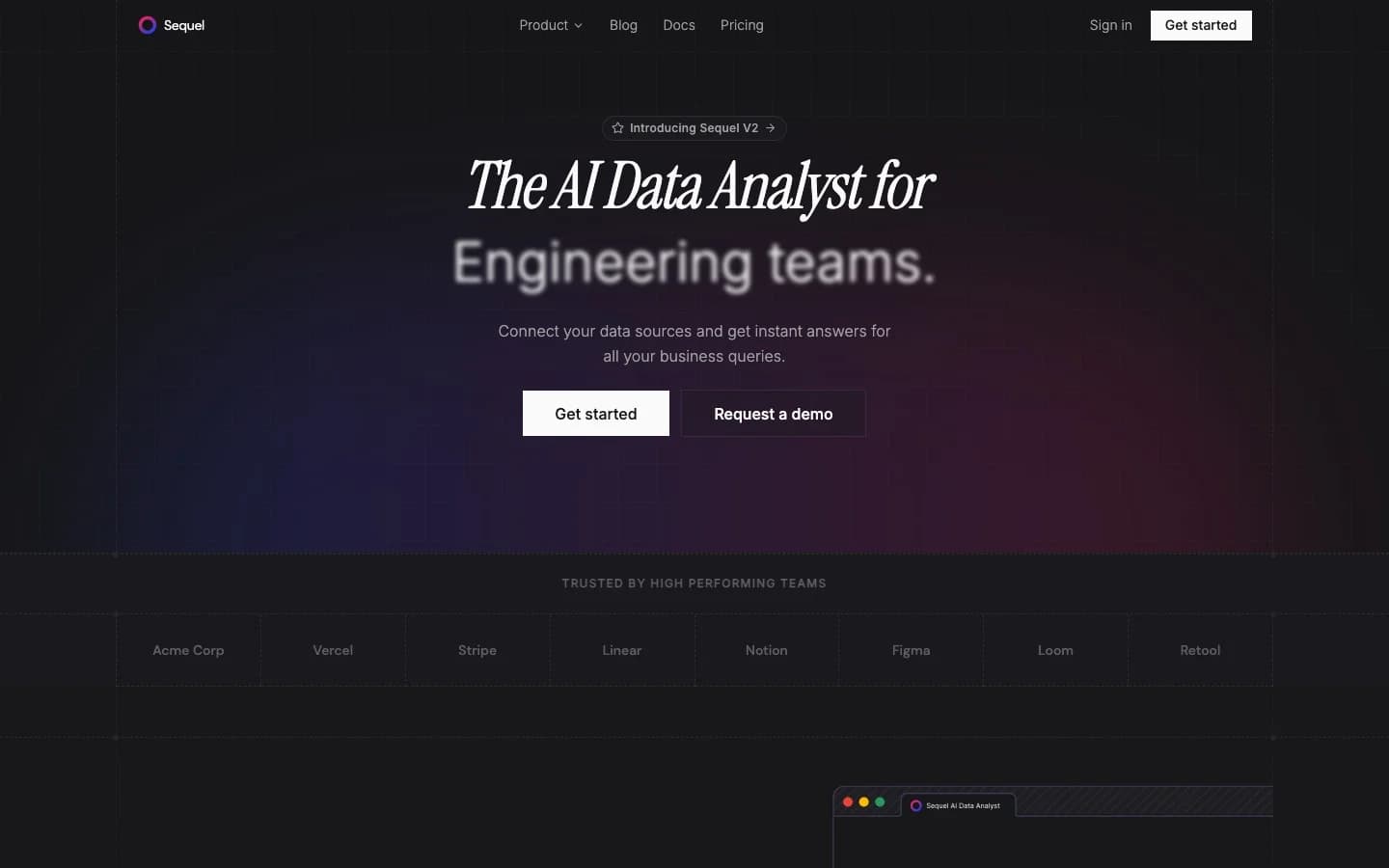
Sequel is an AI data analyst built around the idea that the tool should learn your business, not just your schema. When you connect a database, Sequel's agents start building context around your data model, terminology, and KPIs. Over time, when someone asks "what drove churn last quarter?", the system already knows what your team means by churn.
The core differentiator is what happens when questions get complex. Most text-to-SQL tools break down when a question requires joining tables across two different databases, or when business logic isn't encoded anywhere in the schema. Sequel's multi-agent architecture handles both, running queries across multiple connected data sources in a single question.
What you get:
- Self-learning agents that improve with every query, not just RAG over your schema
- Joins across multiple data sources from one natural language question
- Multi-agent systems that learn company-specific KPIs and terminology over time
- Slack integration and an MCP server for querying from Claude or Cursor
- Support for PostgreSQL, MySQL, ClickHouse, Turso, Cloudflare D1, and MotherDuck (BigQuery, Snowflake, MongoDB, Redshift coming)
Pricing (As of April 2026):
| Plan | Price | Seats | Sources | AI credits |
|---|---|---|---|---|
| Free | $0 | 3 | 1 | Up to $10/month |
| Pro | $99/month | 10 | 10 | Up to $25/month |
| Startup | $999/month | 25 | Unlimited | Up to $250/month |
| Enterprise | Custom | Unlimited | Unlimited | Bring your own keys |
The Startup plan at $999/month serves 25 users with unlimited data sources. That is the same seat count as Basedash's Growth plan at $1,000/month, but with unlimited sources and no AI credit overage risk. Enterprise and self-hosted tiers let you bring your own API keys, which means your usage costs are controlled by you, not by Sequel's pricing model.
One thing to watch: Database support is still expanding. BigQuery, Snowflake, and Redshift are on the roadmap but not yet live. Teams on those warehouses should check current availability before switching.
Choose Sequel when your team needs to ask questions across more than one data source and you want the tool to get smarter about your business over time without SQL knowledge.
Basedash still wins when you need a Slack-native BI workflow today and your entire stack runs on a single SQL database, and you can justify the $250/month minimum.
2. Julius AI
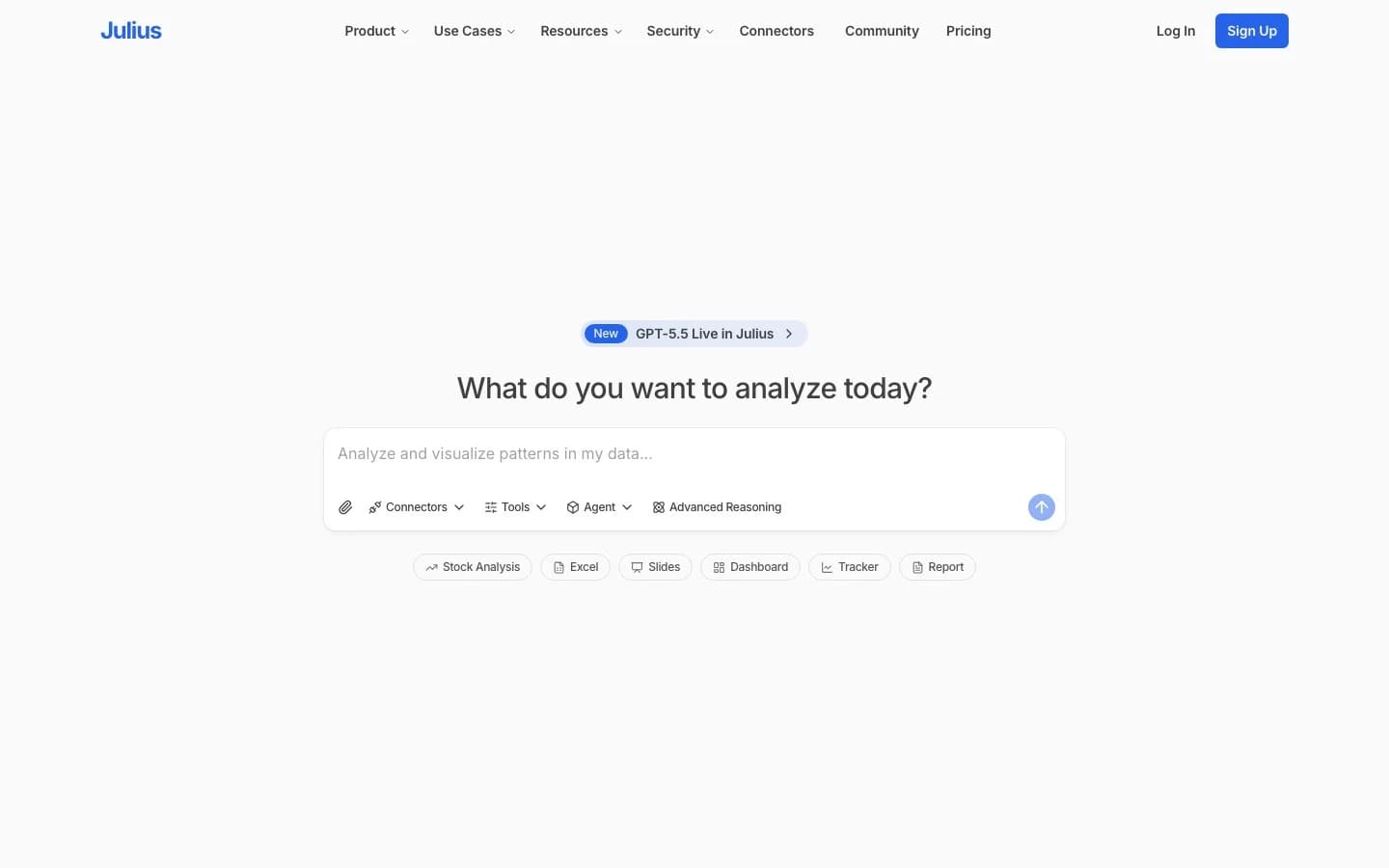
Julius AI is the consumer-friendly end of the AI data analyst market. Upload a CSV, connect Google Sheets, and ask questions in plain English. It generates Python or R code behind the scenes, runs the analysis, and produces charts. For individuals and small teams working with file-based data, it is fast and intuitive.
Julius added database connectors for Postgres, BigQuery, and Snowflake after a $10M seed round in July 2025. It reports 2M+ users.
What you get:
- File-first analysis: CSV, Excel, Google Sheets, Google Drive, OneDrive, SharePoint
- Python/R code generation and execution
- Scheduled reports and Slack delivery (Growth tier)
- Database connectors for Postgres, BigQuery, Snowflake (Business tier)
- SOC 2 Type II, GDPR, CCPA compliance
- Student and educator discounts (50% off all plans)
Pricing (As of April 2026):
| Plan | Monthly | Annual | Notes |
|---|---|---|---|
| Free | $0 | - | 100 credits/month, file analysis only |
| Plus | $20/month | $16/month | 2,000 credits, 1 seat |
| Pro | $45/month | $37/month | 4,000 credits, 1 seat, all models |
| Max | $200/month | $166/month | 20,000 credits, 1 seat |
| Business | $450/month | $375/month | 10 seats, database connectors |
| Growth | $750/month | $625/month | 30 seats, custom agents |
One thing to watch: Database connectors are a Business-tier feature. Getting there from an individual plan means going from $45/month to $375/month annually. That is a significant jump, and the database functionality was added after the fact. Some users note the SQL experience feels secondary to the core file analysis workflow, and without a semantic layer, metric definitions can drift across queries.
Choose Julius AI when your team primarily works with Excel files and Google Sheets, and you need occasional, lightweight database queries.
Basedash still wins when you need a fully integrated BI platform with dashboards, Automations, and a Slack bot rather than per-query file analysis.
3. Hex
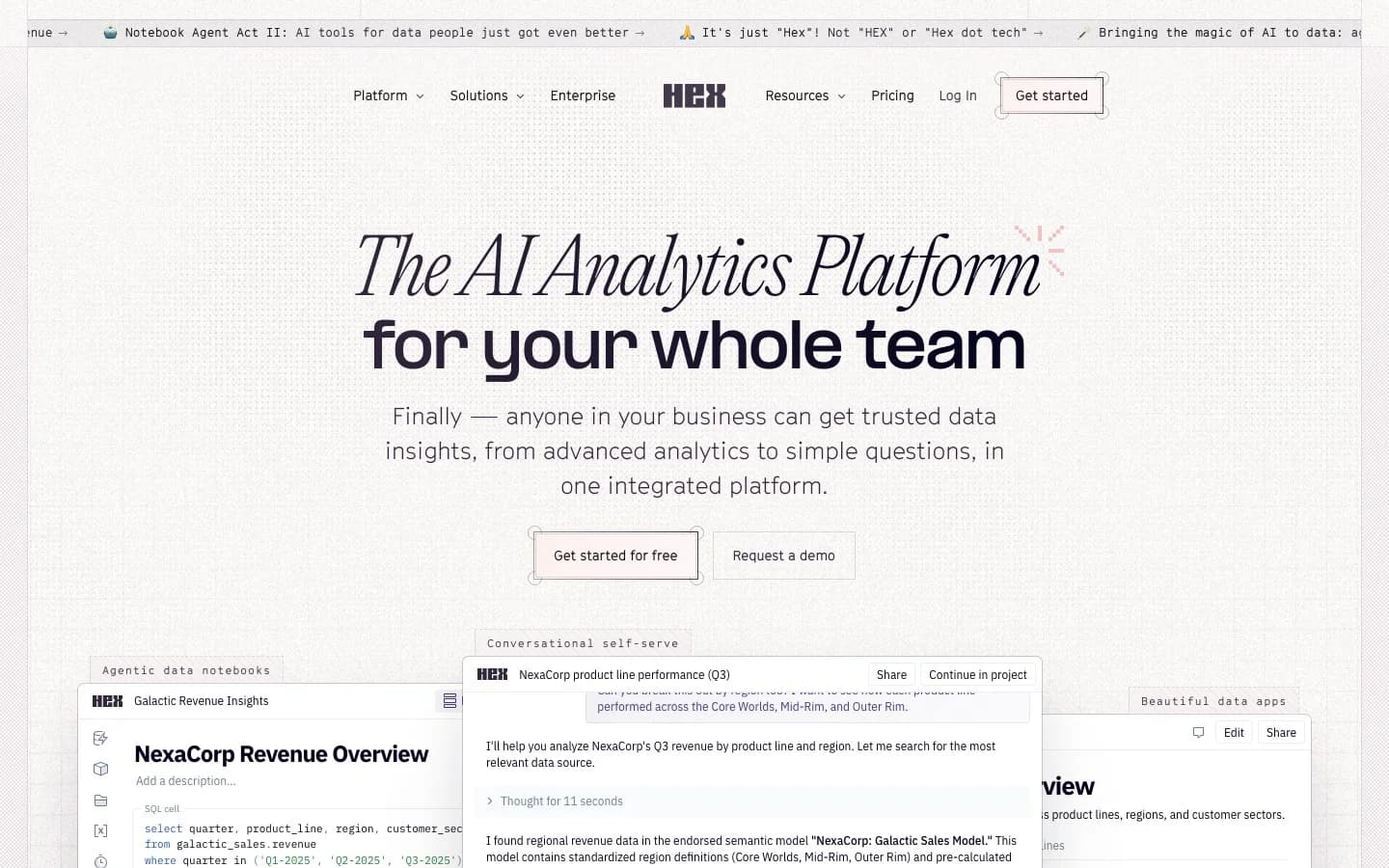
Hex is a collaborative data platform for technical data teams. It combines SQL notebooks, Python notebooks, and AI assistance ("Magic") in a shared environment. Teams write queries and analysis code together, then publish results as interactive data apps that non-technical stakeholders can explore.
Hex raised a $70M Series C in May 2025 and acquired Hashboard in April 2025. Revenue was $19.8M in 2024. Snowflake is a strategic investor.
What you get:
- SQL and Python notebooks with real-time collaboration
- AI code generation and editing across both SQL and Python
- Interactive data apps published from notebooks (no separate dashboard tool needed)
- Agentic features: Notebook agent, Threads agent, Semantic model agent
- Integrations: Snowflake, BigQuery, Redshift, ClickHouse, Databricks, Postgres, MySQL + 8 more
- Scheduling, version control, and embedding for shared data apps
Pricing (As of April 2026):
| Plan | Price | Notes |
|---|---|---|
| Community | Free | Up to 5 notebooks and apps |
| Professional | $36/editor/month | Unlimited notebooks, Notebook agent |
| Team | $75/editor/month | Threads agent, Semantic model agent, scheduling |
| Enterprise | Custom | SSO, HIPAA, single-tenant, embedded analytics |
Compute hours are billed separately on paid plans ($0.32–$4.06/hour depending on size).
One thing to watch: Hex is a technical tool. It was built for data engineers and analysts who are comfortable writing SQL and Python. Non-technical business users can view and interact with published apps, but they cannot build their own analyses without learning the platform. Enterprise procurement has also been slowed in some organizations by ToS concerns around data handling. Worth reviewing before committing.
Choose Hex when you have a technical data team that needs a collaborative notebook environment and wants to publish polished data apps to the rest of the business.
Basedash still wins when your users are not technical and need to run their own queries without help from the data team.
4. BlazeSQL
BlazeSQL is an AI-native BI tool built for enterprise SQL environments. Its standout feature is a desktop app with a local/offline mode. For teams in regulated industries where data cannot leave a specific environment, BlazeSQL's architecture is a genuine differentiator. Enterprise customers include Flixbus, eBay, Siemens, and Yamaha.
What you get:
- Natural language to SQL over live databases
- Desktop app with local/offline mode (privacy-first option)
- Supports 12+ enterprise databases: Snowflake, BigQuery, SQL Server, Postgres, MySQL, MariaDB, Oracle, Redshift, Databricks, Athena, ClickHouse, SAP
- Unlimited AI chat messages on all paid plans
- Up to 300 tables per database connection
Pricing (As of April 2026):
| Plan | Price | Seats | Notes |
|---|---|---|---|
| Blaze Pro | $39/month | 1 | Single user |
| Blaze Advanced | $99/month | 1 | Single user, advanced features |
| Blaze Team | $149/month | 3 | +$49/extra user |
| Blaze Team Advanced | $499/month | 3 | +$75/extra user |
| Blaze Enterprise | Custom | Custom | White-label, API access |
Note: Pricing sourced from a September 2024 BlazeSQL blog post. The /pricing page returned a 404 as of April 30, 2026. Verify current pricing directly before committing.
One thing to watch: BlazeSQL performs best when your database schema is clean and well-documented. Teams with messy schemas or wide tables with many fields report needing to refine queries manually. Complex joins occasionally require human adjustment, and the tool's visualization options are limited compared to dedicated BI platforms.
Choose BlazeSQL when your team needs a privacy-first SQL analysis tool and works with enterprise databases where data must stay local or within a controlled environment.
Basedash still wins when you need a cloud-based dashboard and Automations workflow rather than a desktop query interface.
5. AI2SQL
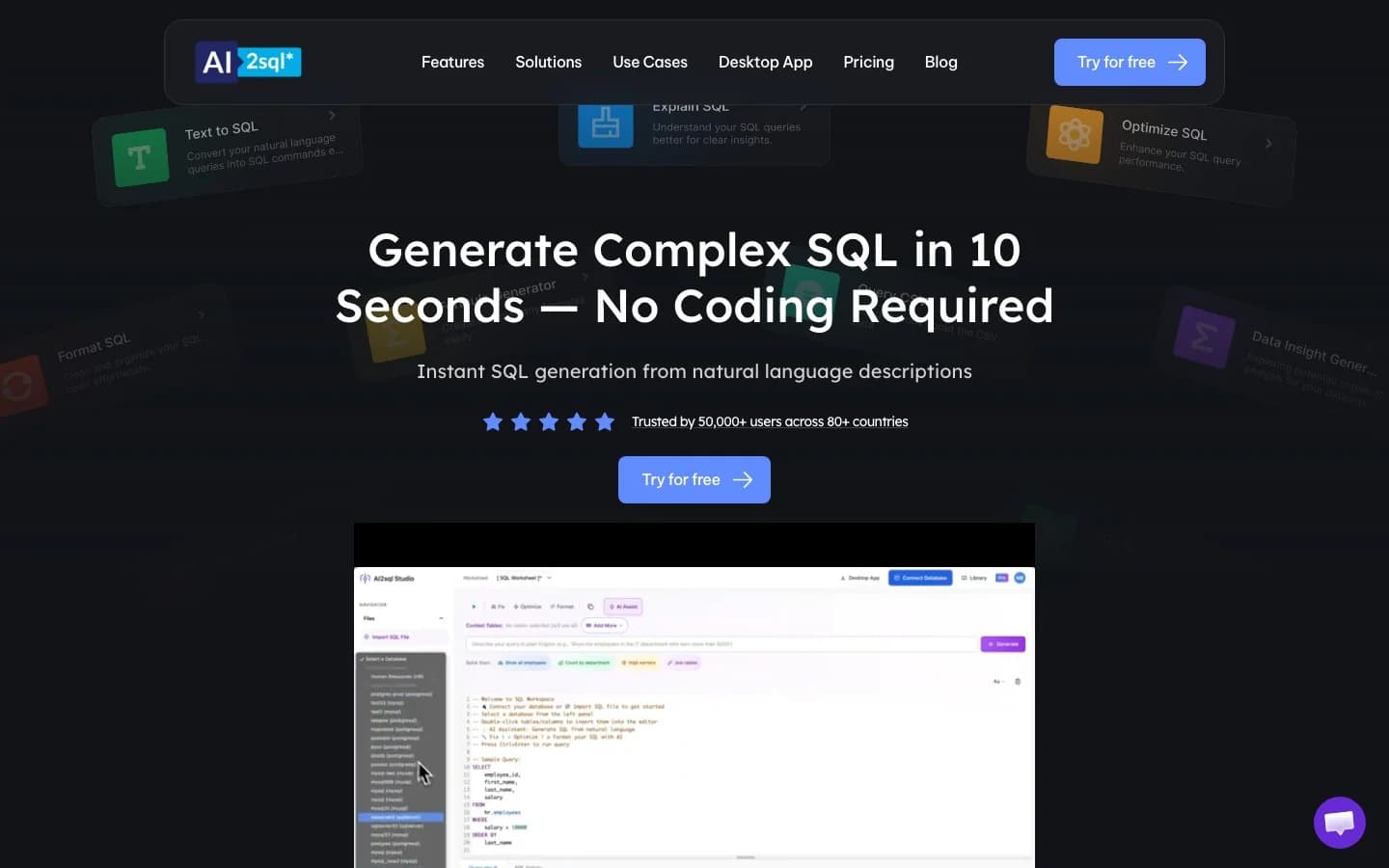
AI2SQL is the simplest tool in this list. It takes a plain English description and returns valid SQL, either as a standalone query builder or connected to your database. No dashboards, no collaboration features, no reporting. Just SQL generation.
It started in 2021, has been built by a solo founder, and has attracted 50,000+ registered users. For developers or analysts who know SQL and just want to move faster on query writing, it serves that narrow use case well.
What you get:
- Natural language to SQL query generation
- Support for MySQL, PostgreSQL, Oracle, MongoDB, BigQuery, MariaDB, Redshift, Snowflake (varies by tier)
- ER diagram generation and formula builder
- Desktop app and API integration (Business tier)
- 7-day free trial on all plans
Pricing (As of April 2026):
| Plan | Price | Query limit | Table limit |
|---|---|---|---|
| Start | $9/month | 100 queries/month | 10 tables |
| Pro | $24/month | 300 queries/month | 50 tables |
| Business | $39/month | 1,000 queries/month | Unlimited |
| Enterprise | Custom | Custom | Custom |
One thing to watch: AI2SQL is a solo-founder product with around $60K ARR. There are no employees, no investors, and no disclosed roadmap. If the founder steps back, support and updates stop. That is worth factoring in for any team considering it as a production tool. The query limits are also aggressive: 100 queries at $9/month is not much headroom for active analysis.
Choose AI2SQL when you are a developer or analyst who writes SQL regularly and wants a quick assistant for translating business questions into query syntax, with minimal overhead.
Basedash still wins when you need a full BI workflow with dashboards, Automations, and team collaboration rather than a standalone query generator.
6. Chat2DB
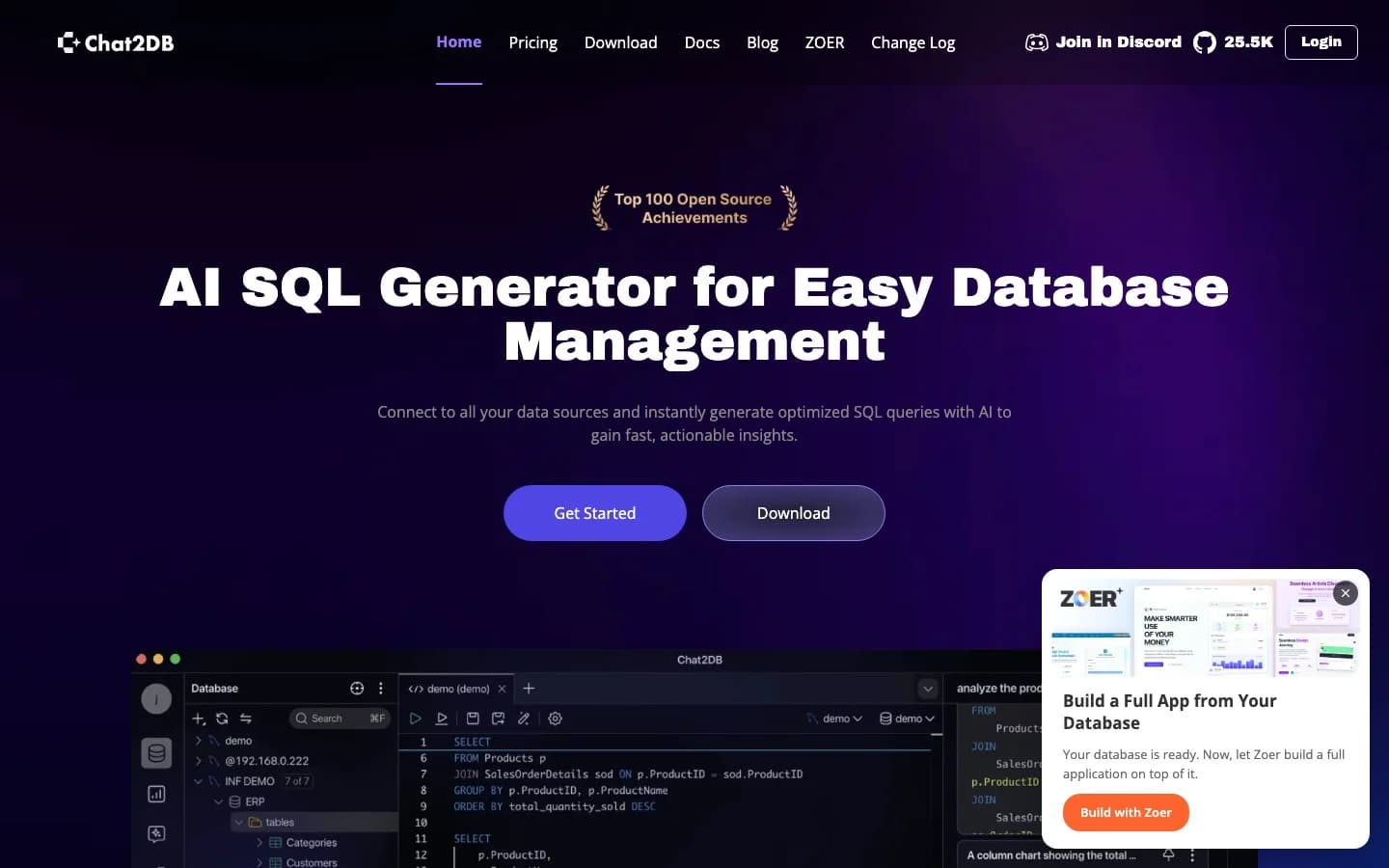
Chat2DB is an open-source SQL client that originated as an Alibaba project and is now operated commercially by CodePhiliaX in Hangzhou, China. The codebase is Apache 2.0 licensed and self-hostable. The cloud product (Chat2DB PRO) adds AI-powered query generation, a database management UI, and team collaboration features. It claims 1M+ developers using it.
For teams that want a full SQL client with AI features and prefer open-source infrastructure, Chat2DB is the only option in this list that delivers both.
What you get:
- AI-powered text-to-SQL over 20+ databases
- Full SQL client: table editor, console, formatting, schema browser
- Cloud SaaS (PRO) and self-hosted options
- Team management and shared workspaces (Team tier)
- 30-day trial on Pro, no payment info required
- Apache 2.0 license, full self-host available
Pricing (As of April 2026):
| Plan | Monthly | Annual | Notes |
|---|---|---|---|
| Community | Free | - | Manual AI config, basic SQL client |
| Starter | $8/user/month | ~$6/user/month | 3,000 AI requests/month |
| Pro | $16/user/month | ~$12/user/month | Unlimited AI requests |
| Team | $40/user/month | ~$30/user/month | Shared team management |
| Enterprise | Custom | Custom | Private deployment, SSO |
One thing to watch: Chat2DB's cloud product runs on infrastructure in China, which raises data residency questions for European teams and regulated industries. The HN launch was flagged by moderators for suspected vote manipulation. Primary documentation and community support are in Chinese. Teams outside China should evaluate compliance implications carefully before adopting the cloud tier. The open-source self-hosted version sidesteps most of these concerns.
Choose Chat2DB when you want an open-source SQL client with AI query generation, and you are comfortable self-hosting or have evaluated the data residency implications of the cloud product.
Basedash still wins when you need AI-generated dashboards, Automations, and a Slack bot rather than a database management interface.
How to choose
The decision depends on two things: who is asking the questions, and where your data lives.
For non-technical teams asking business questions over live databases, Sequel is the strongest fit. The self-learning agents mean the tool improves as your team uses it, and the multi-source query capability removes the constraint of having to normalize everything into one warehouse first. The free plan lets you start immediately without a budget conversation.
For individuals and small teams working primarily with files, Julius AI covers that use case at the free and Plus tiers. If you eventually need database connectors, expect the jump to $375/month (annual) at the Business tier.
For technical data teams building shared analyses, Hex offers the most mature collaborative notebook environment. The Series C funding and Snowflake partnership make it a safe long-term bet for teams that need SQL and Python together.
For regulated or privacy-sensitive environments, BlazeSQL's desktop app and local mode are unique in this category. No other tool here offers true offline analysis.
For individual developers who just need faster SQL generation, AI2SQL covers the basics at $9/month, though the query limits and solo-founder risk are real constraints.
For open-source advocates, Chat2DB's self-hosted tier works for SQL client needs, with the caveat that cloud sync and data residency require careful evaluation for non-Chinese teams.
If you want to try Sequel before committing to anything, the free plan is a full product experience: 3 seats, 1 data source, and enough AI credits to evaluate whether the self-learning agent approach works for your team's questions.
Start free with Sequel. No credit card required.