
Julius AI vs Sequel: Which AI Data Analyst Is Right for Your Team?
Julius AI raised $14.5M from Bessemer and reports 2 million users. It was built around file uploads.
Sequel is different. It connects to live databases and runs agents that learn your business over time — not just your files. Same category label. Very different products in practice.
If you're choosing between them for a team that runs on real data, the differences matter more than the branding.
Quick Comparison
| Feature | Julius AI | Sequel |
|---|---|---|
| Starting price | $0 (file-only) | $0 (3 seats, 1 DB) |
| Team DB access | $375/month (annual) | $99/month |
| Database connectors | PostgreSQL, BigQuery, Snowflake (Business+) | PostgreSQL, MySQL, ClickHouse, Turso, Cloudflare D1, MotherDuck |
| Cross-source joins | No | Yes |
| Self-learning agents | No | Yes |
| Credit-based pricing | Yes | No (flat + AI credit budget) |
| Semantic layer | No | Yes (agents learn your schema) |
| Self-hosted option | Enterprise (custom) | Enterprise ($custom) |
| Multi-model support | GPT, Claude, Gemini (Pro+) | Yes (BYO keys on Enterprise) |
| SOC 2 compliant | Yes | Enterprise tier |
Pricing as of April 2026.
What Is Julius AI?
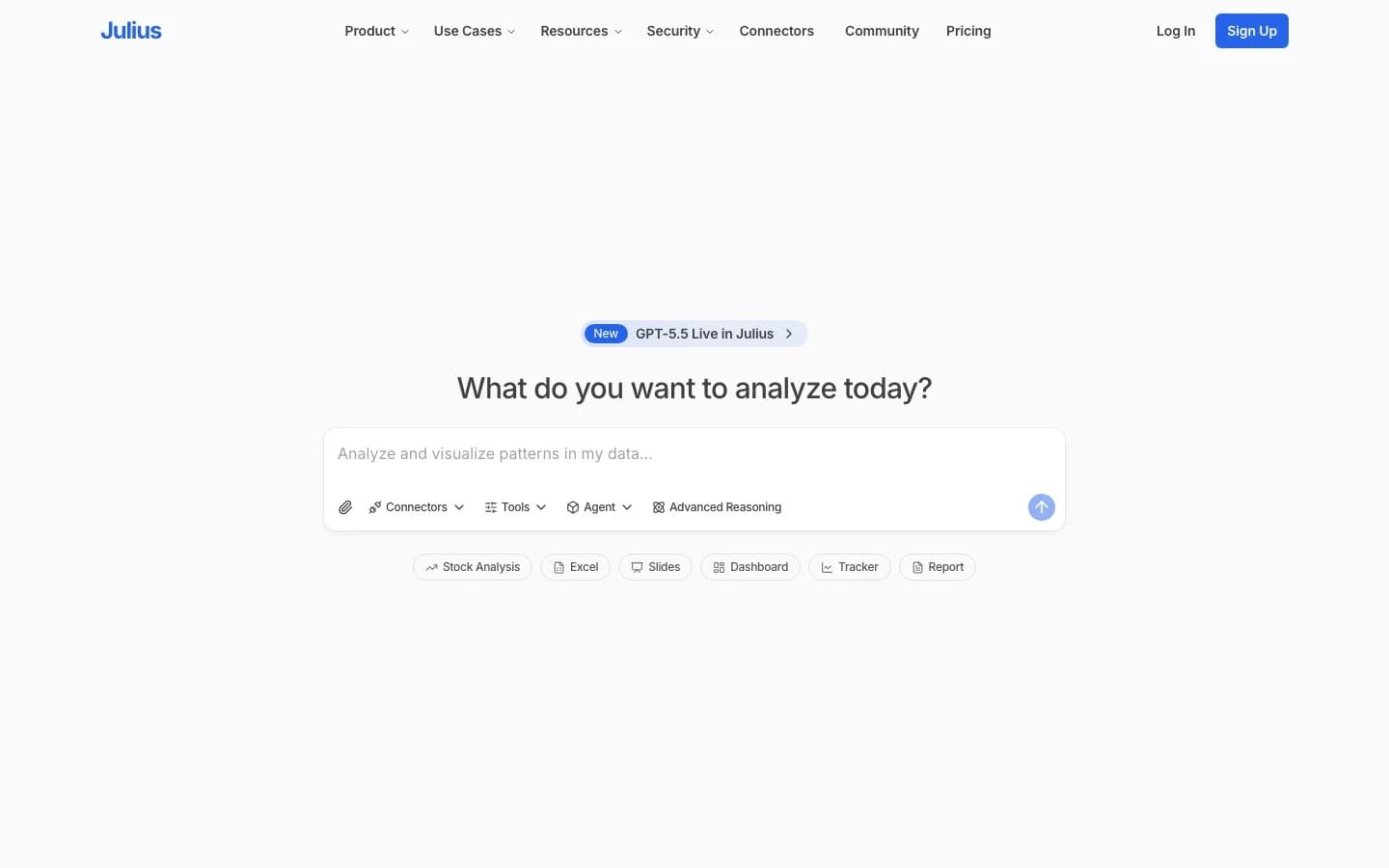
Julius AI started as a file-first tool. Upload a CSV, ask a question, get a chart. The product supports multiple AI models on the Pro plan and reports 2 million users.
The 2025 seed round from Bessemer pushed Julius toward enterprise. Direct database connectors landed. Scheduled Slack reports followed. SOC 2 Type II compliance was certified. The product is clearly trying to grow from consumer tool to team platform.
Where teams run into friction is the architecture underneath. Julius was built around files. The database connectors arrived later, and it shows. There's no semantic layer, so the same question asked twice might return calculations from different columns depending on which model run interprets "revenue" that day. For individual analysts, that's manageable. For a team where five different people query the same metric, it becomes a consistency problem.
The pricing compounds the issue. Database access for a team requires the Business plan at $375/month (billed annually, or $450/month). Individual plans are file-only. That's a meaningful jump for a feature set that was added as an extension rather than a foundation.
From the HN thread on Julius's competitors: "IMO they suck because they try to solve an advanced problem without addressing intermediate steps first. How can their AI answer questions about entire data ecosystems if AI as a whole can't even correctly answer questions about individual databases?" (u/Durovilla, r/datascience)
The criticism is pointed, but it identifies something real: bolting database complexity onto a file-analysis core creates gaps that pricing tiers alone can't fix.
Julius AI is strongest when:
- Users work primarily with uploaded files (CSV, Excel, Google Sheets)
- The team is small and doesn't need a shared semantic layer
- Multi-model flexibility matters more than schema-level consistency
- The workflow centers on one-off analyses rather than recurring team queries
What Is Sequel?
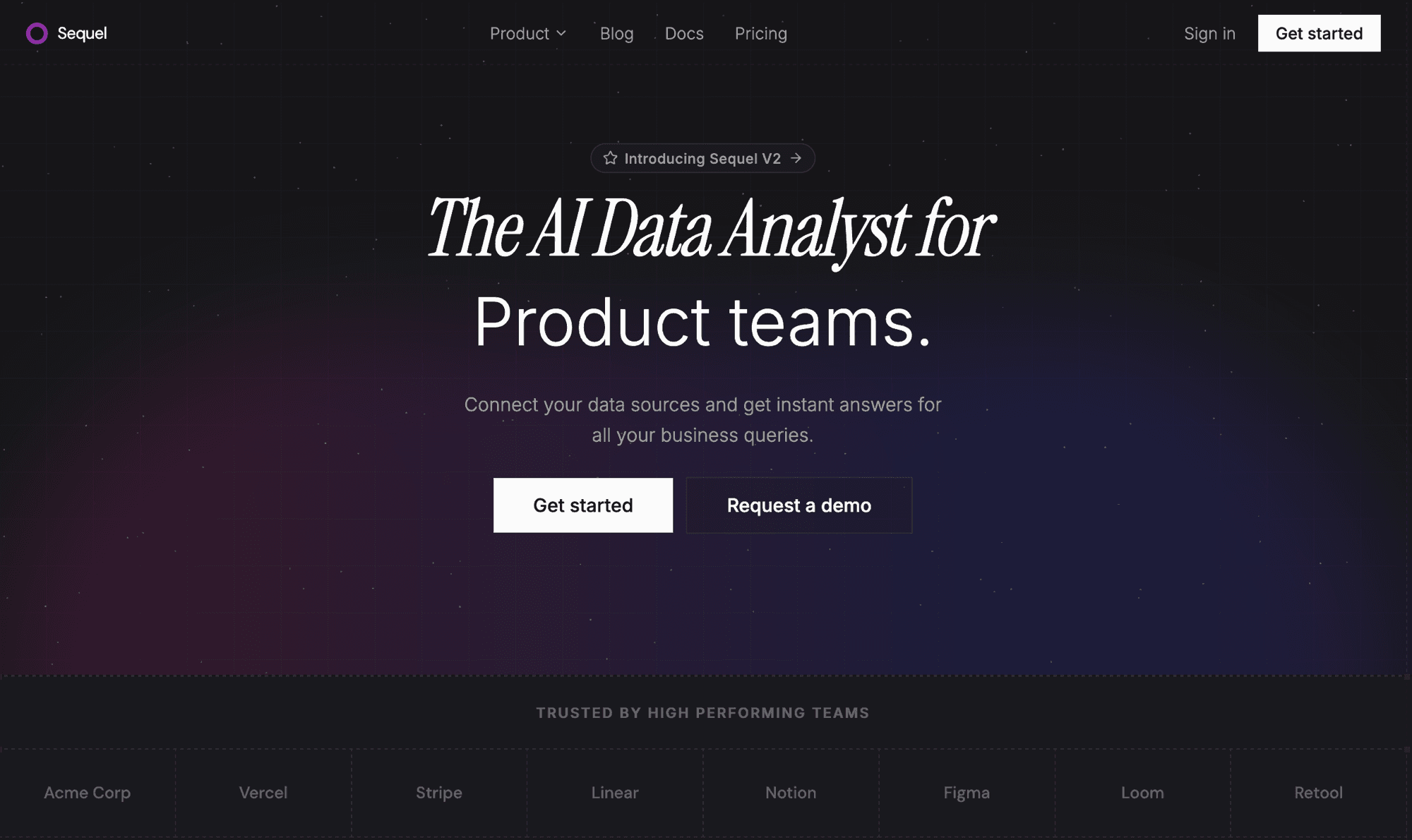
Sequel was built database-first. Connect a live source, ask a question in plain English, get SQL back with a rendered chart. The product launched publicly in September 2024 and has since expanded to support multiple database types and a set of differentiators that go meaningfully beyond query generation.
Self-learning agents
Sequel's agents don't start from zero every time. They build understanding of your schema and query patterns across sessions. Ask about "MRR" and the agent learns that in your database, that's calculated from the subscriptions table with specific filters. The next time someone asks, that context is already there. Over weeks and months, the agent's understanding of your data model compounds.
Self-improving from feedback
When a query result is wrong, Sequel learns from the correction. Agents refine themselves based on explicit feedback and result patterns. The improvement is continuous and doesn't require manual rule-writing or prompt tuning by the team.
Cross-source joins in a single question
Most tools query one source at a time. Sequel can span multiple connected databases and APIs in a single natural language question. Ask "Which of our customers from the CRM also have active subscriptions in the billing database?" and Sequel handles the join across sources, returning a unified answer rather than making you stitch results together manually.
Multi-agent systems that learn the business
Sequel builds context at the organizational level, not just the query level. It learns your terminology, KPIs, and data model over time. Teams that use Sequel for months end up with an AI analyst that genuinely understands how the business measures things, not just how to run SQL.
Pricing (As of April 2026)
| Plan | Price | Seats | Sources | AI credits |
|---|---|---|---|---|
| Free | $0 | 3 | 1 | Up to $10/month |
| Pro | $99/month | 10 | 10 | Up to $25/month |
| Startup | $999/month | 25 | Unlimited | Up to $250/month |
| Enterprise | Custom | Unlimited | Unlimited | Bring your own keys |
The Enterprise tier supports full self-hosting. Teams bring their own API keys, host on their own infrastructure, and control their own costs. Usage is effectively unlimited when self-hosted.
Supported databases: PostgreSQL, MySQL, ClickHouse, Turso, Cloudflare D1, MotherDuck. BigQuery, Snowflake, MongoDB, and Redshift are on the roadmap.
Head-to-Head: Five Dimensions That Actually Matter
1. Pricing for teams with database access
Julius AI's free tier is file-only. To connect a database for a team, you need the Business plan: $375/month billed annually, or $450/month month-to-month. That plan includes 10 seats and a credit allotment that can run out depending on query volume.
Sequel's Free plan includes 3 seats and one database connection at no cost. The Pro plan is $99/month for 10 seats and 10 sources. For teams that need database access from day one, the entry cost is dramatically lower. And the pricing is flat rather than credit-based, which makes budgeting predictable.
If your team of 10 needs live database access, Julius AI costs $375/month at minimum. Sequel costs $99/month.
2. Database support and architecture
Julius supports PostgreSQL, BigQuery, and Snowflake on Business plans. These are the major cloud data warehouses, but the connectors were added after the fact. Teams querying complex schemas have reported inconsistent results across sessions because there's no shared semantic layer holding metric definitions in place.
Sequel supports PostgreSQL, MySQL, ClickHouse, Turso, Cloudflare D1, and MotherDuck. The architecture is database-native from the start. More importantly, Sequel's semantic layer means the agent retains definitions across queries. "Revenue" means the same thing every time, because the system learned it from your schema and team usage.
3. Multi-source queries
Julius queries one connected source at a time. Cross-referencing data from two databases means running separate queries and combining results yourself.
Sequel handles cross-source joins natively. A single natural language question can span multiple databases and APIs. For teams whose data lives in more than one place (which is most teams), this removes a step that often breaks the self-service promise entirely.
4. Agent learning and team context
Julius has no persistent learning layer. Each session starts fresh from the connected schema. There's no mechanism for the system to retain what "churn" means in your data model, or to remember that last Tuesday's query about "active users" used a 30-day rolling window.
Sequel's agents accumulate context. The longer the team uses it, the more accurately the agent interprets ambiguous terms, selects the right tables, and applies the right filters. It's not a static query generator. It's an analyst that gets better at your specific business over time.
5. Non-technical users in a team context
Julius's file-upload flow is genuinely accessible. Uploading a CSV and asking questions requires no technical knowledge, and the interface is clean. But when database connectors enter the picture, the gap between what non-technical users expect and what the tool delivers can widen. Without a semantic layer, results depend on which column names the AI happens to pick, and there's no feedback mechanism to correct recurring misinterpretations.
Sequel is designed for exactly this use case: non-technical team members asking questions against live data, with an agent that improves from corrections. Business teams can define KPIs once, and the agent applies them consistently across every user's questions. The feedback loop turns misses into improvements rather than leaving them as unresolved inconsistencies.
Who Should Choose Julius AI
Julius AI fits teams whose main workflow is uploading files — CSVs, Excel sheets, or Google Sheets. If your team doesn't need live database access and works primarily with exports, Julius covers that use case.
Individual analysts who want ad-hoc queries without team context or shared metric definitions may also find it useful at the Pro tier ($45/month).
Who Should Choose Sequel
Sequel is built for teams that work with live databases and need more than a query generator. If your team has grown past ad-hoc analysis into repeatable workflows, shared metric definitions, and multi-source questions, Sequel's architecture addresses problems that Julius's wasn't designed to solve.
The self-learning agents are particularly useful for growing teams. As more people query the same data, the agent's understanding of the business compounds. The result is an AI analyst that gets meaningfully better over months rather than one that resets with every session.
Sequel is also the practical choice for teams that need database access without a $375/month commitment. The Pro plan at $99/month covers 10 seats and 10 sources, with the agent learning built in from day one.
For teams on self-hosted infrastructure, or those with strict data residency requirements, the Enterprise tier with bring-your-own keys and full self-hosting makes Sequel viable in environments where SaaS AI tools are otherwise a compliance problem.
Conclusion
Julius AI started as a consumer file-analysis tool and has since added enterprise features. But the architecture reflects where the product started, not where teams need it to go. No semantic layer, credit-based pricing that scales unpredictably, and database connectors added on top of a file-first core. These are structural constraints, not gaps a new pricing tier can patch.
Sequel was designed for teams that run on databases from the start. Agents that learn your schema. Agents that improve from feedback. Cross-source joins in a single question. Flat, predictable pricing that starts at $0 for three seats with a live database connection.
If your team is outgrowing spreadsheet-based analysis and needs an AI analyst that actually learns your business, try Sequel free. No credit card required.