
BlazeSQL vs Sequel: Which AI Data Analyst Is Right for Your Team?
BlazeSQL and Sequel both translate natural language into SQL queries against your databases. BlazeSQL offers broad database support and a desktop app with local data processing. Sequel builds an AI layer that learns how your business works and improves with use.
The question isn't which product is more impressive on a spec sheet. It's which one actually fits how your team works.
Quick comparison
| BlazeSQL | Sequel | |
|---|---|---|
| Free tier | No (14-day trial only) | Yes, 3 seats |
| Starting price | ~$149/month (Sept 2024; pricing page is a 404 as of April 2026) | $99/month (10 seats) |
| Database support | 12+ (Snowflake, BigQuery, PostgreSQL, MySQL, and more) | 6 live (PostgreSQL, MySQL, ClickHouse, Turso, Cloudflare D1, MotherDuck) |
| Self-hosted option | Enterprise (custom) | Enterprise |
| Bring-your-own API keys | Not publicly documented | Yes (Enterprise) |
| Agent learning | Not documented | Self-learning and self-improving |
| Cross-source joins | Not documented | Yes |
| Desktop app | Yes (privacy-first offline mode) | No |
What is BlazeSQL?
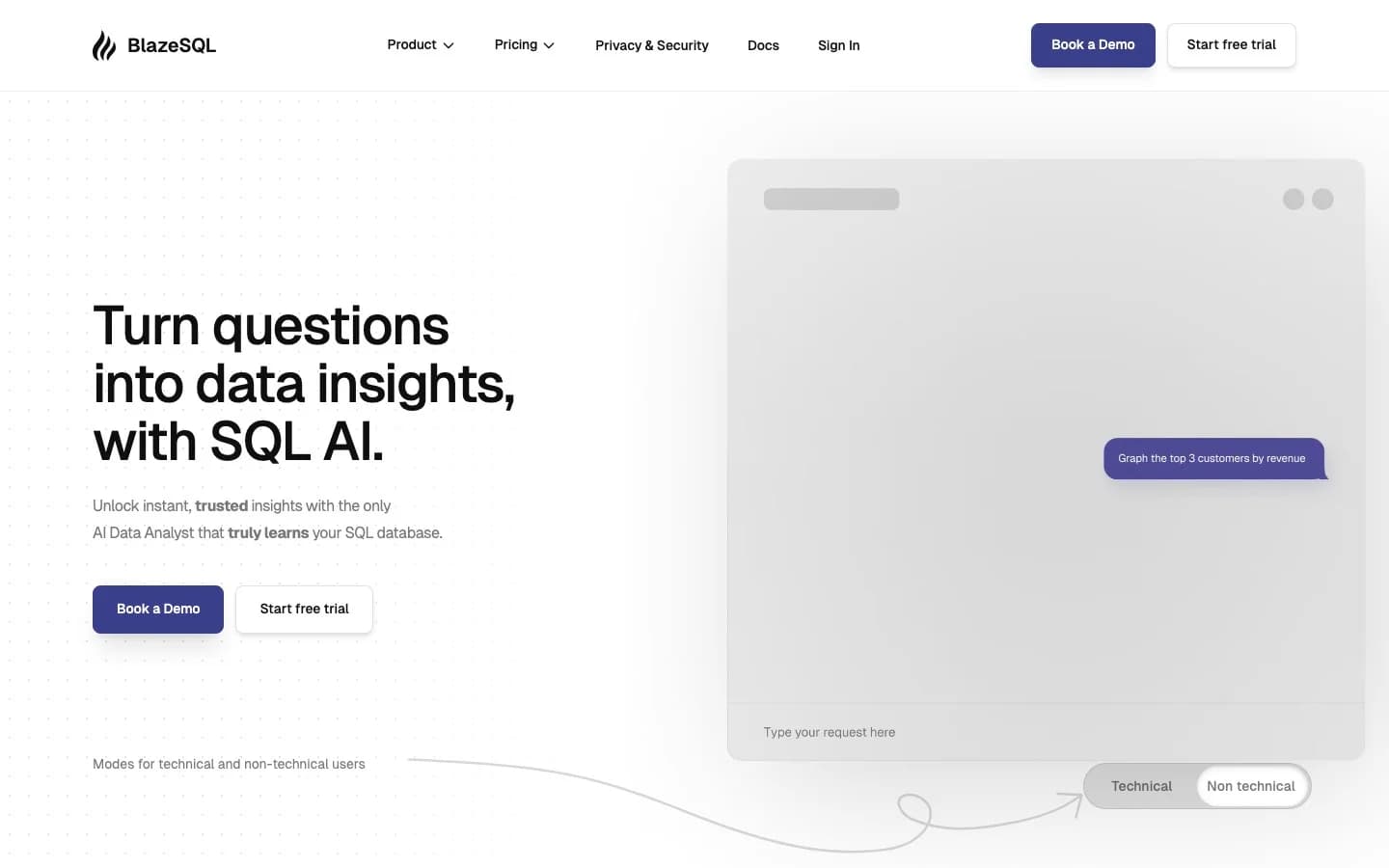
BlazeSQL is an AI-native BI platform built around natural language queries over SQL databases. Its clearest differentiator is the desktop app with a local/offline mode, which keeps query data on the user's machine rather than sending it through a cloud service. For teams in regulated industries where data can't touch external servers, that's a meaningful option.
The product claims 2M+ questions answered and lists enterprise customers including Flixbus, eBay, Siemens, Yamaha, and Amazon.
Database coverage is BlazeSQL's broadest strength. The platform connects to more than 12 SQL environments: Snowflake, BigQuery, Microsoft SQL Server, PostgreSQL, MySQL, MariaDB, Oracle, Redshift, Databricks, Amazon Athena, ClickHouse, and SAP SQL Anywhere. If your team runs on any major enterprise data warehouse, BlazeSQL almost certainly connects to it.
There are consistent complaints worth knowing before you evaluate. Multiple users report the tool slows on large datasets. Complex queries sometimes need manual adjustment to return accurate results. Visualization customization is limited compared to dedicated BI tools. And documentation is sparse enough that some users described learning features through trial and error.
The biggest practical issue for teams doing pre-purchase research: BlazeSQL's pricing page (blazesql.com/pricing) returns a 404 as of April 30, 2026. The pricing data in this article comes from a BlazeSQL blog post published in September 2024. Treat those numbers as directionally accurate but potentially stale. Verify with the BlazeSQL team directly before budgeting.
Pricing (As of September 2024 blog post - current pricing unverifiable as of April 2026):
| Plan | Price | Seats |
|---|---|---|
| Blaze Pro | $39/month | 1 |
| Blaze Advanced | $99/month | 1 |
| Blaze Team | $149/month | 3 (+ $49/extra seat) |
| Blaze Team Advanced | $499/month | 3 (+ $75/extra seat) |
| Blaze Enterprise | Custom | Custom |
No permanent free tier. 14-day trial on the Team plan.
What is Sequel?
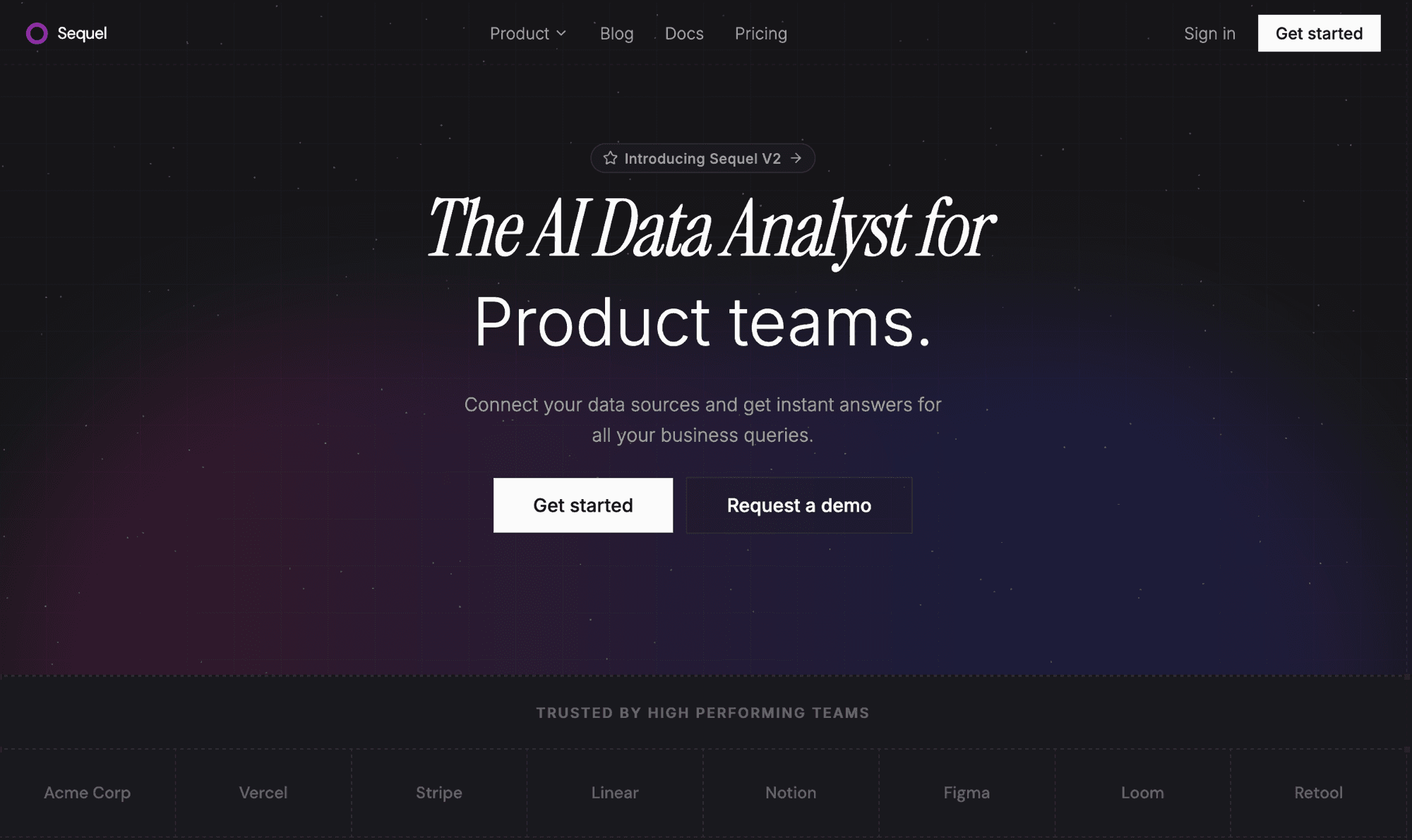
Sequel is an AI data analyst built for teams that want a system that improves with use, not one that requires constant tuning. It launched publicly in September 2024 and is bootstrapped by its founder, Musthaq Ahamad.
The core product translates natural language questions into optimized SQL, runs them instantly, and renders results as charts. What separates Sequel from most tools in this category is what happens after the first query.
Sequel's agents are self-learning. They build context about your schema and query patterns over time, which means the AI gets more accurate as it becomes familiar with your specific data model, terminology, and KPIs. They're also self-improving: the system refines itself based on feedback and results, reducing the manual correction loop that users of other AI SQL tools often describe.
A second structural difference is how Sequel handles data that lives in multiple places. A single natural language question in Sequel can span multiple connected databases, files, and APIs at once. Most teams have data that doesn't live in one place, and Sequel is built around that reality rather than assuming a clean single-source environment.
The multi-agent layer adds another dimension. Over time, Sequel builds a model of how your business works: the terminology your team uses, the KPIs that actually matter, the relationships between data sources. That accumulated context is the difference between an AI tool that answers questions and one that behaves like a colleague who has been on the team long enough to know what you're really asking.
Sequel also ships a Slack integration, an MCP server for use inside Claude and Cursor, and is working on native Firecrawl and web data integrations.
Pricing (As of April 2026):
| Plan | Price | Seats | Data sources | AI credits |
|---|---|---|---|---|
| Free | $0 | 3 | 1 | Up to $10/month |
| Pro | $99/month | 10 | 10 | Up to $25/month |
| Startup | $999/month | 25 | Unlimited | Up to $250/month |
| Enterprise | Custom | Unlimited | Unlimited | Bring your own keys |
Priority support is included on all paid plans. Enterprise includes a dedicated Slack channel, self-hosted deployment, and BYO API keys, which means no usage caps and no data leaving your infrastructure.
Head-to-head: 5 dimensions
1. Pricing transparency
This is a straightforward win for Sequel. Sequel's pricing page is live, detailed, and publicly verifiable. BlazeSQL's pricing page is a 404. The only publicly available BlazeSQL pricing data comes from a blog post the company itself published in September 2024. Whether those prices still apply is genuinely unknown. For a team doing a proper vendor evaluation, that's a material friction point.
2. Free tier
Sequel has one. BlazeSQL does not.
Sequel's Free plan gives 3 seats, 1 data source, and up to $10/month in AI credits with no time limit. That's enough to evaluate the product with a real connection to a real database, without committing to a paid plan or a 14-day countdown.
BlazeSQL's entry point is a 14-day trial on the Team plan. After that, you're paying.
3. Database support
BlazeSQL has the wider catalog right now. Twelve-plus databases, including every major enterprise warehouse: Snowflake, BigQuery, Redshift, Databricks, Oracle, and more. If your team runs on one of those, BlazeSQL connects to it today.
Sequel's live database list is shorter: PostgreSQL, MySQL, ClickHouse, Turso, Cloudflare D1, and MotherDuck. BigQuery, Snowflake, MongoDB, and Redshift are on the roadmap. Teams whose stack is already covered can start immediately. Teams that need BigQuery or Snowflake today will need to wait or use BlazeSQL in the interim.
4. Agent intelligence and learning
BlazeSQL doesn't document anything about agents that learn over time. Based on public information, it is an AI-to-SQL layer with a well-engineered accuracy model, but it does not appear to accumulate context about your business or improve automatically from use.
Sequel's agents are explicitly designed to do both. Self-learning means the agent builds an evolving understanding of your schema and query patterns. Self-improving means it refines its own outputs based on feedback. For teams that run repeated analyses on consistent data, that distinction matters more over time.
5. Documentation and setup
User feedback on BlazeSQL consistently mentions sparse documentation and a learning curve for less common features. One reviewer on aitools.xyz described having to "learn some features through trial and error." The quality of results also depends on how clean and well-documented the database schema is. Messier schemas require more setup time.
Sequel's setup is database-connection-first: connect a source, ask a question, and the agent starts learning from there. The self-learning architecture is designed to reduce the schema-documentation burden over time rather than front-loading it.
Who should choose BlazeSQL?
BlazeSQL is a strong fit if your team:
- Runs on Snowflake, BigQuery, Redshift, Databricks, or Oracle and needs those integrations today
- Operates in a regulated environment where a desktop app with local data processing is a hard requirement
- Is enterprise-scale and willing to negotiate a custom contract for white-label or API access
- Can tolerate a 14-day trial window and opaque current pricing as part of the evaluation process
BlazeSQL is a harder sell if your team needs a permanent free tier to evaluate before buying, or if pricing transparency is part of your procurement checklist.
Who should choose Sequel?
Sequel is the right call if your team:
- Wants a free tier to evaluate properly, with real data, before committing
- Has data spread across multiple sources and needs cross-database joins in a single question
- Values an AI that gets better with use rather than requiring ongoing manual tuning
- Needs self-hosted deployment with BYO API keys at the enterprise level
- Is running on PostgreSQL, MySQL, ClickHouse, or MotherDuck today
- Is on a startup budget and needs ten seats for $99/month without a per-seat penalty
For teams that are building toward a data-fluent culture, the self-learning, self-improving agent model is a structural advantage. The tool adapts to the team instead of the other way around.
The bottom line
BlazeSQL and Sequel solve similar problems with meaningfully different architectures.
BlazeSQL's strength is breadth: more database integrations, a desktop app for privacy-sensitive environments, and enterprise customers that validate it at scale. Its weakness is transparency: a broken pricing page and no free tier make it hard to evaluate without direct contact with their sales team.
Sequel's strength is depth. The self-learning agent model, cross-source joins, and a genuinely accessible pricing structure (including a free tier that doesn't expire) make it easier to start and more valuable over time.
If you need Snowflake or BigQuery today and privacy-first desktop mode is a requirement, BlazeSQL is worth the evaluation call.
If you want to start free, scale transparently, and invest in an AI analyst that learns how your business works, Sequel is where to start.