
Best BlazeSQL Alternatives for AI Data Analysis in 2026
TL;DR
| Alternative | Best for | Starting price |
|---|---|---|
| Sequel | Teams that need multi-source joins and self-learning agents | Free (3 seats, 1 source) |
| Julius AI | Individual analysts uploading files and CSVs | Free (100 credits/month) |
| Hex | Data and engineering teams writing SQL + Python together | Free (Community tier) |
| Basedash | Startups that want AI dashboards with Slack integration | $250/month |
| AI2SQL | Developers who need a quick SQL generator on a tight budget | $9/month |
| Chat2DB | Open-source fans who want a self-hostable SQL client | Free (Community client) |
BlazeSQL lists enterprise customers including Siemens, eBay, Flixbus, and Yamaha. It offers a desktop app and connects to 12+ databases. But teams that try to evaluate it hit a wall fast. The pricing page at blazesql.com/pricing returns a 404. The best available pricing data comes from a BlazeSQL blog post from September 2024. At that rate, a team of three lands somewhere around $149 to $499 per month depending on tier, with G2 listing $400/month as the entry point for teams. There is no free tier, only a 14-day trial. Users report slowdowns on large datasets, limited visualization options, and documentation sparse enough that learning the tool is mostly trial and error.
If that evaluation gap has you looking for alternatives, here are six that are worth a proper look.
What is BlazeSQL?
BlazeSQL is an AI-native BI platform that translates natural language questions into SQL and runs them against your databases. It claims 2M+ questions answered and lists enterprise customers including Siemens, eBay, and Amazon on its homepage. The desktop app is the product's strongest differentiator: teams handling sensitive data can run BlazeSQL locally without sending queries to external servers.
Supported databases include Snowflake, BigQuery, PostgreSQL, MySQL, Microsoft SQL Server, Oracle, Redshift, Databricks, Amazon Athena, ClickHouse, MariaDB, and SAP SQL Anywhere.
Pricing (As of April 2026): The /pricing page is a 404. Based on a September 2024 BlazeSQL blog post, plans ranged from $39/month (single user) to $499/month (3 seats, advanced features), with enterprise pricing on request. BlazeSQL acknowledges in its own writing that it is "pricier than simple chatbots" and "overkill if you're just analyzing local CSVs." There is no free tier.
Comparison overview
| Tool | Starting price | Free tier | Database connectors | Team features |
|---|---|---|---|---|
| Sequel | Free | Yes - 3 seats, 1 source | PostgreSQL, MySQL, ClickHouse, Turso, Cloudflare D1, MotherDuck | All plans |
| Julius AI | Free (100 credits/mo) | Yes - files only | DB connectors from $375/month | Business ($375/mo+) |
| Hex | Free (Community) | Yes - 5 notebooks | 14+ databases | Professional ($36/editor/mo) |
| Basedash | $250/month | No | SQL sources (Basic); 750+ (Growth) | All plans |
| AI2SQL | $9/month | No | MySQL, PostgreSQL (Start); more on Pro | No team plan |
| Chat2DB | $8/user/month (cloud) | Community client only | 20+ databases (Pro+) | Team ($40/user/mo) |
| BlazeSQL | ~$149/month (2024 data) | No - 14-day trial only | 12+ databases | Team plan only |
1. Sequel - Best for multi-source AI analysis that learns your business
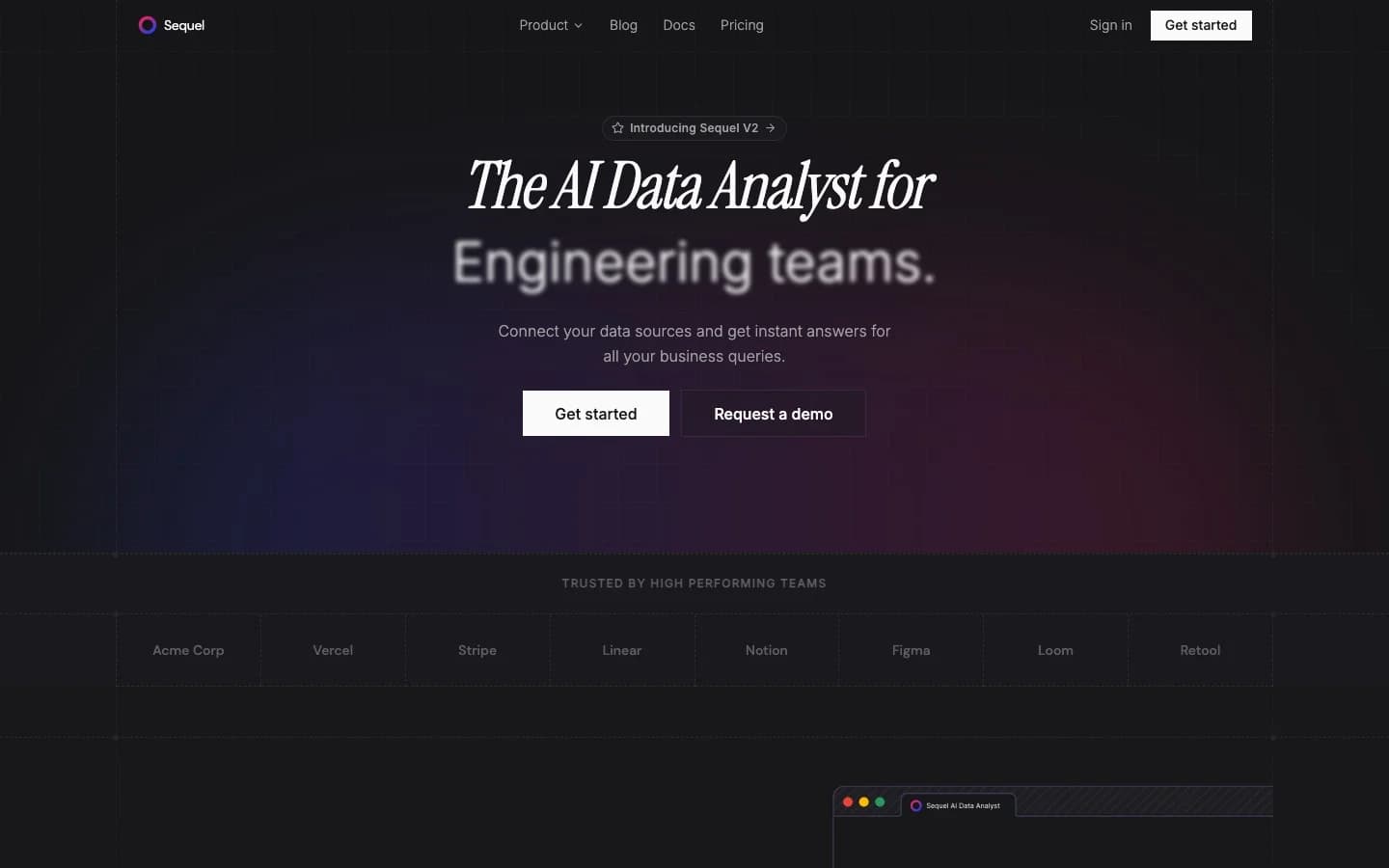
Sequel is an AI-native BI platform built around a different premise than most tools in this category. The core idea is that an AI data analyst should get better at your business over time, not just answer one-off questions. Sequel's agents are self-learning - they improve their understanding of your schema and query patterns as you use them - and self-improving, refining themselves based on the results they produce and the feedback they receive.
The feature that stands out most against BlazeSQL is cross-source joins. Ask Sequel a single question, and it can pull from multiple databases and APIs simultaneously. BlazeSQL connects to one database at a time.
Supported databases (live): PostgreSQL, MySQL, ClickHouse, Turso, Cloudflare D1, MotherDuck. BigQuery, Snowflake, MongoDB, and Redshift are on the roadmap.
Sequel also ships a Slack integration and an MCP server, so teams already inside Claude or Cursor can query their data without opening a separate app.
Pricing (As of April 2026):
| Tier | Price | Seats | Data sources |
|---|---|---|---|
| Free | $0 | 3 | 1 |
| Pro | $99/month | 10 | 10 |
| Startup | $999/month | 25 | Unlimited |
| Enterprise | Custom | Unlimited | Unlimited (self-hosted, BYO keys) |
The Free tier puts Sequel in an entirely different conversation from BlazeSQL for early-stage teams. Three seats and one data source at no cost means you can validate the tool against your actual data before paying anything.
The Enterprise tier supports self-hosting with bring-your-own API keys, which covers the privacy requirement that drives some teams toward BlazeSQL's desktop app in the first place.
One thing to watch: Sequel's database coverage is narrower than BlazeSQL's today. If your stack runs on Oracle, Redshift, or Databricks, you are waiting on the roadmap.
Choose Sequel when your team asks questions that touch more than one data source, you want agents that improve without manual retraining, or you need a free tier to run a real evaluation.
BlazeSQL still wins when you need a desktop app with true local/offline mode and your databases are already on BlazeSQL's supported list.
2. Julius AI - Best for file-based analysis with big-name backing
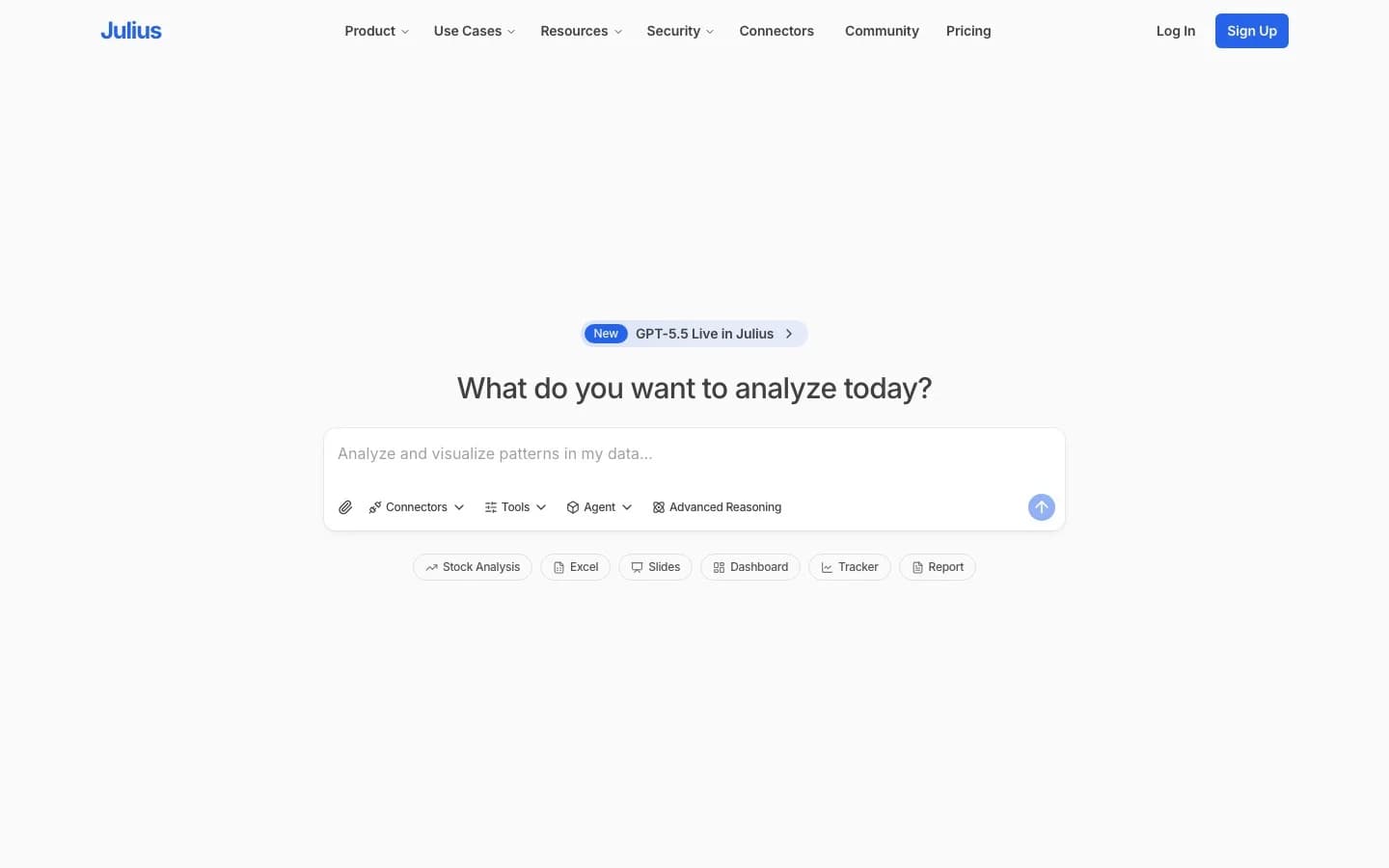
Julius AI is built around file analysis: upload a CSV, ask questions in plain English, get charts and Python code back. Database connectors were added later. Julius reports 2M+ users and raised $14.5M in 2025.
The catch for data teams: database connectors only unlock at the Business tier ($375/month billed annually, $450/month monthly). Below that, you are limited to file uploads. One reviewer on HN put it plainly: "How can their AI answer questions about entire data ecosystems if AI as a whole can't even correctly answer questions about individual databases?" That gap is real.
Julius also lacks a semantic layer. Ask about "revenue" today and it might use one column. Ask tomorrow and it might use another. For individual analysis that is fine. For team reporting where definitions need to be locked in, it is a problem.
Pricing (As of April 2026):
| Tier | Price | Notes |
|---|---|---|
| Free | $0 | 100 credits/month, file upload only |
| Plus | $20/month | 2,000 credits, 1 seat |
| Pro | $45/month | 4,000 credits, 1 seat, GPT + Claude + Gemini |
| Max | $200/month | 20,000 credits, 1 seat |
| Business | $450/month | 10 seats, DB connectors |
| Growth | $750/month | 30 seats, custom agents |
| Enterprise | Custom | SSO, RBAC, 64 GB RAM |
One thing to watch: The credit system means high-volume teams should model their expected usage before committing. Business tier overages are possible.
Choose Julius AI when your team primarily works with files and spreadsheets, wants to explore data without writing SQL, or needs the reassurance of SOC 2 Type II compliance and institutional investors behind the product.
BlazeSQL still wins when you need a direct database connection without paying for a Business-tier plan.
3. Hex - Best for data teams that write SQL and Python together
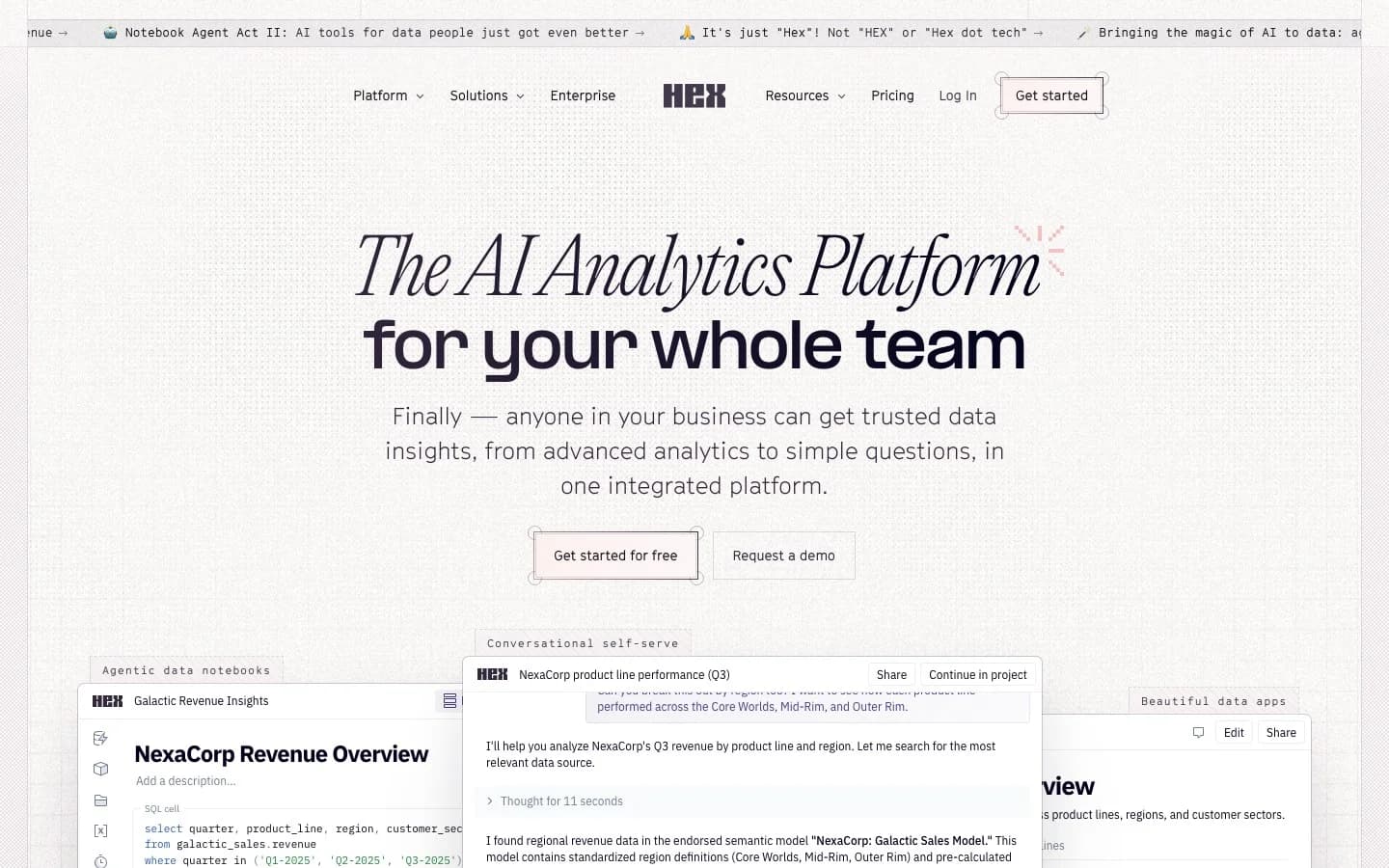
Hex is a collaborative notebook platform where SQL and Python live side by side. Data teams write queries and analysis in shared notebooks, then publish them as interactive apps. It raised a $70M Series C in May 2025 and reports 1,500+ teams and $19.8M in revenue in 2024.
Hex is built for technical users. The Hex team has said publicly they don't think "AI data analyst" should be a product category. A non-technical user asking a business question is not their target. A data engineer who version-controls analysis and publishes it as an app is.
Database coverage is extensive: Athena, ClickHouse, Databricks, BigQuery, MariaDB, MotherDuck, SQL Server, MySQL, Postgres, Redshift, Snowflake, Trino, and more. Snowflake is a strategic investor, so that integration runs particularly deep.
Pricing (As of April 2026):
| Tier | Price | Notes |
|---|---|---|
| Community | Free | 5 notebooks, 5 apps |
| Professional | $36/editor/month | Unlimited notebooks, Notebook agent |
| Team | $75/editor/month | Threads agent, Semantic model agent, scheduling |
| Enterprise | Custom | SSO, HIPAA, single-tenant, embedded analytics |
One thing to watch: Enterprise procurement teams have flagged Hex's Terms of Service around data handling. The concern has been raised publicly enough on r/dataengineering that it is worth legal review before signing an enterprise deal.
Choose Hex when your data team wants collaborative SQL and Python notebooks, you need to publish analysis as interactive apps, and your users are comfortable writing code.
BlazeSQL still wins when you need natural language access for non-technical business users who will not write a single line of SQL.
4. Basedash - Best for startups that want AI dashboards with Slack
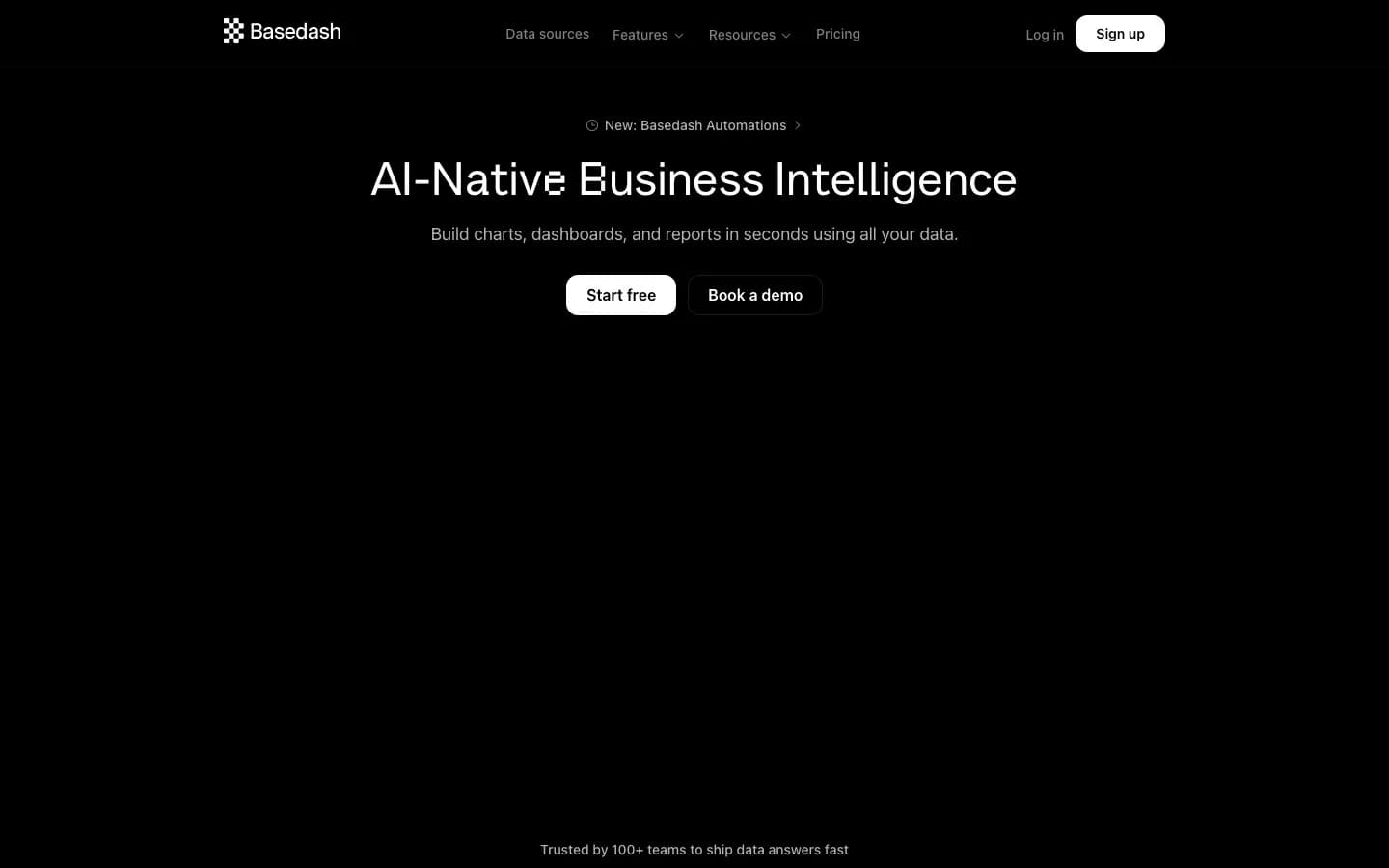
Basedash launched as a database admin panel (YC S20) and pivoted in 2024 to AI-native BI. The current product includes AI-driven dashboards, a Slack app, an MCP server, and Automations for recurring reports. The team is seven people.
The pricing is steep for what you get. Basic starts at $250/month for two users, with SQL sources only and $25/month in AI credits included. Growth is $1,000/month for 25 users with 750+ data sources. Neither tier has a free option.
For more on how Sequel compares directly to Basedash, see the Sequel vs Basedash comparison.
Pricing (As of April 2026):
| Tier | Price | Seats | Sources |
|---|---|---|---|
| Basic | $250/month | 2 | SQL only |
| Growth | $1,000/month | 25 | 750+ |
| Enterprise | Custom | Custom | Custom |
One thing to watch: Basedash is a 7-person bootstrapped team running a relatively complex platform. The product roadmap is moving quickly, but support and bug turnaround are limited by team size. AI credit overages can also surprise teams at the Growth tier.
Choose Basedash when your startup needs AI dashboards with a Slack integration and MCP server, you have a clean SQL database to start with, and your team is small enough that two or three users cover most of your needs.
BlazeSQL still wins when you need broader database coverage beyond SQL sources without jumping to the $1,000/month Growth tier.
5. AI2SQL - Best budget SQL generator for developers
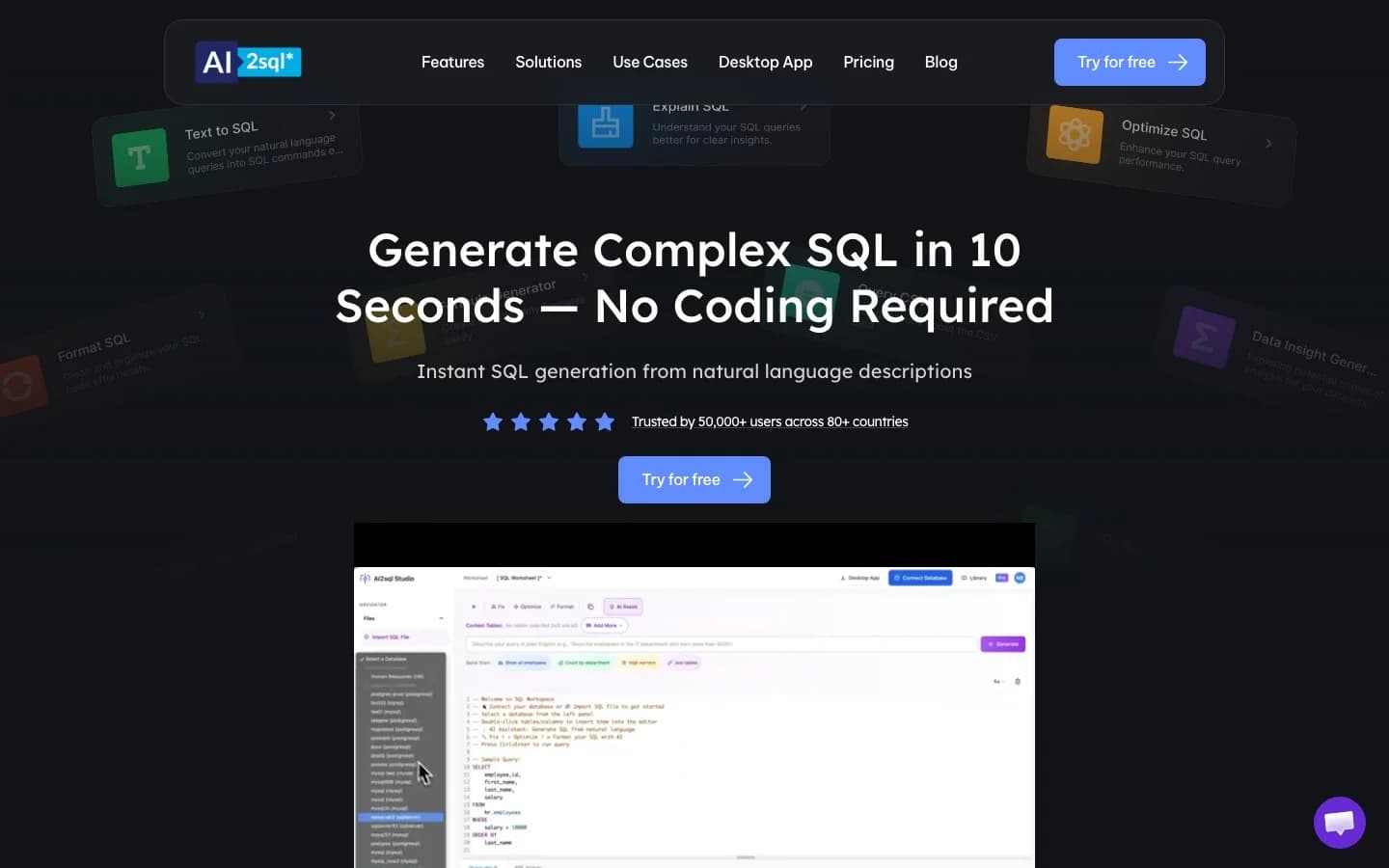
AI2SQL does one thing: it takes a plain-English description and returns a SQL query. That is the entire product. No dashboards, no visualizations, no reports. Connect a schema, describe what you want, get SQL back. At $9/month for 100 queries and $24/month for 300 queries, it is the most affordable entry point in this comparison by a significant margin.
The tradeoff is that it is not a self-service analytics tool. You still need to understand SQL well enough to verify the output and know when the query is wrong. One reviewer put it plainly: "It doesn't provide more advanced data analysis as the purpose is only to generate SQL queries." For a developer who writes SQL regularly and wants to move faster, that is fine. For a non-technical user trying to replace a data analyst, it falls short quickly.
The product is run by a solo founder. Revenue is $60.7K ARR per GetLatka. That is worth knowing: if the founder is unavailable, there is no support team, no roadmap owner, and no one to fix bugs.
Pricing (As of April 2026):
| Tier | Price | Queries/month | Tables |
|---|---|---|---|
| Start | $9/month | 100 | 10 |
| Pro | $24/month | 300 | 50 |
| Business | $39/month | 1,000 | Unlimited |
| Enterprise | Custom | Custom | Custom |
One thing to watch: The query and table limits are low. A team running even moderate analysis will hit the Start and Pro caps quickly. The Business tier at $39/month is the only version where limits stop being a daily concern.
Choose AI2SQL when you are a developer or analyst who writes SQL regularly, wants a fast query generator as a productivity layer, and needs the lowest possible price point.
BlazeSQL still wins when you need full AI-driven analysis including charts and explanation, not just a SQL string to paste into your database client.
6. Chat2DB - Best for open-source teams who want a self-hostable SQL client
Chat2DB started as an open-source project inside Alibaba and is now operated commercially by CodePhiliaX in Hangzhou, China. The GitHub star count is high and the codebase is Apache 2.0, which means you can self-host it without the commercial product. The cloud offering (Chat2DB PRO) starts at $8/user/month and scales to a Team tier at $40/user/month.
As a SQL client and database management tool, it covers a lot of ground: 20+ database types, AI query generation, table management, ER diagrams, and a desktop app. It is particularly popular with developers who want a DBeaver-style client with AI built in rather than a standalone AI analyst.
For enterprise buyers, the data residency question is real. The commercial cloud product routes data through infrastructure based in China. Teams subject to GDPR or operating in regulated industries need to evaluate this carefully before adopting the cloud tier. The self-hosted option exists, but it requires engineering capacity to run.
Pricing (As of April 2026):
| Tier | Price | Notes |
|---|---|---|
| Community (client) | Free | Manual AI config, basic SQL tools |
| Starter | $8/user/month | 3,000 AI requests/month |
| Pro | $16/user/month | Unlimited AI requests |
| Team | $40/user/month | Shared team management |
| Enterprise | Custom | Private deployment, SSO |
One thing to watch: Chat2DB's 2024 Show HN post was flagged by moderators, and a comment in Chinese appeared to reference vote manipulation. Community trust on Western developer forums is a live issue for the product.
Choose Chat2DB when you want an open-source SQL client with AI query generation, you are comfortable self-hosting, and data residency in the cloud tier is not a concern for your team.
BlazeSQL still wins when you need a desktop app that is clearly designed for enterprise teams and has named enterprise customers behind it.
How to choose
The right tool depends on what specifically sent you looking for BlazeSQL alternatives.
Pricing page is a 404 and you cannot evaluate what you would actually pay: Any tool with a live, transparent pricing page puts you ahead of where you started. Sequel, Julius AI, Hex, Basedash, AI2SQL, and Chat2DB all publish current pricing.
You need a free tier to run a real evaluation: Sequel (3 seats, 1 source, $0) and Julius AI (100 credits/month, file uploads) are the only options in this list with ongoing free access. Hex's Community tier covers 5 notebooks. Everyone else is a time-limited trial.
You want AI that improves over time: Sequel's self-learning and self-improving agents build context about your schema, terminology, and KPIs across sessions. That is qualitatively different from tools that treat every conversation as fresh.
You need to join data from multiple sources in one question: Sequel handles this natively. No other tool on this list does it by default.
You need a technical notebook environment: Hex is the clear choice. SQL and Python together, version-controlled, publishable as apps.
You want the cheapest possible SQL generator: AI2SQL at $9/month is the floor.
You want open-source and self-hostable: Chat2DB's Apache 2.0 client is the answer, with the data residency caveat understood.
Sequel's free tier covers three seats and one data source. If you are evaluating BlazeSQL and cannot get a clear answer on what it would cost your team, starting a Sequel evaluation costs nothing. The agents will start learning your schema from the first question.