
Best Chat2DB Alternatives for AI Data Analysis in 2026
TL;DR: best Chat2DB alternatives in 2026
| Alternative | Best for | Starting price |
|---|---|---|
| Sequel | Teams that want an AI data analyst that learns your business | Free (3 seats) |
| Julius AI | Knowledge workers analyzing uploaded files with AI | Free (100 credits/mo) |
| Hex | Data and engineering teams building collaborative notebooks | Free (5 notebooks) |
| Basedash | Startups that want AI-powered dashboards with Slack integration | $250/month |
| BlazeSQL | Privacy-first teams that need a local desktop AI SQL tool | $39/month |
| AI2SQL | Individual developers who want a lightweight SQL generator | $9/month |
Chat2DB is self-hostable under Apache 2.0 and connects to 20+ databases. The cloud SaaS starts at $8/user/month. The problems show up at the team level. Chat2DB's Pro tier requires cloud sync through servers operated in Hangzhou, China, which is a compliance non-starter for EU buyers and regulated industries. The tool's own FAQ acknowledges failures when tables have too many fields. The primary community and documentation are in Chinese. And in 2024, the Show HN launch was flagged by moderators after a comment surfaced in the thread appeared to show organized vote manipulation. The core product is also competing for engineering attention with Zoer, a companion app-builder that Chat2DB is building simultaneously.
Here are the six best Chat2DB alternatives in 2026, with pricing verified as of April 2026.
What is Chat2DB?
Chat2DB is an AI-powered SQL client and database management tool that began as an open-source project at Alibaba before spinning out as a commercial product under CodePhiliaX, a company based in Hangzhou, China. It claims over one million developers using the tool. The product line now spans a free desktop client, a cloud SaaS subscription (Chat2DB PRO), and an enterprise private deployment tier. The company is also developing Zoer, an AI app-builder product built on top of database connections.
- Community (desktop): Free tier; requires manual AI configuration; basic SQL console and table editor
- Chat2DB PRO (cloud): Subscription SaaS with AI-ready queries, team management, and cloud sync
- Enterprise: Private deployment, SSO, unlimited users, full security suite
Pricing (As of April 2026): the Starter cloud tier is $8/user/month for 3,000 AI requests. Pro is $16/user/month with unlimited AI requests. Team is $40/user/month. Enterprise pricing is by negotiation. A 30-day Pro trial is available without a credit card.
Top 6 Chat2DB alternatives in 2026
| Tool | Best for | Starting price | Natural language queries | Self-hosting | Multi-source joins |
|---|---|---|---|---|---|
| Sequel | AI analyst that learns your business | Free | Yes | Enterprise | Yes |
| Julius AI | File-based AI analysis | Free | Yes | No | No |
| Hex | Collaborative SQL + Python notebooks | Free | Yes (AI assist) | No | No |
| Basedash | Startup BI with Slack integration | $250/month | Yes | Enterprise | Yes (Growth) |
| BlazeSQL | Local desktop privacy | $39/month | Yes | Desktop app | No |
| AI2SQL | Lightweight SQL generation | $9/month | SQL generation only | No | No |
1. Sequel: the AI data analyst that learns your business
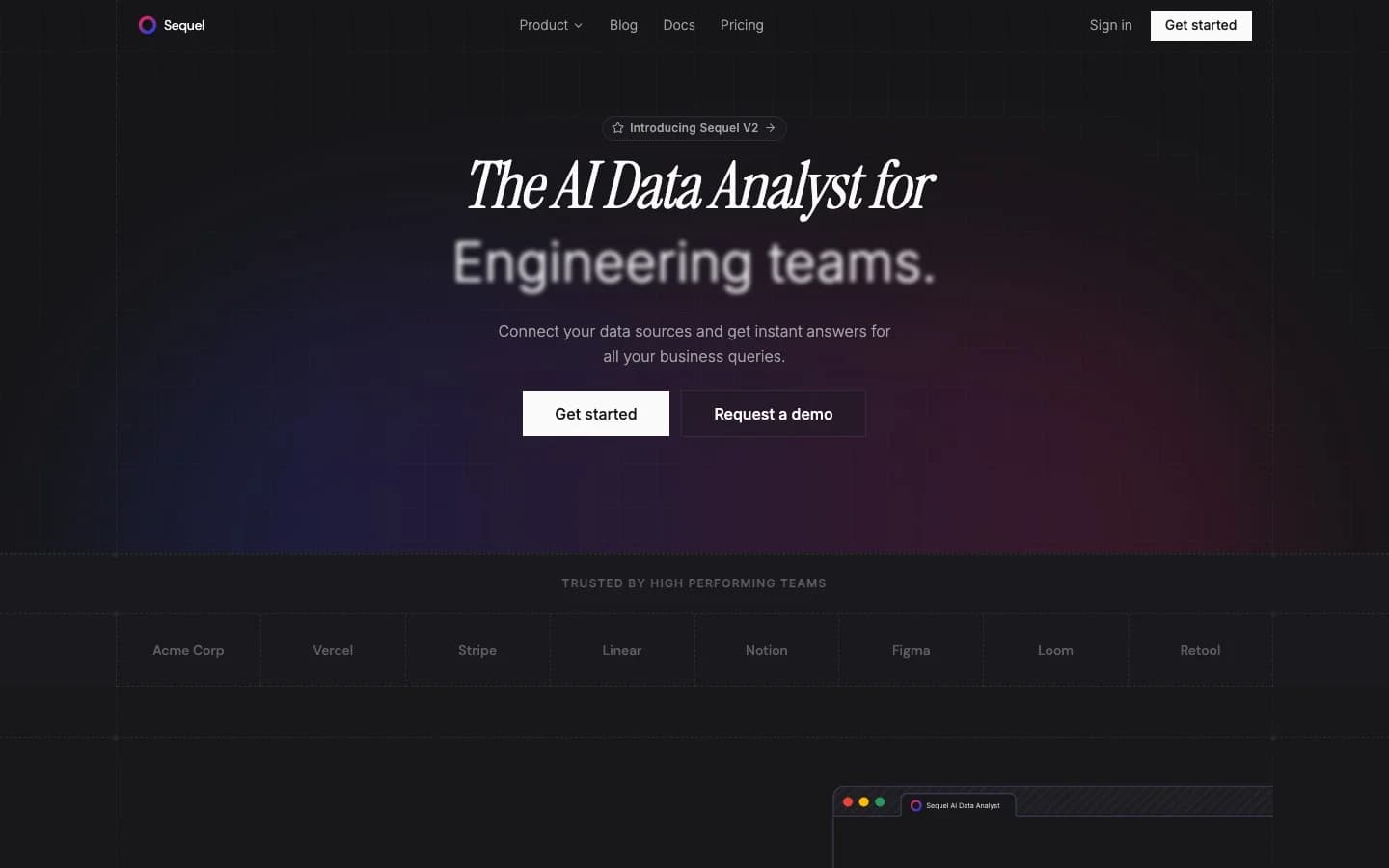
Sequel is an AI-native BI platform built from the ground up for teams that want a data analyst, not just a query generator. You ask questions in plain English. Sequel writes the SQL, runs it against your database, and renders the results as charts automatically. The agents are self-learning: they improve their understanding of your schema and query patterns the longer you use the product. They are also self-improving, refining themselves based on feedback and results over time. That combination means Sequel gets more accurate for your specific data model rather than staying static.
The most important architectural difference from Chat2DB is multi-agent intelligence. Sequel builds up context about your company's data model, business terminology, and KPIs across sessions. A single natural language question can span multiple databases and APIs simultaneously. Chat2DB operates as a SQL client with AI assistance; Sequel operates as an AI analyst that happens to query databases.
What Sequel does:
- Natural language to SQL with automatic chart rendering
- Self-learning agents that improve on your schema over time
- Multi-source joins: one question across PostgreSQL, ClickHouse, and external APIs in a single response
- Slack integration for querying data without opening a browser
- MCP server for use inside Claude and Cursor
- Enterprise tier: fully self-hosted, bring-your-own API keys, data never leaves your infrastructure
Live database connections: PostgreSQL, MySQL, ClickHouse, Turso, Cloudflare D1, MotherDuck. BigQuery, Snowflake, MongoDB, and Redshift are coming.
| Feature | Sequel | Chat2DB |
|---|---|---|
| Natural language to SQL | Yes | Yes |
| Self-learning agents | Yes | No |
| Multi-source joins | Yes | No |
| Self-hosted option | Enterprise | OSS (Apache 2.0) |
| Data residency control | Enterprise: full control | Cloud sync through Hangzhou |
| Starting price | Free (3 seats) | $8/user/month (cloud) |
Pricing (As of April 2026): sequel.sh/pricing
- Free: $0, 3 seats, 1 data source, up to $10/month in AI credits
- Pro: $99/month, 10 seats, 10 data sources, up to $25/month in AI credits, premium models
- Startup: $999/month, 25 seats, unlimited data sources, up to $250/month in AI credits
- Enterprise: custom pricing, self-hosted, bring your own API keys, unlimited seats and data sources, dedicated Slack channel
The Enterprise tier is the clearest differentiator for regulated-industry teams. You bring your own API keys and host on your own servers. Sequel's infrastructure never touches your data.
Choose Sequel when your team asks business questions that span multiple databases, when data residency is a procurement requirement, or when you want an AI analyst that improves with use rather than one that stays at a fixed capability level.
Chat2DB still wins when you need a self-hosted open-source SQL client with no ongoing cost and are comfortable manually configuring your own AI integration. The Apache 2.0 license and desktop client make Chat2DB a reasonable personal tool.
2. Julius AI: file-first AI analysis with database connectors added
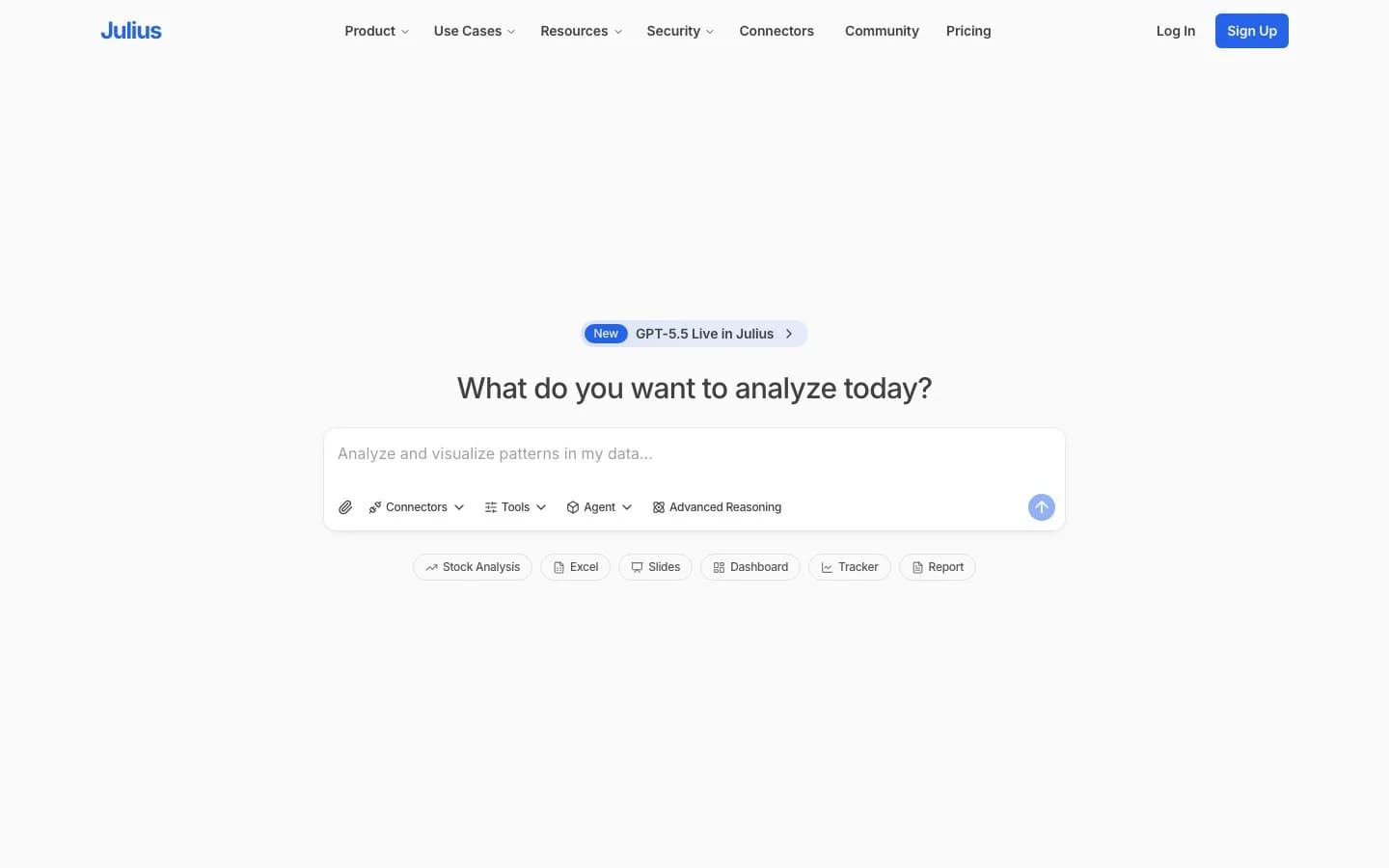
Julius AI is built around file uploads. Upload a CSV, an Excel file, or connect a Google Sheet, and Julius generates Python or R code to run the analysis, then produces charts. It reports over two million users and carries SOC 2 Type II, GDPR, and CCPA certifications.
The important context is that Julius was built as a file-analysis tool. Database connectors for PostgreSQL, BigQuery, and Snowflake were added later, and the underlying architecture reflects that history.
What Julius AI does:
- Natural language analysis on CSV, Excel, Google Sheets, OneDrive, and SharePoint
- Python and R code generation to run statistical analyses
- Scheduled reports delivered via Slack
- Database connectors for PostgreSQL, BigQuery, Snowflake (Business tier and above only)
- Model selection across GPT, Claude, and Gemini on Pro and above
One limitation to understand: database connectors are not part of the core product experience. As one competitive analysis notes, "Julius added SQL connectors, but the underlying architecture wasn't designed for data warehouse complexity." Metric definitions also drift between sessions since there is no semantic layer to lock in consistent column mappings. A reviewer on r/datascience put it plainly: "How can their AI answer questions about entire data ecosystems if AI as a whole can't even correctly answer questions about individual databases?"
| Feature | Julius AI | Chat2DB |
|---|---|---|
| File-based analysis (CSV, Excel) | Yes | No |
| Database connectors | Business tier ($375/mo annual) | Yes (all tiers) |
| Semantic layer | No | No |
| Visualization | Yes | Yes |
| Self-hosted option | No | Yes (Apache 2.0) |
| Starting price | Free (100 credits/mo) | $8/user/month |
Pricing (As of April 2026):
- Free: $0, 100 credits/month, Julius 1.1 Lite only, Google Drive only
- Plus: $20/month (or $16/month annual), 2,000 credits, 1 seat
- Pro: $45/month (or $37/month annual), 4,000 credits, all models
- Max: $200/month (or $166/month annual), 20,000 credits
- Business: $450/month (or $375/month annual), 45,000 credits, 10 seats, database connectors
- Growth: $750/month (or $625/month annual), 75,000 credits, 30 seats, custom agents
- Enterprise: custom pricing, 64 GB RAM, SSO, RBAC
One thing to watch. Julius's Trustpilot score sits at 2.5 out of 5 across six reviews, with recurring mentions of login failures and slow support responses. The jump from individual plans to Business ($375/month annual) for database access is steep for what still functions as secondary functionality. The credit system can also produce unexpected charges for teams used to flat-rate pricing.
Choose Julius AI when your team's primary workflow involves analyzing uploaded files, CSVs, or Google Sheets, and database queries are occasional rather than core.
Chat2DB still wins when your team primarily queries databases directly and does not need file-based analysis. Chat2DB's $8/user/month Starter is significantly cheaper than Julius's Business tier for teams that only need SQL generation.
3. Hex: collaborative notebooks for data and engineering teams
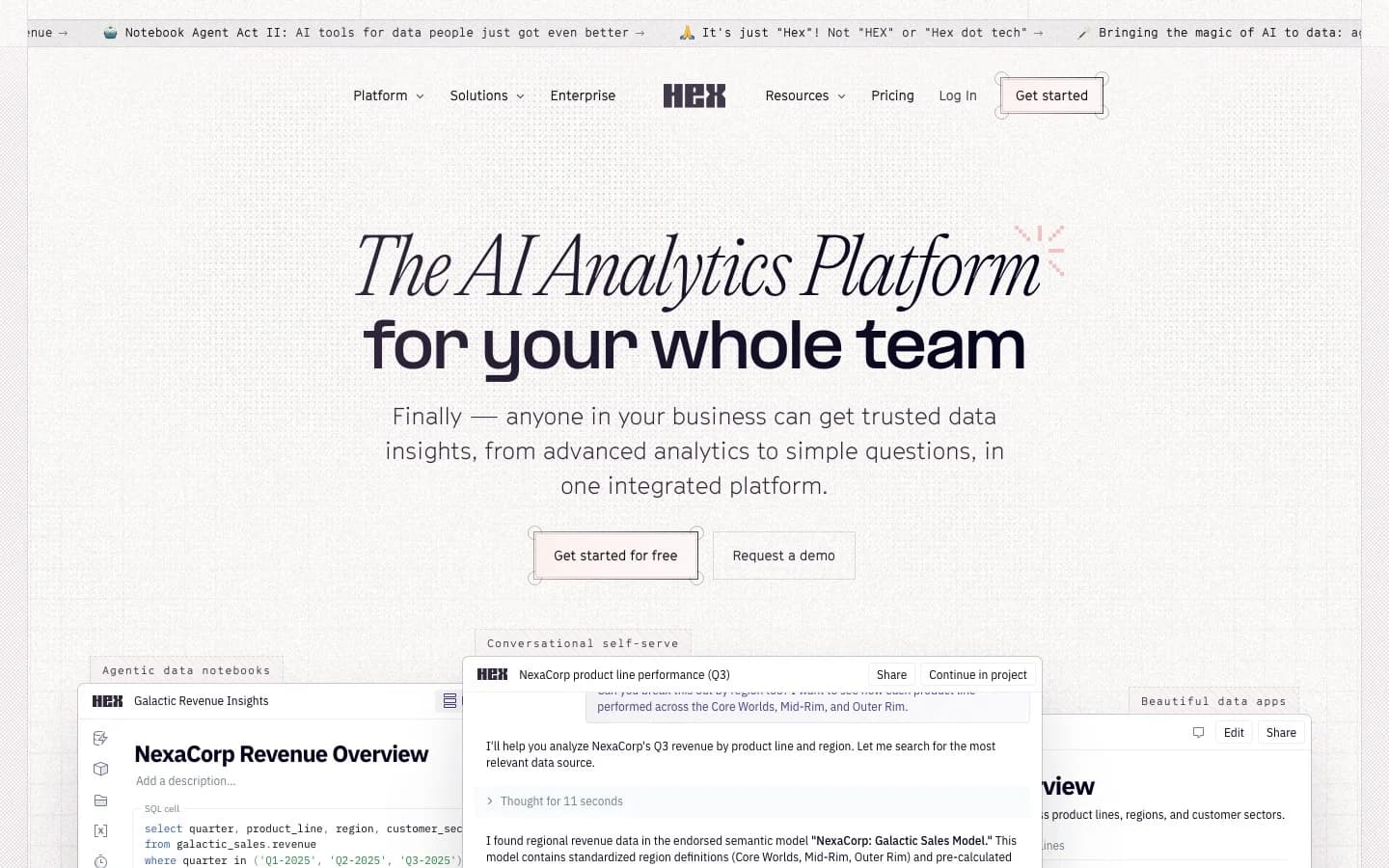
Hex is a collaborative data platform where teams write SQL and Python together in shared notebooks, then publish results as interactive apps. The AI features generate and edit code inline. Hex raised a $70M Series C in May 2025, reports $19.8M in revenue (2024), and serves over 1,500 teams.
In late 2025, Hex added a Notebook agent, a Threads agent, and a Semantic model agent. In April 2025, Hex acquired Hashboard, a BI startup; that integration is ongoing.
What Hex does:
- SQL and Python notebooks with reactive execution
- AI-assisted code generation and editing inline
- Publishable data apps from notebook outputs
- Connections to Snowflake, BigQuery, Redshift, Postgres, ClickHouse, Databricks, and others
- Agentic analytics: Notebook agent, Threads agent, Semantic model agent (Team tier)
Who it is not for: Hex is a technical tool. It requires SQL and some Python comfort. Business users without coding experience will struggle.
| Feature | Hex | Chat2DB |
|---|---|---|
| SQL notebooks | Yes | No |
| Python support | Yes | No |
| Agentic analytics | Yes (Team tier) | No |
| Non-technical user access | Limited | Yes |
| Self-hosted option | No (Enterprise: single-tenant) | Yes (Apache 2.0) |
| Starting price | Free (5 notebooks) | $8/user/month |
Pricing (As of April 2026):
- Community: Free, up to 5 notebooks and 5 apps
- Professional: $36/editor/month, unlimited notebooks, standard AI credits
- Team: $75/editor/month, 14-day trial, Threads agent and Semantic model agent, scheduling
- Enterprise: custom pricing, SSO, HIPAA, single-tenant deployment, embedded analytics
- Compute add-ons billed per hour (Large 16 GB: $0.32/hr; Extra Large 32 GB: $0.65/hr; GPU: $4.06/hr)
One thing to watch. Hex's Terms of Service have blocked enterprise procurement for some teams. A discussion in r/dataengineering flagged the concern directly: "I'd be very careful about Hex and what data they are pulling off you. On their Terms of Service there are several problems and it's what keeps them from being adopted by larger companies." The AI credits system is also just rolling out on the Team plan, and the budget implications are still unclear for heavy users. The Hashboard integration is in progress, which introduces migration risk for existing Hashboard customers.
Choose Hex when your data team writes SQL and Python regularly, wants to collaborate in shared notebooks, and needs to publish results as interactive apps that non-technical stakeholders can explore.
Chat2DB still wins when your team includes non-technical users who need to write queries without any coding background. Hex's workflow assumes code literacy; Chat2DB's natural language interface does not.
4. Basedash: AI-powered BI for startups and small teams

Basedash started in 2020 as a YC S20-backed database GUI, often described as a modern successor to Django Admin. In 2024, the team did a full product pivot to AI-native BI. Today it markets AI-driven dashboards, a Slack app for querying data from chat, an MCP server, and an Automations feature for scheduled queries. The team is seven people, and the product carries SOC 2 Type II certification. Revenue is approximately $1 million ARR.
The pivot is worth understanding. The original product built integrations for internal tools and admin panels. Those workflows are now deprecated. Current Basedash is a different product aimed at a different use case.
What Basedash does:
- Natural language to dashboard creation
- Slack app for querying databases from Slack channels
- Automations for scheduled queries and alerts
- MCP server for AI tool integration
- 750+ data sources on Growth and above
| Feature | Basedash | Chat2DB |
|---|---|---|
| Dashboard creation | Yes | Limited |
| Slack query integration | Yes | No |
| Automations / scheduled queries | Yes | No |
| Free tier | No (14-day trial only) | Yes (Community desktop) |
| Self-hosted option | Enterprise | Yes (Apache 2.0) |
| Starting price | $250/month (2 users) | $8/user/month |
Pricing (As of April 2026): Full comparison at sequel.sh/blog/basedash-alterntives
- Basic: $250/month, 2 users, SQL sources only, MCP server, Slack app, Automations
- Growth: $1,000/month, 25 users, 750+ data sources, OpenAI models, advanced embedding
- Enterprise: custom pricing, self-hosting, SSO, custom AI models, dedicated support
There is no free tier. The 14-day trial requires no credit card and gives full feature access, but converting to any paid plan starts at $250/month.
One thing to watch. At $250/month for two seats, Basedash is one of the most expensive entry points in this category. Overage billing applies once the monthly AI credit allowance is exceeded. A product review from r/SaaS noted the friction: "I was using BaseDash and loved the idea, but it felt overkill and expensive for simple internal tools and data analysis." The 2024 pivot also means anyone who built workflows on the original admin panel product has to rebuild from scratch.
Choose Basedash when your startup needs a production-ready BI tool with Slack integration and automated query scheduling, and $250/month for two power users fits the budget.
Chat2DB still wins when you need a low-cost entry point. Chat2DB's $8/user/month is a fraction of Basedash's $125/user (at the Basic tier), and it includes database management features that Basedash does not.
5. BlazeSQL: local desktop AI analyst with enterprise database support
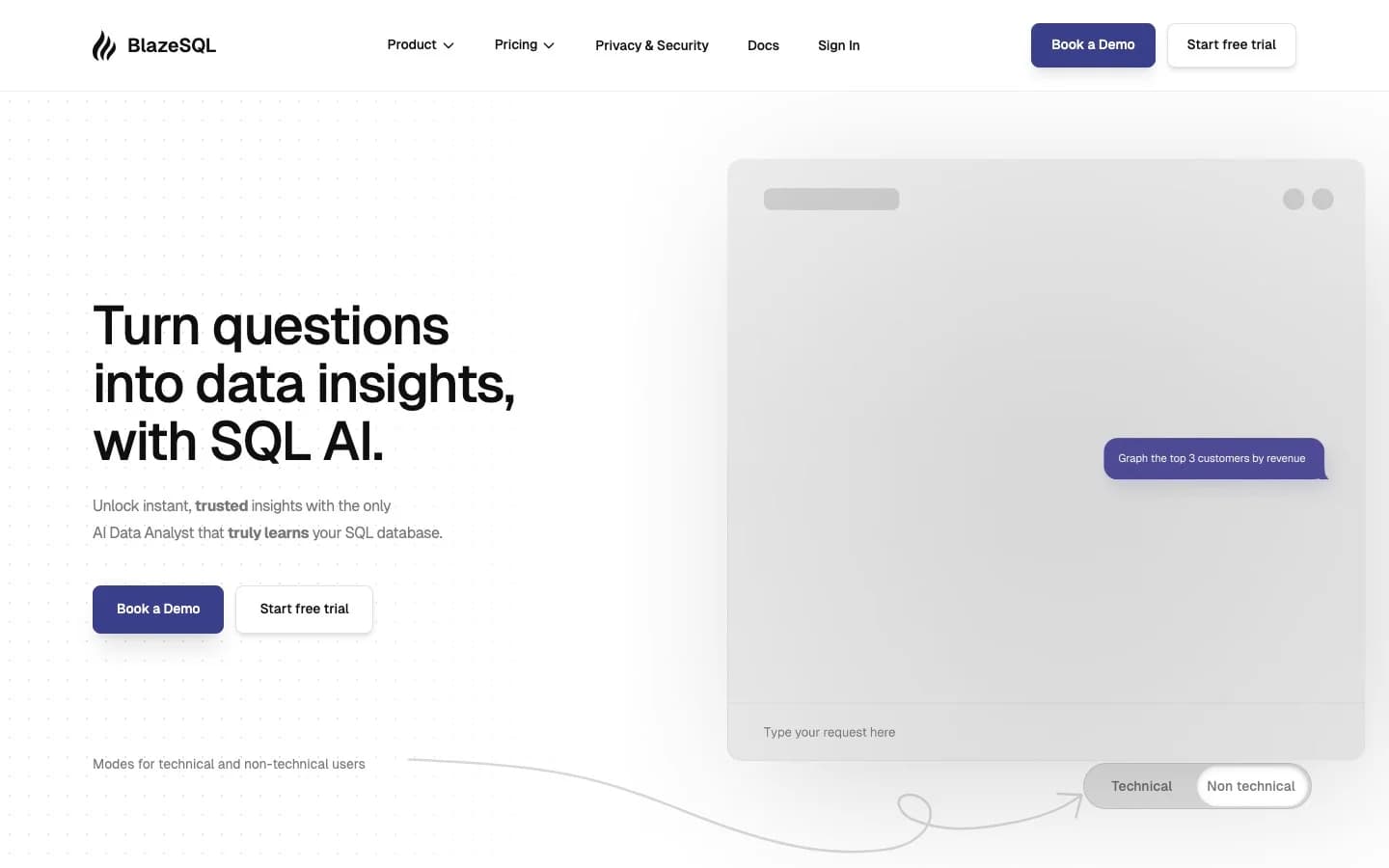
BlazeSQL is an AI data analyst with a notable differentiator: a desktop app that runs locally with an offline mode. For teams where data privacy means keeping queries off any external cloud, BlazeSQL is one of the few tools in this category that makes that practical. The company claims 2 million questions answered and lists Flixbus, eBay, Siemens, Yamaha, and Amazon among its customers.
The database coverage is broad: Snowflake, BigQuery, Microsoft SQL Server, PostgreSQL, MySQL, MariaDB, Oracle, Redshift, Databricks, Athena, ClickHouse, and SAP SQL Anywhere across 12+ total connections.
What BlazeSQL does:
- Natural language to SQL with local query execution (desktop app)
- Offline mode for air-gapped or strict privacy environments
- Enterprise database coverage across 12+ warehouse and SQL systems
- Unlimited AI chat messages on all paid plans (300 table limit per connection)
| Feature | BlazeSQL | Chat2DB |
|---|---|---|
| Desktop app with offline mode | Yes | Yes (Community) |
| Enterprise DB support (Snowflake, Redshift, etc.) | Yes | Yes (Pro tier) |
| Cloud-hosted option | No | Yes (Chat2DB PRO) |
| Visualization | Basic | Yes |
| Free tier | No | Yes (Community) |
| Starting price | $39/month | $8/user/month |
Pricing (As of April 2026): Pricing sourced from a September 2024 BlazeSQL blog post; the BlazeSQL pricing page returns a 404 as of April 30, 2026. Treat these figures as potentially stale and verify before committing.
- Blaze Pro: $39/month, 1 seat
- Blaze Advanced: $99/month, 1 seat
- Blaze Team: $149/month, 3 seats included (+$49 per additional user)
- Blaze Team Advanced: $499/month, 3 seats included (+$75 per additional user)
- Blaze Enterprise: custom pricing, white-label, API access
No free tier. 14-day trial on the Team plan.
One thing to watch. The pricing page returning a 404 is a meaningful signal for a SaaS product. It suggests the pricing structure may have changed without the site being updated, which makes budgeting difficult. Community reviewers also note that BlazeSQL slows down with large datasets and requires well-documented schemas to work reliably: "Depending on how clean and simple your DB is, you will have to invest varying amounts of time to set things up." Complex queries sometimes need manual adjustment to produce the correct output.
Choose BlazeSQL when your privacy requirements mean SQL queries cannot leave your machine, or when you need an enterprise desktop SQL tool that covers Oracle, Databricks, and SAP in addition to standard databases.
Chat2DB still wins when you need a free tier, cloud access from a browser, or a tool whose pricing you can actually find and verify before buying.
6. AI2SQL: lightweight SQL generator for individual developers
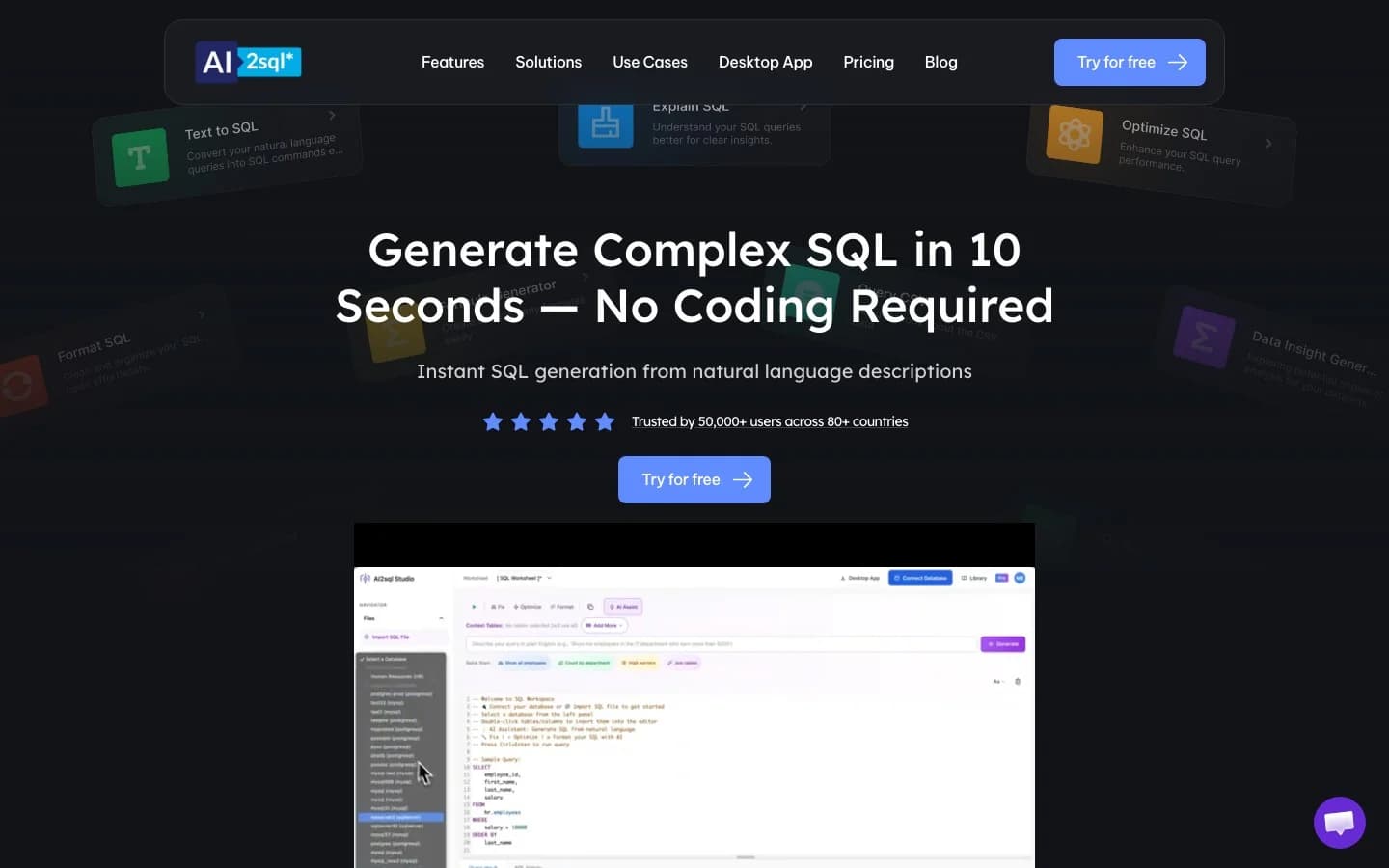
AI2SQL is the smallest and simplest product in this comparison. Built and maintained by a single founder, Mustafa Ergisi, it translates plain English descriptions into SQL for a specific database type. It is a query-generation utility. There are no built-in dashboards, no visualization layer, and no team collaboration features on lower tiers. The product launched on Product Hunt in October 2021 and reports 50,000+ professionals as customers.
For developers who want to write SQL faster without changing their existing workflow, it is a focused, affordable tool. For teams that want an AI data analyst, it is not the right category of product.
What AI2SQL does:
- Natural language to SQL for MySQL, PostgreSQL, Oracle, BigQuery, MongoDB, Redshift, Snowflake, and others (tier-dependent)
- Schema upload for query generation without a live connection (Start tier)
- Database connectors for live query execution (Pro tier and above)
- ER diagram generation
- SQL file upload
- Formula generator
| Feature | AI2SQL | Chat2DB |
|---|---|---|
| Natural language to SQL | Yes | Yes |
| Visualization | No | Yes |
| Database GUI | No | Yes |
| Team collaboration | Business tier+ | All tiers |
| Self-hosted option | No (Enterprise: on-premise) | Yes (Apache 2.0) |
| Starting price | $9/month | $8/user/month |
Pricing (As of April 2026):
- Start: $9/month, 100 queries/month, 10 table limit, MySQL and PostgreSQL
- Pro: $24/month, 300 queries/month, 50 table limit, + Oracle, MongoDB, BigQuery
- Business: $39/month, 1,000 queries/month, unlimited tables, + Redshift, SnowSQL, API, desktop app
- Enterprise: custom pricing, on-premise option
No free tier. 7-day free trial on all plans.
One thing to watch. AI2SQL is a one-person company with approximately $60,700 in annual recurring revenue. Any disruption to the founder's capacity, whether personal or competitive, means no support, no updates, and no roadmap. The query limits are also low: 100 queries for $9/month means a single active analyst will hit the cap quickly. A Substack review noted the tool still expects some SQL knowledge to validate output: "It is a little bit unfriendly for non-technical users as it only serves to generate SQL queries from our schema. It means we need to know a little about SQL."
Choose AI2SQL when you are an individual developer who wants a cheap, simple SQL generator to speed up query writing without switching to a full BI platform, and you are comfortable validating the output yourself.
Chat2DB still wins when you need visualization, a database management interface, or any team features. AI2SQL and Chat2DB are priced similarly at the entry level, but Chat2DB's feature set is broader at every tier.
How to choose
The right tool depends on what "AI data analyst" means for your team. If you need a tool that queries databases directly, learns your schema over time, and returns answers rather than raw SQL, Sequel is the strongest option, particularly for teams that need data residency control at the Enterprise level. If your workflow centers on uploaded files and spreadsheets with occasional database queries, Julius AI fits that pattern despite the steep jump to its Business tier. For engineering teams that think in SQL and Python notebooks, Hex's collaborative environment is well-suited. Basedash makes sense for startups that want production-ready BI with Slack integration and have the budget for a $250/month floor. BlazeSQL is the right call when offline desktop operation is a firm requirement. AI2SQL works for individual developers who want faster query writing without a platform change.
Sequel's free tier includes three seats and one data source with no credit card required. That is the lowest-friction way to evaluate whether an AI analyst workflow fits before committing to a paid plan.
Entry points for each tool:
- Sequel: Free tier, 3 seats, 1 data source, no credit card required at sequel.sh/pricing
- Julius AI: Free tier, 100 credits/month, file analysis only
- Hex: Community tier, 5 notebooks and 5 apps, free
- Basedash: 14-day free trial, no credit card required, full feature access
- BlazeSQL: 14-day trial on the Team plan
- AI2SQL: 7-day free trial on all paid plans