
Claude Code is a terminal agent, and Instagram analytics is mostly a data wrangling job: pull media, pull insights per post, compute rates, rank. Sequel's MCP server hands Claude Code read access to your Instagram Professional account so it can do that work in a loop rather than you clicking through Insights.
What You'll Accomplish
Once connected, you can ask Claude Code:
- "Pull every post from 2026 and write me a CSV ranked by saves per reach."
- "Chart my monthly non-follower reach share for the last year."
- "Which reels beat the 8.5 second average watch time benchmark?"
Prerequisites
- A Sequel account: Sign up free at sequel.sh
- An Instagram Professional account: Business or Creator. Personal accounts are not supported by the API
- Claude Code: any recent version with
--transport httpsupport
Step 1: Connect Instagram to Sequel
Sign in to sequel.sh and click Data Sources in the left sidebar.
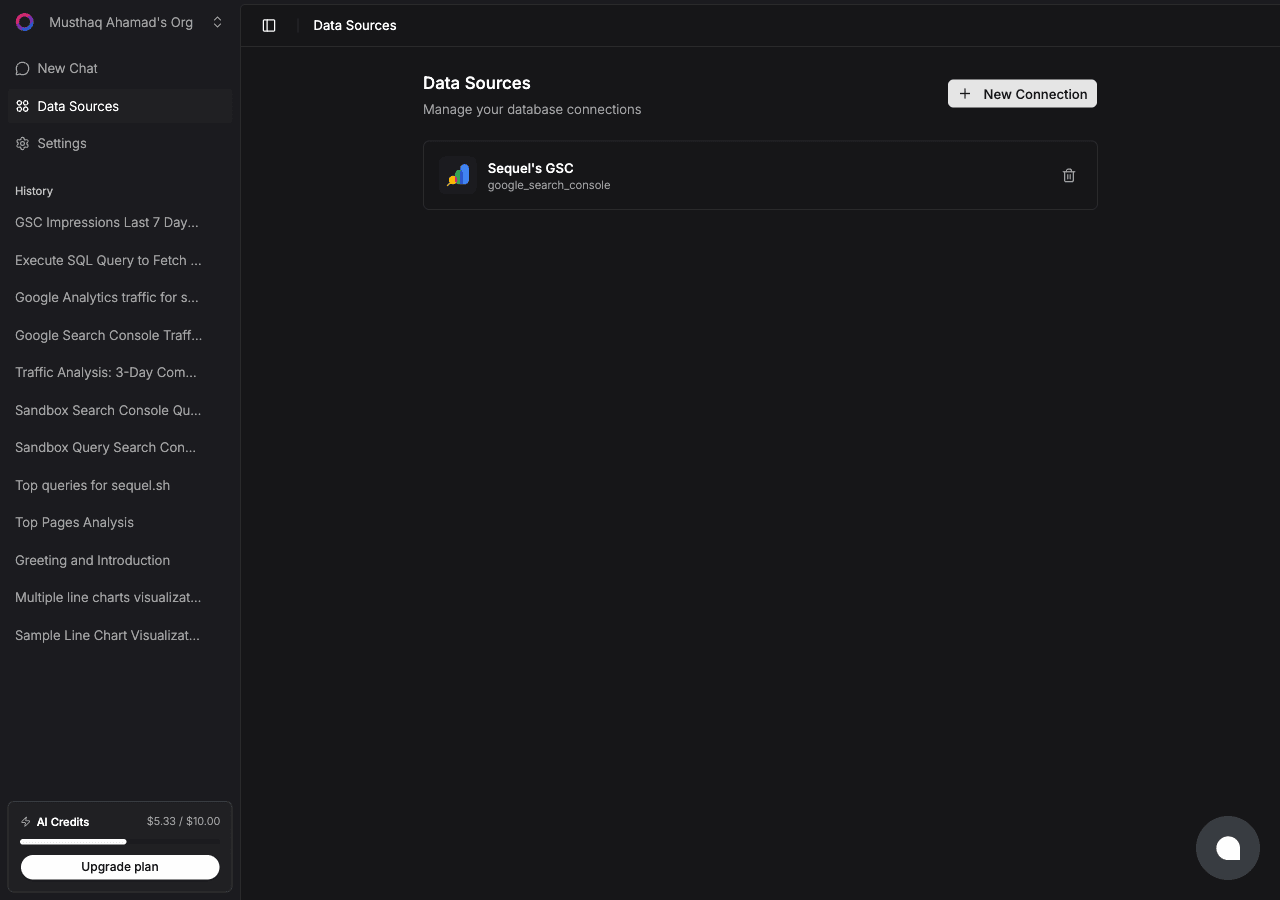
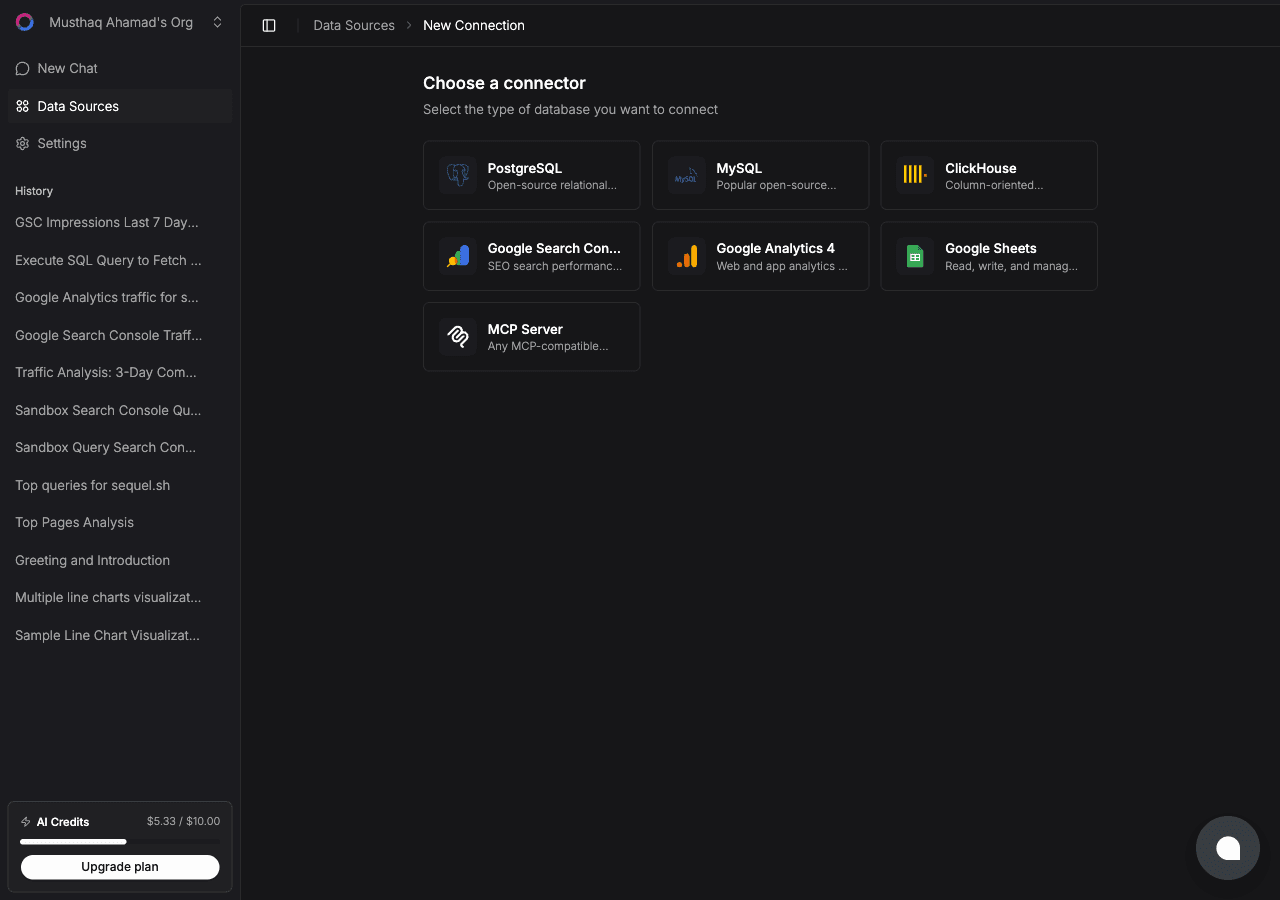
Click New Connection. On the "Choose a connector" page, select Instagram.
Enter a Connection Name, then click Connect with Instagram. Sign in with the account you want to analyze and approve the three read-only scopes: profile and media, insights, and comments. You'll be redirected back with the connection saved under the resolved handle.
Step 2: Add Sequel to Claude Code
claude mcp add sequel \
  --transport http \
  https://api.sequel.sh/mcp
Claude Code opens a browser to authorize. Once that completes the server is saved and loads in future sessions automatically.
To make it available everywhere rather than in just this project:
claude mcp add sequel \
  --scope user \
  --transport http \
  https://api.sequel.sh/mcp
Verify it registered:
claude mcp listWhat Instagram data Sequel exposes
| Area | Available | Not available |
|---|---|---|
| Profile | Followers, follows, media count, bio, account type | Email, phone, private profile fields |
| Posts and reels | Reach, views, likes, comments, saves, shares, reel watch time | Per-slide carousel breakdowns |
| Account | Reach, accounts engaged, profile views, website clicks, follows and unfollows | Anything older than roughly two years |
| Audience | Followers, reached and engaged audiences by age, gender, country, city | Individual follower identities |
| Comments | Text, timestamp, like count, commenter handle | Hidden or age-gated comments |
| Not covered | Ads and spend, hashtag search, competitor accounts |
Step 3: Query Your Instagram Data
Pull all my posts from the last 12 months, fetch insights for each, and save a CSV with reach, saves, shares, engagement per reach and format.Compute my monthly net follower change by comparing follows against unfollows, and flag any month that was net negative.For every reel, give me average watch time in seconds alongside reach, and sort by watch time descending.What You Can Do Now
- Script the reporting you keep redoing: "Write a script that outputs my monthly Instagram summary and save it so I can rerun it." Claude Code can keep the analysis as a file instead of a one-off answer.
- Join Instagram to the rest of your stack: "Compare monthly Instagram profile visits to GA4 social sessions and tell me where the gap is." Sequel exposes your warehouse and GA4 over the same MCP connection, so cross-source questions are one prompt.
- Build your own benchmark: "Compute my median engagement per reach by format and by quarter, so I have a baseline to judge new posts against." Published benchmarks vary by 10x depending on the denominator, so your own history is the only comparison that means anything.
- Audit before you conclude: "Flag any post where views divided by reach is above 10, since the reach figure is probably unreliable." Older reels sometimes report implausible reach, which quietly breaks every rate you calculate from it.
- Watch distribution, not vanity: "Track shares per thousand reached by month." Sends are the signal Instagram weights most for pushing content to people who don't follow you.
For cross-source work, the same connection covers Google Analytics in Claude Code and Search Console in Claude Code. Background reading: what MCP is, what an AI data analyst does, AI agents for marketing analytics, and why your follower count hides unfollows.