
Most data teams spend more time answering the same small questions than doing the work they were hired for. In a Sigma Computing survey, 76% of data experts said up to half their time goes to ad-hoc reporting, and 53% reported three to four follow-up questions after every request. They called it report factory hell.
That backlog is not a scheduling problem you can hire your way out of. It is a structural one. This guide explains why the queue forms, why the usual fixes only help a little, and the one change that keeps routine questions off your team's plate for good. The survey fieldwork dates to 2020, but anyone running a data team in 2026 will recognize every number.
What the backlog actually costs
The queue is expensive on both sides. The business waits, and the data team burns out.
| Cost | What the data shows |
|---|---|
| Slow answers | 55% say a request takes 1-4 weeks to turn around |
| Abandoned questions | 25% of business users gave up because analysis took too long |
| Guessed decisions | 20% made an important call without the data |
| Analyst burnout | 27% of data experts feel unfulfilled in their roles |
The abandoned-question number is the one that should worry leaders. A backlog does not just delay answers. It quietly trains the business to stop asking, or worse, to decide on a hunch.
It drains the people too. Most analysts want to be doing harder work. Alteryx's 2025 survey of data analysts found 94% say their role impacts strategic decisions, yet the queue keeps pulling them back to repetitive pulls.
Why the queue forms
The backlog is not a sign of a lazy or understaffed team. It forms because every question has to route through a small group of people who can write SQL.
The Sigma survey named the causes data teams cite: 29% say there are too few analysts for too many teams, 28% say C-level requests jump the queue and create backlog, and 27% say large datasets are slow to curate. The common thread is a single chokepoint.

Adding analysts does not break this loop. It just widens the chokepoint slightly while demand keeps climbing. The loop only breaks when routine questions stop entering it.
The fixes that only half-work
Most teams reach for process first. Intake forms, ticket queues, prioritization rubrics, office hours. These are worth doing, and they are not enough.
| Tactic | Helps with | The limit |
|---|---|---|
| Intake form / ticket queue | Noise, expectations | Volume of routine asks stays |
| Prioritization rubric | Triage, focus | High-clout asks still jump it |
| Documentation / wiki | Repeat questions | People do not read it |
| Office hours | Batching | Caps your time, not demand |
The ceiling is human behavior. As one analyst observed on r/datascience, "no matter how many processes and self service tools you put in place, stakeholders will escalate and get you to pull the data." Process manages the queue. It does not remove the reason the queue exists.
The structural fix: stop questions from reaching you
The only durable fix is to let the routine questions answer themselves. If a marketer can get "which campaigns drove paid signups" without you, that request never enters the queue.
This is the promise of data democratization, and it has historically failed because traditional self-service tools are too hard for non-technical users. Dashboards go unused. The shift that changes this is the plain-English interface.
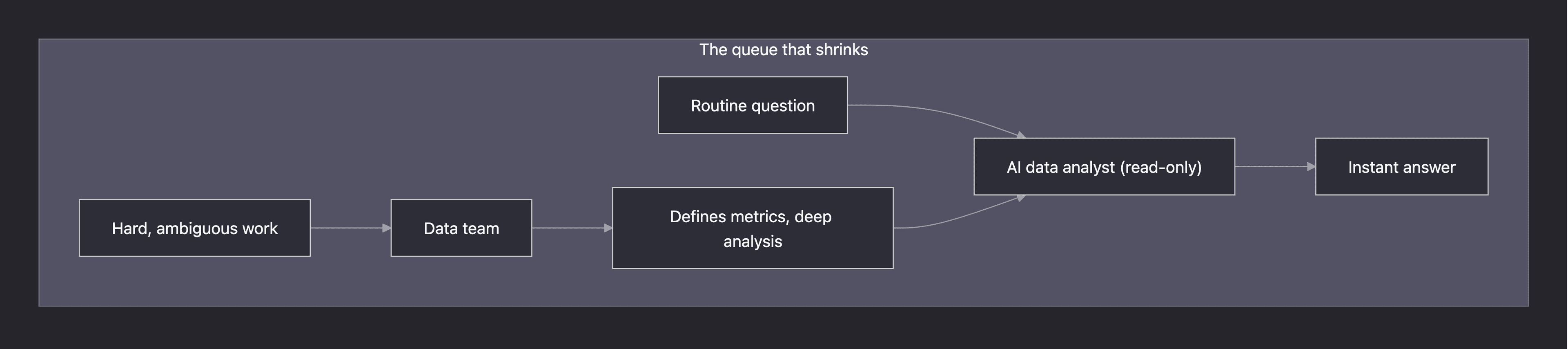
When a person asks an AI data analyst in plain language, the routine question gets answered in seconds, read-only, without an analyst. dbt's 2025 survey found around 65% of practitioners think enabling non-technical users to create governed datasets would improve their data's value, and 29% want natural-language AI querying but cannot yet offer it. The demand is there. We cover the interface in conversational analytics.
How to roll it out
Offload the routine, keep the hard, and govern the middle.
- Find the repetitive questions. Look at your last month of requests. The metric lookups and simple filters are your offload candidates.
- Give read-only, plain-English access. Connect through a read-only user so exploration is safe. Bring it into the tools teams already use with MCP.
- Govern the metrics. Define terms once so self-serve answers match your reports.
- Reserve analysts for judgment work. Modeling, experiment design, and ambiguous questions still need a person.
The dividing line matters. Offload metric lookups and recurring pulls. Keep anything that needs interpretation. This is not about replacing analysts; it is about moving them off the queue.
To make the split concrete, sort a week of requests against this guide.
| Request | Offload or keep |
|---|---|
| "What was signups by source last week?" | Offload to self-serve |
| "Pull the same revenue report, monthly" | Offload to self-serve |
| "Why did churn spike in the EU region?" | Keep: needs investigation |
| "Define our official activation metric" | Keep: needs judgment |
| "Design the pricing experiment" | Keep: needs an analyst |
The pattern is clear once you list them. The lookups and recurring pulls dominate the volume, and they are exactly the ones self-serve handles. The work that survives is the work your analysts actually want, the analysis that, per Alteryx, 94% of them say drives strategic decisions.
Measure whether it worked
Track two things. First, deflection: what share of routine questions now get answered without a ticket. Second, turnaround: how the wait time on the requests that still reach you changes once the routine volume drops.
If both move, your analysts are spending more time on work that needs them, and the business is getting answers faster. Shared, governed access in team workspaces is what makes that durable.
The takeaway
You cannot hire your way out of an ad-hoc backlog, because access is the bottleneck, not headcount. Let routine questions answer themselves through governed, plain-English self-serve, and reserve your team for the work that needs them. Want to take routine pulls off your plate? Get started free or read the data democratization guide.