
Gartner surveyed analytics leaders in late 2024 and found that over half of organizations already use AI tools for natural-language queries. The same firm predicts 75% of new analytics content will be shaped by generative AI by 2027. Asking your data a question in plain English has gone from demo to default.
That capability has a name: conversational analytics. This guide explains what it is, how it works under the hood, how it differs from the dashboards and text-to-SQL you already know, and how accurate it really is. The honest answer on accuracy is more interesting than the hype.
What conversational analytics is
Conversational analytics lets business users ask data questions in plain language instead of writing SQL or clicking through dashboards. The system uses large language models to translate the question into a query, runs it, and returns an answer as a chart or a sentence.
It is the interface layer of self-service analytics and a key enabler of data democratization. The reason it matters is simple. It removes the build step that stops non-technical people from self-serving.
How conversational analytics works
A question travels through several stages before an answer comes back. The sequence below traces one plain-English question end to end.
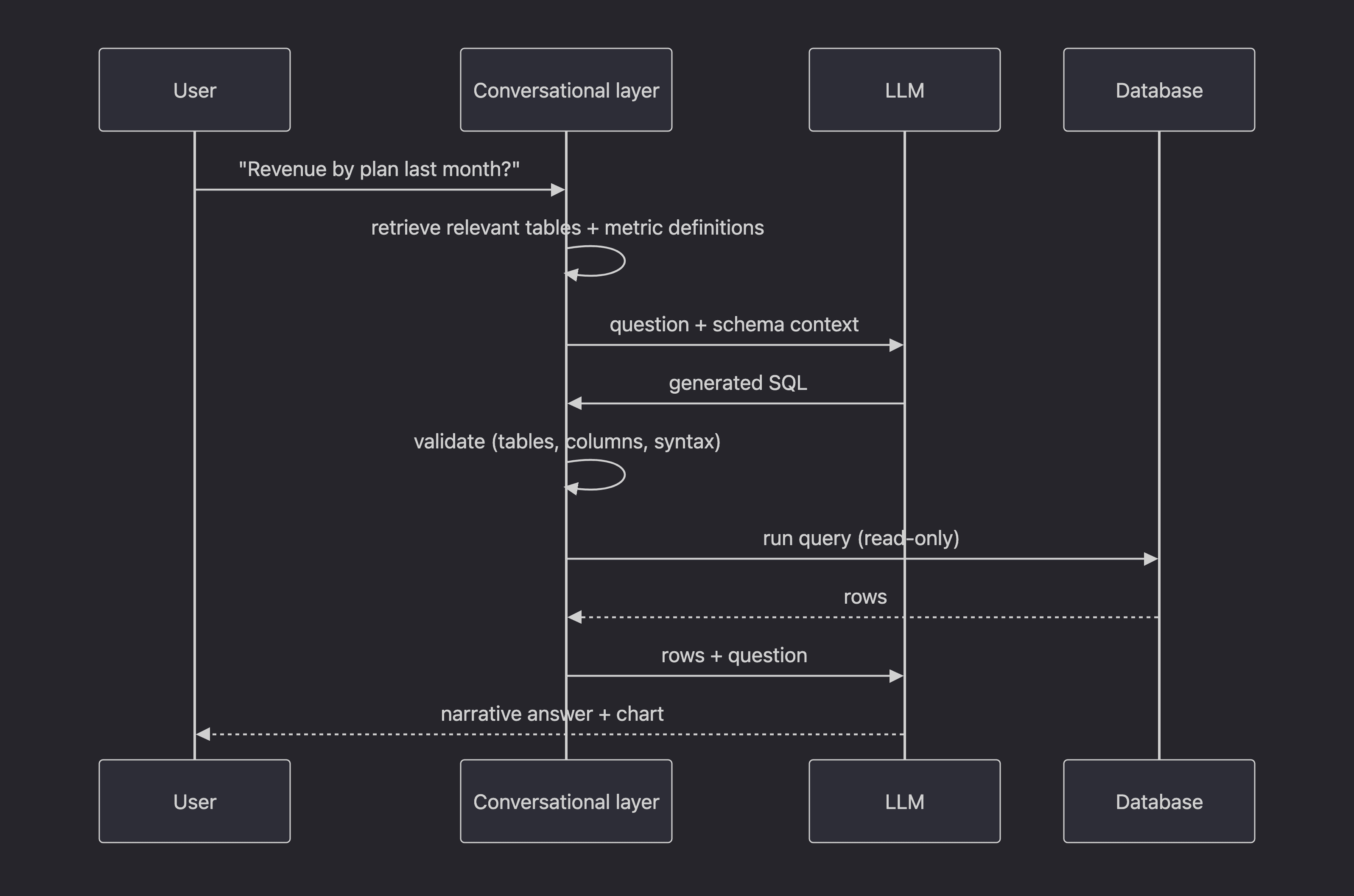
Each stage does real work, and skipping any of them hurts the answer.
| Stage | What happens |
|---|---|
| Retrieval | Find the relevant tables and metric definitions for the question |
| Generation | The LLM writes SQL from the question and that context |
| Validation | Check tables, columns, and syntax before running |
| Execution | Run the query against the database, read-only |
| Narration | Turn the rows into a chart and a plain-language answer |
The retrieval and context step is the one that determines quality. The engineering teams who built these systems agree: Pinterest found that adding table documentation pushed its retrieval hit rate from 40% to 90%. Context, not raw model power, is the lever. We unpack it in how text-to-SQL works.
How it differs from dashboards and text-to-SQL
Conversational analytics gets confused with two neighbors. The differences are worth pinning down.
| Dashboard | Text-to-SQL | Conversational analytics | |
|---|---|---|---|
| Form | Pre-built charts | A query string | A back-and-forth answer |
| Best for | Metrics you check daily | Generating one query | Questions you have once |
| Who builds it | An analyst, ahead of time | The model, on request | The model, in conversation |
| Follow-ups | Add a filter manually | New prompt each time | Keeps context across turns |
A dashboard answers a question you already knew to ask. Conversational analytics answers the one you just thought of. The two are complementary, which we cover in AI data analyst vs BI tools.
Text-to-SQL is the engine inside conversational analytics, not a competitor to it. The natural-language-to-SQL step generates the query; the conversational layer runs it, charts it, and remembers the thread.
How accurate is it, really
This is where honesty beats marketing. Conversational analytics is good and getting better, and it is not a solved problem.
On the BIRD benchmark, which grades text-to-SQL against real databases, the best models reach about 82% execution accuracy. Human data engineers score roughly 93%. As of late 2025, that is an 11-point gap. We dig into the numbers in how accurate text-to-SQL is.
Context is the multiplier. AtScale found LLMs were incorrect over 80% of the time when working directly with raw data models, before a governed semantic layer was added. Ambiguity is the other challenge. LinkedIn found that around 60% of benchmark questions had more than one valid answer, because natural language is imprecise.
A practitioner on r/BusinessIntelligence framed the stakes well: "When a CEO asks a natural language question about revenue or churn, a probabilistic best guess isn't good enough. If the AI hallucinates a metric or writes a flawed SQL query behind the scenes, trust is instantly broken." The fix is governed context and a visible query, not a bigger model.
It already works at scale
The strongest evidence comes from engineering teams who built conversational analytics for their own people and published the results.
| Company | Tool | Reported result |
|---|---|---|
| Uber | QueryGPT | Query authoring cut from ~10 min to ~3 min |
| Text-to-SQL | First-shot acceptance rose from 20% to over 40% | |
| SQL Bot | ~95% of users rated accuracy "passes" or above |
These are not vendor claims. They are internal systems with measured before-and-after numbers. We did a full deep dive on Uber's QueryGPT if you want the architecture. The common thread across all three: heavy investment in schema context and table selection, with a human still reading the result.
What makes an answer trustworthy
If conversational analytics is going to inform decisions, it needs to earn trust. Three things do that.
- It shows the SQL. Seeing the query is the single best trust signal. You can check the logic or hand it to someone who can.
- It uses governed metrics. When "revenue" is defined once, every answer agrees. No dueling numbers.
- It connects read-only. A read-only user means exploration can never change data.
This is what separates a conversational AI data analyst from a chatbot guessing at your schema. To bring it into the tools your team already uses, see how to query your database with AI using MCP.
Where it leaves you
Conversational analytics turns a plain-English question into a checked, charted answer, and in 2026 it is accurate enough to be useful as long as the context is governed and the query is visible. Treat the answer as a draft you can read, not a black box. Want to talk to your own data? Get started free or read the data democratization guide.