
I spent a long time building Sequel as a chat application. A nice interface, a place to ask your data questions, charts that render on the fly. Then one morning I admitted something I had been avoiding for months. The chat window already exists. It just is not ours.
People already pay for ChatGPT or Claude. They already do most of their work there. They have their prompts, their habits, their skills, their connected tools. Asking them to leave all of that and come talk to my box instead was never going to win. I wrote this down as a public note to myself.
Should be treating these AI coding tools as the browser equivalent of building web apps for. Users spend quite a lot of time there, it's a no brainer to build your apps there.
So we are changing how Sequel works. This is the reasoning, and why I think it points at something bigger than one product.
AI tools are the new browser
Think about what the browser did. Before it, software meant a separate install for every task. After it, you built for one surface that everyone already had open. The browser was where people were, so that is where the apps went.
The same shift is happening with AI tools, and the numbers are not subtle. ChatGPT crossed 800 million weekly users and 4 million developers by late 2025. Cursor passed a billion dollars in annualized revenue. Anthropic reported that Claude Code alone reached a $2.5 billion run rate with weekly active users doubling inside a single year.
These are not tabs people open and close. They are where the work happens now. People live in them the way they used to live in the browser and the inbox.
When a surface gets that much attention, the smart move is not to compete with it for attention. The smart move is to build on top of it. That is what we did with the web, and it is what almost nobody is doing with AI tools yet.
Nobody wants another chat sidebar
Right now the reflex across software is the opposite. Every product is bolting a chat box onto the corner of its UI. Your analytics tool has one. Your CRM has one. Your note app has one. Most of them are thin, forgettable, and slightly in the way.
The people you are building for have already noticed. This is a real complaint, posted by a real person, and it has a lot of company.
I don't need my calculator to have a chatbot. I don't need my weather app to write me a poem about the rain. I just want to know if I need an umbrella.
The same person called most of it "wrapper slop." On Hacker News, the reaction to a new AI editor was a one-liner that gets posted under almost every launch now: "Just another AI wrapper around VS Code smh." Another commenter put the design lesson plainly.
The best AI is invisible. When you notice the chatbot, it's usually already failed.
If you ship another chat box, you are entering a race against ChatGPT and Claude on the exact thing they are best at. You will lose. They have the model, the memory, the habits, and the integrations. Your chat box is a worse version of a tool your user already pays for.
The tools you tried once and forgot
Here is the part founders do not like to say out loud. Even I forget the tools I sign up for. I try something on a Tuesday, it solves one problem, and by Friday it has fallen out of my head completely.
This is not a personal failing. It is the base rate. Software keeps about 30 percent of users by month three, and that is the average across products people actually chose. The classic mobile benchmark is even harsher. Apps lose 77 percent of daily users within three days of install, and 90 percent within a month.
The graveyard is expensive too. The average company wastes close to 20 million dollars a year on software licenses nobody uses. A standalone app is a tab you have to remember to open. Most of the time, you do not.
Stickiness is usually treated as a notification problem. Send the email, ping the badge, win the user back. I think that is backwards. The stickiest thing you can be is already present in the surface the user opens every single day. Not a destination they navigate to. A capability that is just there when the work starts.
So we are moving inside the tools you already use
That is the pivot. Sequel is becoming an integration into the workflow you are already in, not a place you have to visit.
The shape is simple. You sign up, you get an API key, and you use it inside Claude, Cursor, Codex, or ChatGPT. No new window to learn. No second home for your data. You ask your agent a marketing question, and it has the tools to actually answer it.
The plumbing for this already exists, and it standardized fast. Anthropic released the Model Context Protocol in late 2024. OpenAI adopted the same standard a few months later. By the end of 2025 there were more than 10,000 active public MCP servers and 97 million SDK downloads a month, and the protocol was handed to the Linux Foundation. One commenter on Hacker News caught the significance early.
It's like USB-C. If we're lucky it will turn into TCP/IP and transform the whole economy.
If you want the longer explainer, we wrote one on what MCP is and why it matters for data teams. The short version is that there is now a clean, shared way to give any AI tool real capabilities. We do not have to own the window anymore. We just have to plug in.
This also fixes pricing. When you are an integration instead of a destination, you can charge for the value you actually deliver, not for seats on a dashboard nobody logs into. Simple and predictable, for everyone.
The real user is the agent, not the human
Once you make this move, the product changes underneath you. The human is no longer the one clicking your buttons. The human talks to their agent. The agent calls your tools.
That sounds like a small reframe. It is not. It changes what good even means.
| You are building for a human (chat app) | You are building for an agent (tools) |
|---|---|
| A pretty UI and onboarding flow | Clean tool definitions and predictable outputs |
| Engagement and time on screen | Fast, correct answers with low latency |
| Features users discover by clicking | Capabilities an agent can find and call on its own |
| Memory you ask the user to set up | Memory the agent can rely on by default |
We used to argue that dashboards were built for humans while agents are built for outcomes. The same logic applies to chat apps. If the agent is the operator, you should be building tools the operator can wield, not a cockpit for a pilot who already left.
What an agent actually needs to do real work
So we are optimizing for the agent. Three things matter most, and none of them is a chat interface.
The first is memory. An agent is useless on your business if it relearns everything each session. It needs to know that your team defines an active user a specific way, that "spend" excludes a certain channel, that last quarter you already tested a campaign and it flopped. Marketing's real bottleneck was never the data, it was the decision, and decisions need context that survives between conversations.
The second is a solid execution layer. The agent needs to read across your sources reliably and safely. We keep access read only by design, so the agent can analyze your data but never write to it or mutate it. If you care about the governance details, we cover auth, read-only roles, and audit logs separately.
The third is speed across sources. A real marketing question is rarely one query. It is ad spend here, conversions there, revenue in a third place. An agent chains many calls to answer it, so latency compounds. The product is not one clever query. It is how fast the agent can pull a coherent answer from many sources at once, which is the cross-source unification problem we have been working on the whole time.
Notice what is not on that list. The headline is not writing SQL. The agent can do that. Our job is to make the data underneath fast, trustworthy, and connected, so asking your database a question actually returns something you can act on.
Discovery is moving from search to agents
There is a second shift hiding under the first one, and it changed how we think about being found at all.
For twenty years, the way you got discovered was search. You ranked, people clicked, they landed on your site. That path is narrowing. A majority of Google searches now end without a click to the open web, and only about 360 of every 1,000 US searches reach an outside page. Gartner has forecast that search volume will fall 25 percent as people move to AI assistants.
Meanwhile the new path is growing fast. Referral traffic from AI tools more than tripled in a year, and the assistant is increasingly the first place people ask. The front door is moving.
So we are optimizing for that door. Not just SEO for humans, but discovery and self-serve signup for agents. An agent should be able to find Sequel, sign up, get a key, and start working with very little human babysitting. Being a place a person has to navigate to and remember is the losing position. Being something an agent can pull in the moment it needs your data is the winning one.
The interface is commoditizing, the layer beneath it is not
Step back and the pattern is clear. The chat window is becoming free and everywhere. Every model has one. Every tool ships one. As an interface, it is on its way to being a commodity.
When an interface commoditizes, the value moves underneath it. With the browser, the tab was free, but the things you plugged into it were not. The same is happening here. The durable value is not the chat box. It is the context and the execution layer beneath it. Memory of your business, safe access to your sources, and speed across all of them.
That is the bet. Do not build the tab. Build the thing that makes the agent genuinely good at your domain. Whoever owns memory, execution, and speed for a specific domain is going to matter a lot more than whoever ships the prettiest chat UI.
Where Sequel fits now
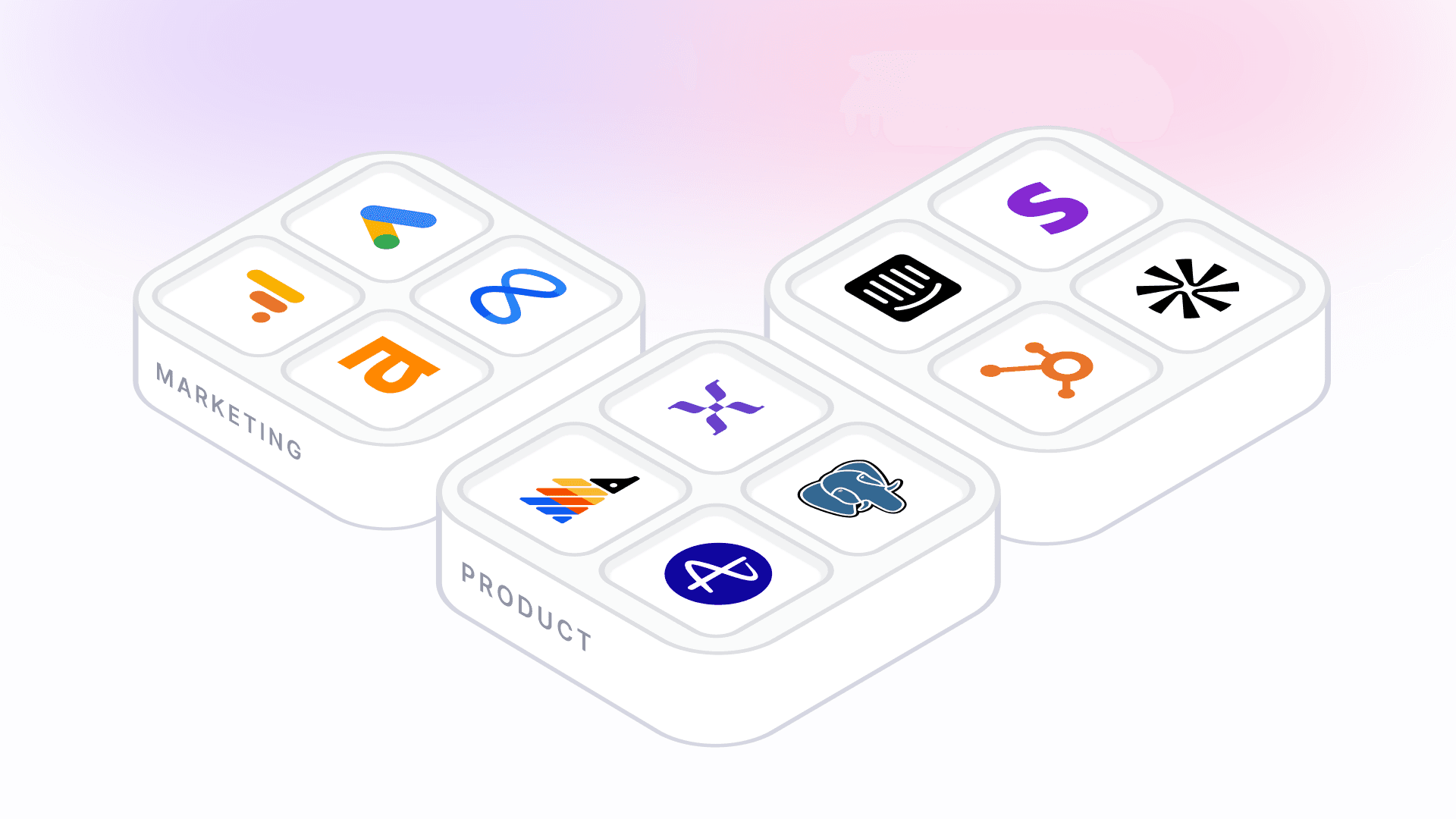
Sequel is the marketing intelligence layer that lives inside your agent. You connect your marketing stack, you get a key, and you use it in Claude, Cursor, Codex, or ChatGPT. The agent gets memory of how your team defines things, read-only access across your sources, and the speed to answer real questions that span all of them.
It is an evolution of what we shipped in the Sequel v2 launch, pointed at where people actually work. We are building it to be open and integration first, so it slots into the tools you already trust instead of asking you to adopt one more. If you want to see how it sits against the rest of the field, we keep an honest survey of the marketing AI agents worth knowing in 2026, and a deeper look at AI agents for marketing analytics.
We spent a long time trying to be a place you visit. We would rather be the capability that is already there when you start working.
Build where the work happens
The lesson is older than AI. You build where your users already are, and right now they are inside their agents for hours a day. The chat window is not the product anymore. What the agent can actually do is.
You already have the window open. Get started free, point your agent at your marketing data, and ask it the hardest cross-source question you have.